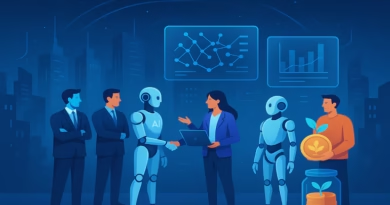
Freehand Raises $75 Million to Revolutionize Enterprise Supply Chains with Autonomous AI Agents

In a significant vote of confidence for India-origin AI innovation, San Francisco-headquartered enterprise AI startup Freehand has raised $75 million in a Series B funding round to scale its autonomous AI platform for global supply chains. Co-founded by Indian-origin entrepreneurs Nitin Jayakrishnan and Abhijeet Manohar, the company has emerged from two years of stealth to address one of global commerce’s most persistent bottlenecks: manual procurement and supply-chain administration.
The Funding Round
The Series B round was co-led by Battery Ventures and NewRoad Capital Partners, with significant participation from PSP Growth (founded by former US Commerce Secretary Penny Pritzker) and Nexus Venture Partners. The funding will be used to expand Freehand’s AI platform, accelerate product development, and drive wider deployment of its AI agents across enterprise procurement, finance, and supply chain operations.
This investment reflects growing investor appetite for AI solutions that move beyond dashboards and recommendations to actual execution—a transition from software that assists to software that runs the business.
The Technology: From Insight to Action
Freehand’s platform is built around autonomous AI agents that manage the entire procure-to-pay lifecycle. At the core of the platform is a proprietary Category Context Graph, which fuses structured ERP data with unstructured contracts, invoices, and communication logs. This enables AI agents to:
- Verify billing accuracy and detect overpayments
- Negotiate vendor contracts and terms
- Reconcile payments and resolve disputes
- Enforce contract compliance and financial governance
Unlike traditional “co-pilot” tools that simply answer questions, Freehand’s agents make decisions, take actions, and maintain accountability for outcomes. They integrate directly with enterprise systems—reading unstructured data, reasoning across contracts and policies, and executing decisions without manual intervention.
Real-World Impact: Clients and Results
Freehand’s AI agents are already deployed at some of the world’s largest enterprises, including Meta, Unilever, Johnson & Johnson, Pfizer, Dunkin’, and Cardinal Health. Early deployments have delivered measurable results:
| Metric | Improvement |
|---|---|
| Cost recovery in complex procurement categories | 5–10% of spending |
| Workflow completion speed | 5–7x faster |
| Procure-to-pay cycle time reduction | More than 70% |
| Audit coverage | 100% |
“Freehand marks one of the first full-scale agentic deployments at Unilever and is an early anchor in the shift from software that assists to software that runs our supply chain.” — Matt Algar, Global VP of Supply Chain, Unilever
The Founders: Indian-Origin Leadership in Global AI
Freehand was co-founded by Nitin Jayakrishnan (CEO) and Abhijeet Manohar, both of Indian origin. The company operated in stealth for two years, building a platform that addresses the $16 billion enterprises spend annually on supply chain software—and the additional $348 billion they spend hiring people to do what that software cannot.
“Enterprises spend $16 billion a year on supply chain software and another $348 billion hiring people to do what this software cannot. We built Freehand to close that gap—with AI Agents that decide, act and take accountability for outcomes. This is the beginning of true autonomy in the enterprise.” — Nitin Jayakrishnan, Co-founder and CEO, Freehand
The Chennai Connection
While Freehand is headquartered in San Francisco, its co-founding team and much of its engineering talent are rooted in India. The company’s Chennai presence has been noted in Indian startup funding reports, where it was listed among the week’s top fundraisers. This reflects a broader trend of Indian-origin founders building globally competitive AI companies—what some analysts describe as “reverse brain drain” in action.
Market Context: Why Now?
The funding comes at a time when global supply chains are under unprecedented strain. Changing tariffs, tax policies, and immigration regulations are prompting enterprises to reduce dependence on traditional outsourcing models and adopt AI-led automation. Legacy supply chain systems—reliant on spreadsheets, emails, and fragmented data—are no longer adequate for the complexity of modern commerce.
Freehand positions its AI agents as “acting” components within the supply chain rather than isolated analytical tools. By replacing outsourced labour and legacy software, the company is helping organisations save millions of dollars annually while freeing human workers to focus on judgment, strategy, and relationships.
“When the machine handles the routine, your team steps back into the driver’s seat. The work that remains is the work that matters: judgement, strategy, relationships. Not a world with less human work. A world with better human work.” — Nitin Jayakrishnan
The Road Ahead
With $75 million in fresh capital, Freehand is poised to scale its AI teams and expand its footprint across Fortune 500 enterprises. Dharmesh Thakker, General Partner at Battery Ventures, who is joining Freehand’s board, noted: “Unlike co-pilots that simply answer questions, Freehand’s Agents have enterprise context, make decisions and take actions—this agency unlocks millions in savings for enterprises”.
As enterprises increasingly move from AI experimentation to production-scale deployment, Freehand represents a new category of autonomous enterprise software—one where AI doesn’t just recommend but executes, and doesn’t just assist but takes accountability. For Indian-origin founders and the broader AI ecosystem, it is a powerful signal that the next generation of enterprise technology is being built by teams that understand both global scale and the deep operational challenges of modern supply chains.