India’s Deep-Tech Blueprint: Modi’s Vision for a Self-Reliant, Innovation-Led Future

The story of India’s startup ecosystem has been one of exponential growth. From a mere 350-400 ventures a decade ago, the country’s innovation landscape has expanded to nearly 2.3 lakh DPIIT-recognised startups, making it the world’s third-largest startup ecosystem. But for Prime Minister Narendra Modi, this is merely the foundation upon which a greater edifice must be built. In recent months, he has articulated a decisive shift: India’s next decade must be defined not by incremental gains, but by deep-tech leadership in artificial intelligence, semiconductors, and space technology.
The New Mantra: Excellence and Deep-Tech
The signal could not be clearer. Addressing the nation during the 130th episode of his monthly radio programme Mann Ki Baat, PM Modi lauded the country’s young entrepreneurs for transforming India into a global innovation hub, but immediately pivoted to a sterner message. “This decade belongs to excellence,” he declared. He cautioned that the era of shortcuts and compromises was over, urging founders and manufacturers to hit global standards.
This call for “Zero Defect, Zero Effect” is a strategic reframing of India’s economic ambition. It moves the focus from volume to value, from services to sovereign technology, positioning deep-tech as the cornerstone of India’s quest for technological self-reliance (Atmanirbhar Bharat).
Youth as the Architects of a New India
At the heart of this transformation is India’s demographic dividend. Speaking at the inauguration of the Swami Vivekananda Cultural Youth Centre in Mysuru, PM Modi emphasised that India’s youth have been the primary drivers of the nation’s emergence as the world’s second-largest mobile phone manufacturer. They are not just participants in this growth story but its lead architects, driving advances in AI, semiconductors, space, and deep tech.
He highlighted that young entrepreneurs are powering India’s digital economy, building startups, and creating jobs through initiatives like the Mudra loans, while leading the Make in India and Atmanirbhar Bharat initiatives. The recent success of a privately built rocket, developed by young entrepreneurs, was cited as a powerful testament to India’s growing private space capabilities. This narrative is reinforced by the fact that Indian startups are now doing remarkable work across AI, defence, and space.
A Global Platform for Indian Deep-Tech
India’s deep-tech ambitions are not being pursued in isolation. In a powerful display of global partnership, PM Modi and French President Emmanuel Macron jointly inaugurated the Bharat Innovates 2026 summit in Nice, France. This flagship initiative was designed to showcase India’s deep-tech and startup capabilities, connecting 120 Indian innovators with over 500 global investors across 13 critical sectors, including AI, advanced computing, semiconductors, space, and biotechnology.
At the summit, PM Modi pitched India as the premier destination to “design, develop, and deploy technologies for the world”. This marked a shift in India’s global positioning: from being a back-office to becoming a powerhouse of original technological creation.
The Strategic Pillars: AI, Semiconductors, and Space
PM Modi’s vision rests on a trinity of strategic sectors that are receiving unprecedented government support.
The AI Imperative
India is “writing new chapters in AI”. The government’s focus is not just on using AI but on creating indigenous, sovereign AI capabilities. The Prime Minister has affirmed that India is moving away from a dependency on foreign technologies to building its own AI models and infrastructure, a sentiment echoed by his backing for Indian AI start-ups as “co-architects of the nation’s tech future”. The establishment of the IndiaAI Mission is a key pillar of this strategy.
Semiconductor Sovereignty
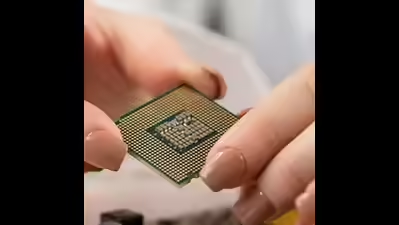
The push for semiconductor manufacturing is perhaps the most visible aspect of this deep-tech strategy. PM Modi has stated that “Made-in-India chips are the backbone of a Viksit Bharat” (Developed India), powering critical sectors from AI and 6G to defence and electric vehicles. He noted that India is rapidly moving forward on a “new journey of semiconductor manufacturing”, a journey that promises to secure critical supply chains and position India as a global manufacturing hub for electronics.
The Final Frontier: SpaceTech
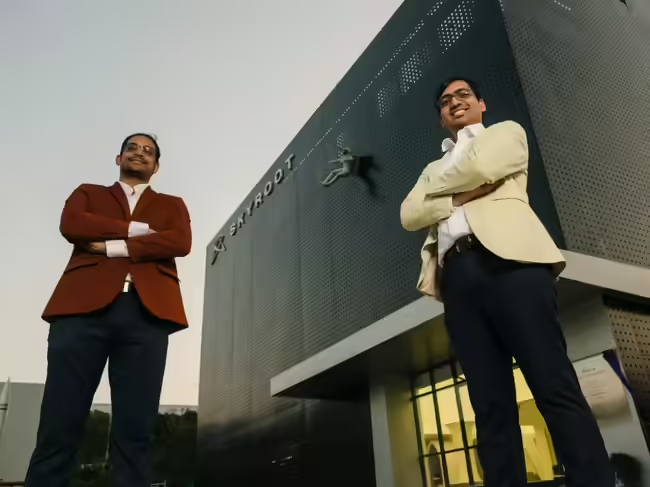
The success of private space ventures like Skyroot Aerospace’s Vikram-1 launch has become a powerful symbol of India’s capabilities. PM Modi described it as “a defining moment in India’s space journey,” reflecting the vibrant spirit of the private space ecosystem. The liberalisation of the space sector and the growing role of young entrepreneurs are turning India into a serious contender in the global commercial launch market, with the space economy targeted to grow from its current valuation to $44 billion by 2033.
A Vision for a Viksit Bharat
PM Modi’s deep-tech push is not merely about creating the next unicorn; it is about building the technological sovereignty required for India to become a developed nation by 2047. It is a recognition that in the 21st century, economic and strategic power will be defined by control over critical technologies. By nurturing an ecosystem of deep-tech innovation, India is building the foundation for a future where it is not just a consumer of technology, but a creator—a nation where young minds are empowered to lead the world in the technologies that will define the coming decades. As the Prime Minister said, “Aspirations in India are unlimited, so efforts are also becoming limitless”.