
Kashmir’s Prime Movr Lights the Way: Laser-Based Wireless Power Transmission Set for Pune Pilots
For decades, the vision of transmitting electricity through the air without wires has been the domain of science fiction—Nikola Tesla’s Wardenclyffe Tower, a staple of futuristic imaginings, but rarely a practical reality. While the world has untethered its data (Wi-Fi, Bluetooth, 5G), we remain stubbornly tethered to the grid for power.
A deep-tech startup from Kashmir is determined to change that.
Prime Movr, an emerging player in the global race for wireless power transmission, is preparing to launch its first pilot deployments in Pune . Leveraging laser-based power beaming technology, the company aims to deliver electricity without traditional wires, targeting the industrial and IoT sectors where such innovation could be truly transformative.
As global giants chase kilometre-scale energy transfer for space-based grids, Prime Movr is carving out a pragmatic niche: powering the sensors, cameras, and automated systems that form the backbone of modern smart infrastructure .
The Technology: Converting Light into Electricity
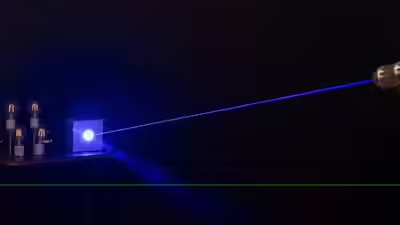
Prime Movr’s core innovation lies in its ability to convert the optical energy from laser beams into usable electrical power . Unlike radio frequency (RF) systems, which broadcast energy in a wide field, lasers offer higher energy density and far more precise targeting . This focused approach minimizes energy loss and reduces interference, making it ideal for delivering consistent power over longer distances without the need for bulky cabling.
The system consists of a transmitter (the laser source) and a receiver equipped with an optical collection and conversion module. Using patent-pending technology to maximize light capture and conversion efficiency, the system is designed to power low-energy devices in hard-to-reach environments .
Why Lasers over Radio Waves?
While Prime Movr is also exploring RF-based wireless power in collaboration with the University of Kashmir’s Institute of Technology, lasers offer distinct advantages for specific use cases :
- Higher Energy Density: Lasers can deliver more power to a smaller target.
- Precision: Energy is directed exactly where it is needed, reducing waste.
- Distance: Lasers can maintain coherence and power transfer over significantly longer distances than RF.
“This technology holds promise for applications such as powering remote sensors and outdoor surveillance cameras, where wired connectivity or frequent battery replacement is not feasible,” said co-founder Parvez Rishi .
Pune: The Ideal Testbed for Industrial Innovation
Pune has been selected as the launchpad for Prime Movr’s initial pilots, and the choice is strategic. The city is a major industrial and manufacturing hub, with a thriving ecosystem of engineering talent and ongoing smart city initiatives .
Planned Pilot Applications:
The initial deployments will focus on industrial and infrastructure use cases where the cost and complexity of wiring are prohibitive :
- Industrial IoT (IIoT) Sensors: Powering vibration, temperature, and humidity sensors in hard-to-reach areas of factories and warehouses, eliminating the need for battery replacement.
- Perimeter Surveillance: Keeping security cameras and intrusion detection systems online 24/7 without the need for trenching cables.
- Automation and Robotics: Providing a tetherless power source for automated guided vehicles (AGVs) and robotic arms, allowing for greater flexibility on the factory floor.
By targeting these practical applications, Prime Movr is sidestepping the massive capital requirements of space-based solar power and focusing on near-term commercial viability .
The Global Context: India Joins the Wireless Power Race
Prime Movr is entering a field that has recently attracted intense global interest. Major players are racing to solve the challenge of long-distance energy transfer:
- Mitsubishi Heavy Industries & NTT (Japan): Have demonstrated kilometer-scale laser power transfer .
- Star Catcher Industries (US): Is working on an orbital power grid for satellites and lunar vehicles .
- DARPA (US Defense Agency): Is actively investing in wireless power programs for strategic military applications .
While these entities focus on massive infrastructure, Prime Movr’s laser focus on deployable, low-power solutions gives it a unique edge. By prioritizing cost-effective, scalable units for factories and smart cities, the startup is positioning itself as a leader in the applied layer of this emerging technology .
“The ability to transmit focused energy over long distances will have broad appeal across several applications,” Rishi noted, highlighting the startup’s ambition to capture the commercial middle-market rather than just the mega-projects .
The Kashmir Advantage: Deep-Tech from the Valley
The emergence of Prime Movr from Kashmir is a significant marker for India’s decentralizing startup ecosystem. It highlights how deep-tech innovation is flourishing beyond the traditional metropolitan hubs.
The company has deep ties to academic research, specifically through its ongoing collaboration with the University of Kashmir’s Institute of Technology . This partnership has allowed the team to advance both RF-based energy harvesting and laser transmission technologies simultaneously.
With teams based in India and the US, Prime Movr operates with a global mindset, holding a portfolio of renewable energy-focused patents aimed at reducing dependence on conventional power sources .
The Road Ahead: From Pilots to Pervasive Power
The Pune pilots are the first step in a journey to commercialize wireless power. If successful, the implications for the Indian startup ecosystem and industrial landscape are vast:
- Smart Infrastructure: Warehouses and factories could become truly “wireless,” allowing for dynamic reconfiguration of machinery without the constraints of power outlets.
- IoT Scalability: The promise of the Internet of Things has always been hampered by battery life. Wireless power removes that barrier, allowing millions of sensors to operate continuously for years.
- Sustainable Energy: By enabling remote power transmission, this technology can more easily integrate renewable energy sources with distributed loads .
The road to wireless power is not without challenges—regulatory approvals for laser safety, cost of deployment, and standardization remain hurdles . However, Prime Movr’s pragmatic approach suggests that the first tangible benefits for Indian industry could be realized very soon.
As Prime Movr prepares to light up its first sensors in Pune, it sends a powerful message: the future of energy is not just about generating more power, but about delivering it smarter, cleaner, and without the wire.
The Final Word
Prime Movr represents a new wave of Indian deep-tech—ventures that are not just imitating global trends but carving out unique positions in complex, hard-tech fields. By bringing laser-based wireless power to the factory floors of Pune, this Kashmir-based startup is poised to redefine the economics of industrial automation.
As co-founder Parvez Rishi aptly stated, “We are delighted to add lasers to our collection of wireless power transfer technologies” . For India’s manufacturing and smart city ambitions, that delight could soon translate into a decisive competitive advantage.