PM Modi Unveils “MANAV Vision”: India’s Blueprint for Ethical, Inclusive AI That Serves All Humanity
India isn’t just participating in the AI revolution—it’s shaping the moral compass that will guide it.
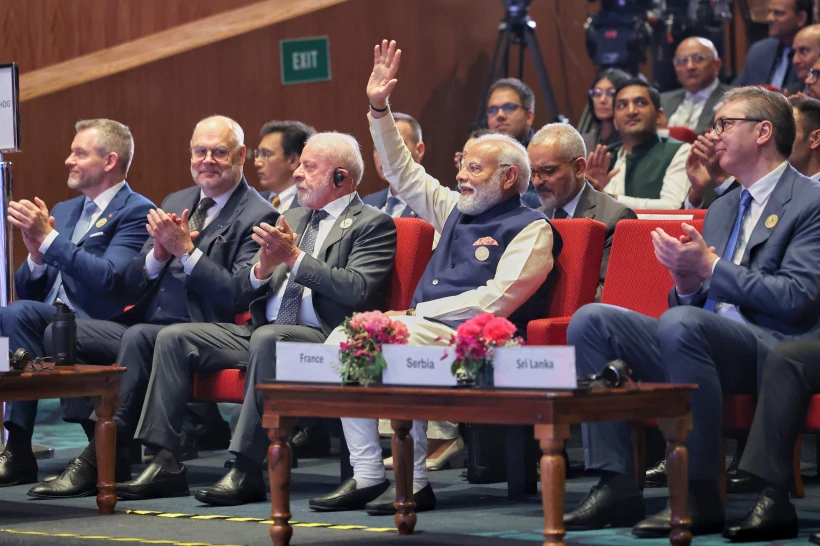
In a historic keynote address delivered on February 19, 2026, at the Leaders’ Plenary session of the India AI Impact Summit at Bharat Mandapam, Prime Minister Narendra Modi unveiled India’s comprehensive vision for artificial intelligence: the MANAV Vision. This framework—where MANAV (the Hindi word for “human”) serves as an acronym—outlines five core principles that will guide India’s approach to AI development, deployment, and governance .
Speaking to a packed hall of global leaders, tech CEOs, and innovators, PM Modi drew a powerful parallel: “Like nuclear power, AI has the potential to transform humanity—but the direction we take today will determine whether it becomes a force for empowerment or exclusion. The choice is ours, and the time to choose wisely is now” .
The MANAV Framework: Five Pillars of Human-Centric AI
The acronym MANAV encapsulates India’s holistic approach to artificial intelligence—one that prioritizes humanity above all else.
M — Moral and Ethical System
The first pillar establishes that AI must be built on a foundation of strong moral and ethical principles. This means:
- Embedding human values into AI systems from the ground up
- Ensuring algorithms respect cultural sensitivities and diverse worldviews
- Creating guardrails that prevent AI from being weaponized or misused
PM Modi emphasized that technology without ethics is like a body without a soul—capable of great feats but devoid of purpose. India’s ancient philosophical traditions of Vasudhaiva Kutumbakam (the world is one family) offer a unique lens through which to develop AI that serves collective rather than narrow interests .
A — Accountable Governance
The second pillar focuses on transparent and responsible governance of AI systems. Key elements include:
- Clear frameworks for liability when AI systems cause harm
- Mechanisms for audit and oversight of algorithmic decisions
- Participatory governance models involving citizens, experts, and civil society
“AI cannot be a black box,” the Prime Minister stated. “Those who create it, deploy it, and benefit from it must be accountable to those affected by it—especially the most vulnerable” .
N — National Sovereignty (Especially Data Rights)
The third pillar addresses perhaps the most critical geopolitical dimension of AI: data sovereignty. This encompasses:
- Protecting the data rights of Indian citizens
- Ensuring that AI models trained on Indian data respect Indian laws (including the DPDP Act)
- Building sovereign AI infrastructure that reduces dependence on foreign systems
- Creating frameworks for data sharing that benefit Indian innovators while protecting privacy
This aligns perfectly with recent developments like Sarvam AI’s 105B-parameter model (trained entirely on Indian compute) and Yotta’s $2 billion GPU supercluster—both announced at the same summit .
A — Accessible and Inclusive Technology
The fourth pillar embodies India’s commitment to democratizing AI. PM Modi stressed that AI must not become a privilege of the few but a tool for the many:
- Multilingual AI supporting all 22 scheduled languages
- Voice-first interfaces for India’s diverse population
- Affordable access for startups, researchers, and students
- Solutions designed for the last mile, not just the first world
“India represents one-sixth of humanity, the world’s largest young population, and a massive tech talent pool,” the Prime Minister reminded the audience. “We are uniquely positioned to lead and shape the AI revolution—not just participate in it. But leadership means ensuring no one is left behind” .
V — Valid and Legitimate Systems
The final pillar focuses on trustworthiness and reliability:
- Rigorous validation of AI systems before deployment
- Legitimacy through compliance with Indian laws and international norms
- Accuracy and fairness in high-stakes domains like healthcare, education, and justice
- Continuous monitoring and improvement post-deployment
A Message to the Global South: This Is Your Moment Too
Perhaps the most significant aspect of PM Modi’s address was its explicit focus on the Global South. The India AI Impact Summit 2026 is the first major global AI summit hosted in the Global South, bringing together over 20 Heads of State, 60 Ministers, and 500+ global AI leaders from emerging economies alongside tech giants like Anthropic, Google, and OpenAI .
The Prime Minister used this platform to amplify voices often marginalized in global AI discussions:
- Solving real challenges: From agriculture and healthcare to education and climate resilience, AI must address the pressing needs of developing nations, not just the priorities of Silicon Valley boardrooms
- Affordable solutions: Cost cannot be a barrier—AI tools must be accessible to farmers, small businesses, and government schools
- Culturally relevant AI: Models trained primarily on English internet data fail to understand the linguistic diversity and cultural contexts of the Global South
- Bridging the digital divide: AI must close gaps, not widen them
“The benefits of AI cannot be confined to a privileged few in privileged geographies,” PM Modi declared. “We must ensure that every village, every small business, every student—regardless of language or location—can harness the power of AI for their progress” .
India’s AI Ecosystem: The Foundation Is Being Built
The MANAV Vision isn’t just philosophy—it’s being backed by concrete action. Over the past week at the India AI Impact Summit, multiple announcements have demonstrated India’s commitment:
1. Massive Compute Infrastructure
Yotta Data Services announced its $2 billion AI supercluster powered by 20,736 NVIDIA Blackwell Ultra GPUs, going live in August 2026 . This positions India among the top tier of global AI compute hubs.
2. Sovereign Foundation Models
Sarvam AI unveiled its 105B-parameter model—trained entirely on Indian infrastructure and outperforming larger global models on Indic language benchmarks . This proves that Indian innovation can compete with frontier systems.
3. Startup Ecosystem Acceleration
NVIDIA partnered with AI Grants India (AIGI) to catalyze 10,000 early-stage builders and spark up to 500 new AI ventures focused on India-specific challenges .
4. Space-AI Convergence
IN-SPACe launched its ₹6 crore AI seed fund for space-tech startups working at the intersection of artificial intelligence and space applications .
5. Policy Frameworks
The IndiaAI Mission continues to provide GPU subsidies, compute access, and institutional support for homegrown AI innovation .
Global Response: A Vision That Resonates
The international response to PM Modi’s MANAV Vision has been overwhelmingly positive. Leaders from the Global South, in particular, have welcomed India’s leadership in articulating a framework that prioritizes inclusion and sovereignty.
OpenAI CEO Sam Altman, present at the summit, acknowledged: “India’s approach to AI—focused on accessibility, multilingual support, and solving real-world problems—offers valuable lessons for the entire global community” .
Google’s AI lead noted that the company is committed to deepening its collaboration with Indian researchers and startups, particularly in voice-first AI and Indic language models .
The Path Ahead: From Vision to Reality
As the five-day India AI Impact Summit draws to a close on February 20, 2026, the challenge now is implementation. The MANAV Vision provides the philosophical foundation—but translating principles into practice requires sustained effort across multiple fronts:
For Policymakers:
- Develop concrete regulations that operationalize the five MANAV principles
- Create certification frameworks for “ethical AI” made in India
- Establish international partnerships that reflect Global South priorities
For Startups and Innovators:
- Build solutions that address India’s unique challenges in healthcare, agriculture, education, and governance
- Prioritize multilingual and voice-first interfaces
- Engage with government on pilot projects and procurement
For Global Partners:
- Invest in Indian AI infrastructure and talent
- Share best practices while respecting sovereignty
- Collaborate on open-source models that serve humanity broadly
For Citizens:
- Participate in shaping AI governance through public consultations
- Demand transparency and accountability from AI deployers
- Embrace AI as a tool for empowerment while remaining vigilant about its risks
Conclusion: India’s Gift to the AI Age
PM Modi’s MANAV Vision is more than a policy framework—it’s a philosophical contribution to the global AI conversation. At a time when much of the discourse around AI is dominated by fears of existential risk or hype about exponential growth, India offers a third path: AI as a shared resource for humanity’s benefit, guided by inclusion, ethics, and progress.
As the Prime Minister concluded his address: “The direction we take AI today will shape humanity’s tomorrow. Let us choose wisely. Let us choose inclusion. Let us choose ethics. Let us choose humanity. Let us choose MANAV” .
With one-sixth of humanity watching, India has staked its claim as not just an AI adopter, but an AI shaper—building technology that empowers the many, not the few.