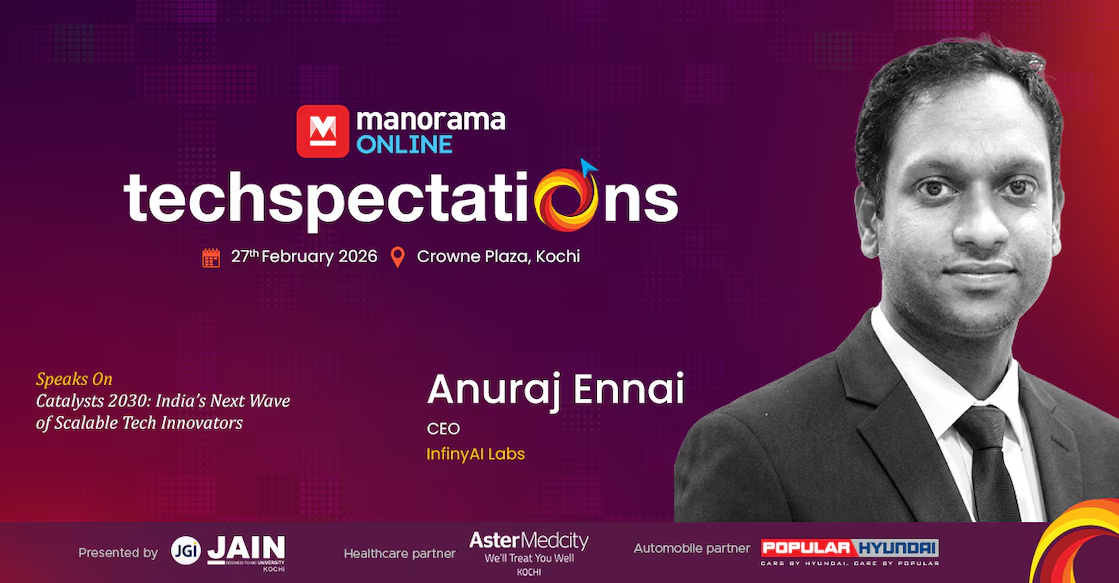
Anuraj Ennai at Manorama Techspectations: The Blueprint for India’s Deep-Tech Future
In a world obsessed with parameter counts and brute-force scaling, one Indian CEO offered a radically different vision: build efficient, sovereign, and frugal AI that solves real problems for a billion people.
At the prestigious Manorama Techspectations conference in Kochi, Anuraj Ennai, CEO & Co-founder of InfinyAI Labs, delivered a masterclass on what it truly takes to build scalable technology innovation in India. Speaking on the panel “India’s Next Wave: Scalable Tech Innovation,” Anuraj outlined a compelling framework for how Indian deep-tech startups can move beyond copying Western playbooks to create solutions uniquely optimized for the country’s constraints and opportunities .
The session resonated deeply with entrepreneurs, investors, and policymakers in attendance, reinforcing a powerful message: India’s tech future lies in homegrown ingenuity, frugal innovation, and developer-led momentum .
The Three Pillars of India’s Deep-Tech Future
Anuraj structured his insights around three core pillars that he believes will shape the next decade of Indian innovation:
1. Future-Ready Foundational Models
The first pillar addresses perhaps the most fundamental question in Indian AI: What should our models look like?
Anuraj challenged the prevailing global narrative that bigger is always better. Instead, he advocated for building AI systems that are:
- Efficient by design —optimized for India’s real-world constraints including limited compute availability, high energy costs, and edge deployment requirements
- Truly multilingual —supporting India’s linguistic diversity with cultural and contextual understanding
- Sovereign and privacy-preserving —ensuring data ownership and control remains within Indian jurisdiction
“We need to shift from chasing parameter size to creating models that deliver high performance per watt and per rupee,” Anuraj emphasized. “That’s what sustainable scaling looks like in emerging markets” .
This philosophy aligns perfectly with recent developments like Sarvam AI’s 105B-parameter model, which outperforms larger global competitors on Indic benchmarks through architectural efficiency rather than brute force .
Key Focus Areas:
- High performance per watt —energy-efficient architectures suitable for India’s power constraints
- Cost-optimized inference —making AI affordable at population scale
- Edge-native design —models that run on devices, not just in the cloud
- Indic language mastery —understanding code-mixing, dialects, and cultural context
2. Developer Ecosystem Empowerment
The second pillar focuses on democratizing AI development—lowering barriers so that thousands of Indian builders can participate in the innovation economy.
Anuraj stressed that India’s deep-tech future cannot be built by a handful of companies alone. It requires a thriving ecosystem of developers, researchers, and entrepreneurs, all equipped with the right tools and resources:
- Accessible inference platforms —making it easy to deploy and run models
- Fine-tuning kits —enabling customization for specific use cases without starting from scratch
- Open-source frameworks —building on shared foundations rather than reinventing wheels
- Community-driven benchmarks —creating evaluation standards that reflect Indian realities, not just Western academic benchmarks
“The next breakthrough in Indian AI won’t come from a single lab,” Anuraj predicted. “It will come from thousands of developers experimenting, iterating, and building on shared infrastructure” .
This vision echoes the NVIDIA-AIGI partnership announced at the India AI Impact Summit, which aims to catalyze 10,000 early-stage builders and spark up to 500 new AI ventures .
Sectoral Opportunities:
- Fintech —vernacular financial assistants, credit scoring for informal economy
- Healthcare —AI diagnostics for rural clinics, drug discovery for tropical diseases
- Agritech —crop advisory, soil health monitoring, supply chain optimization
- Education —personalized learning in regional languages, teacher assistance tools
- Governance —citizen service automation, multilingual grievance redressal
3. Strategic Growth in Deep-Tech Verticals
The third pillar identifies specific domains where India has natural advantages and can build globally competitive capabilities:
- Voice-first AI —Given India’s linguistic diversity and literacy patterns, voice interfaces are not an alternative—they’re the primary interface for billions. Startups building speech recognition, text-to-speech, and conversational AI for Indian languages have a massive home market advantage.
- Multimodal document understanding —India’s economy runs on documents: land records, identity proofs, financial statements, legal contracts. AI that can understand, extract, and process information from diverse document formats addresses a massive, immediate need.
- Enterprise automation —With over 1,800 Global Capability Centres (GCCs) in India, there’s enormous demand for AI-powered workflow automation, business process optimization, and intelligent decision support.
- Climate-resilient tech —From precision agriculture to disaster prediction to resource optimization, India’s vulnerability to climate change creates urgent demand for AI solutions that build resilience.
- Defense-adjacent applications —With growing emphasis on Atmanirbhar Bharat in defense, startups building sovereign AI for surveillance, logistics, and autonomous systems have clear pathways to government procurement.
The InfinyAI Labs Journey: Building India-Optimized AI
Anuraj also shared insights from InfinyAI Labs’ own journey—a case study in how the principles he advocates translate into practice.
InfinyAI Labs is building India-first AI infrastructure and models with a clear focus on:
- Cost optimization —making AI affordable for Indian enterprises and startups
- Low latency —ensuring responsive applications even on modest infrastructure
- Privacy preservation —keeping data within Indian jurisdiction and control
The company positions itself as part of the broader movement toward sovereign, inclusive AI—serving Bharat while competing globally. This means:
- Models optimized for Indian languages and contexts
- Infrastructure designed for Indian compute and energy constraints
- Partnerships with Indian enterprises, government agencies, and developers
- Contribution to open-source ecosystems that benefit all Indian builders
Why This Matters: Beyond Copying Silicon Valley
The resonance of Anuraj’s talk at Techspectations reflects a growing recognition across India’s tech ecosystem: the Silicon Valley playbook doesn’t automatically translate to Indian success.
The Frugal Innovation Advantage
India has a long history of frugal innovation—doing more with less, engineering around constraints, and delivering value at previously impossible price points. This isn’t a weakness; it’s a competitive advantage. As Anuraj noted, building AI that delivers high performance per watt and per rupee prepares Indian companies not just for domestic success but for global leadership in emerging markets worldwide.
The Data Advantage
India generates massive amounts of data—from UPI transactions to Aadhaar authentications to GST filings to citizen-service interactions. Startups that can access and learn from this data (with appropriate privacy safeguards) have a training advantage that foreign competitors cannot replicate.
The Talent Multiplier
With the world’s largest young population and a strong engineering education system, India has a demographic dividend in technical talent. The challenge is channeling this talent into deep-tech innovation rather than low-value services. Ecosystem empowerment—the second pillar—is key to making this happen.
The Policy Tailwind
From the IndiaAI Mission to DPDP Act to production-linked incentives for electronics, government policy is increasingly aligned with the vision Anuraj articulated. Startups that build within this framework benefit from institutional support, procurement pathways, and regulatory clarity.
The Bigger Picture: India’s Deep-Tech Acceleration
Anuraj’s insights at Manorama Techspectations didn’t emerge in isolation. They reflect a broader momentum building across India’s deep-tech landscape:
- Sarvam AI unveiled its 105B-parameter model, outperforming larger global competitors on Indic benchmarks
- Yotta announced a $2 billion GPU supercluster, dramatically expanding domestic compute capacity
- NVIDIA partnered with AIGI to catalyze 10,000+ AI builders and 500+ new ventures
- IN-SPACe launched dedicated funding for space-AI convergence
- PM Modi unveiled the MANAV Vision for ethical, inclusive AI governance
- The New Delhi Frontier AI Impact Commitments established a global framework for responsible development
Each of these developments reinforces the others. Compute infrastructure enables model development. Model development creates demand for developer tools. Developer tools empower startups. Startups build applications that demonstrate value. Demonstrated value attracts investment and talent. And all of it is guided by policy frameworks that prioritize sovereignty, inclusion, and sustainability.
The Road Ahead: From Vision to Reality
Anuraj’s talk at Techspectations concluded with a call to action for the entire ecosystem:
For Founders:
- Build for India first—solve massive, unique problems with homegrown ingenuity
- Optimize for constraints—efficiency isn’t a compromise; it’s a competitive advantage
- Contribute to the ecosystem—open-source tools and datasets benefit everyone
For Investors:
- Practice patient capital—deep-tech takes time to mature
- Support foundational work—infrastructure and platforms matter, not just applications
- Look beyond Bengaluru—talent and innovation are distributed across the country
For Policymakers:
- Continue infrastructure investment—compute, data, and connectivity are public goods
- Enable procurement pathways—government as an early customer for deep-tech solutions
- Support public-private partnerships—combining institutional resources with entrepreneurial energy
For Developers:
- Experiment fearlessly—the tools are becoming accessible
- Build in the open—share your learning with the community
- Think globally, build locally—India-optimized solutions have global relevance
Conclusion: The Decade of Indian Deep-Tech
As the Manorama Techspectations conference drew to a close, Anuraj Ennai’s message lingered in the air: India’s deep-tech story is accelerating, and the next decade belongs to those building scalable, India-optimized solutions.
Not by copying what works in Silicon Valley. Not by chasing parameter counts that make headlines. But by understanding India’s unique constraints and opportunities—and building technology that works for a billion people with diverse languages, varied infrastructure, and massive unmet needs.
InfinyAI Labs is part of that story. So are Sarvam AI, Yotta, the NVIDIA-AIGI partnership, the PARAM robot team, and hundreds of other startups across the country. Together, they’re proving that Indian ingenuity, when combined with the right ecosystem support, can build world-class deep-tech solutions.
The message from Techspectations is clear: India’s tech future isn’t coming—it’s already here, and it’s being built by founders, developers, and innovators who refuse to settle for following.