
Nava Raises $22 Million Led by Greenoaks to Build Asia’s Full-Stack AI Cloud Infrastructure
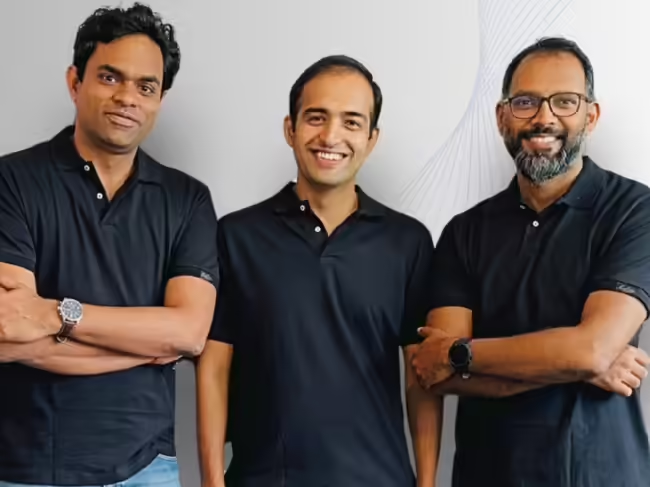
When a startup changes its name, it often signals more than just a rebranding exercise—it marks a fundamental shift in ambition. For Nava, the AI cloud infrastructure company formerly known as Kluisz, that shift is dramatic.
The company has raised $22 million in a Series A funding round led by San Francisco-based Greenoaks Capital, with participation from existing investors RTP Global and Unicorn India Ventures . The round, which closed in early April 2026, comes on the heels of a $9.6 million seed round raised in 2025, bringing the startup’s total funding to approximately $31.6 million .
But the funding is only part of the story. Nava is pivoting from its earlier software-led GPU cloud offering to a vertically integrated, full-stack “neocloud” platform purpose-built for artificial intelligence workloads . This means building not just software, but also AI-optimised data centres, high-performance GPU compute clusters, and AI-native orchestration layers—the complete infrastructure stack for the AI economy .
The Founders: A Team with Deep Operational Experience
Nava was founded in 2025 by a trio of executives who bring deep operational and technical expertise to the venture :
| Founder | Previous Role | Expertise |
|---|---|---|
| Abhinav Sinha (CEO) | Former Global COO & CPO at OYO, ex-BCG | Scale operations, product strategy |
| Vamshidhar Reddy | Former Partner at McKinsey, ex-AMD | Strategy, semiconductor/GPU ecosystem |
| Abhijeet Singh | Former VP of Cloud at Jio, ex-AT&T | Cloud infrastructure, telecom |
The team’s combined experience spans hyper-growth startups (OYO), global consulting (McKinsey, BCG), semiconductor and hardware (AMD), and large-scale cloud deployment (Jio, AT&T). This rare combination of skills—startup scaling, strategic rigour, and deep technical infrastructure—positions Nava to navigate the complex, capital-intensive world of AI infrastructure .
The Market Opportunity: Asia’s AI Infrastructure Gap
The timing of Nava’s pivot is strategic. As enterprises across Asia rapidly adopt AI, the demand for purpose-built infrastructure is outstripping supply.
According to studies by the Council on Energy, Environment and Water (CEEW) and real estate consulting firm CBRE, while India’s installed data centre capacity reached around 1.5 GW in 2025, it remains in the early stages of a potential fourfold expansion . For context, the US data centre market is projected to reach approximately 76 GW in total power demand in 2026 .
The gap is even more pronounced when considering that most existing capacity is legacy cloud infrastructure, not purpose-built for AI workloads. As KPMG estimates, data centre capacity across Southeast Asia will need to triple by 2030 to meet surging AI compute demand, and India faces a comparable shortfall .
Abhinav Sinha, Co-founder and CEO of Nava, articulated the opportunity: “This fundraise marks an important step in our journey. What started as an AI-native cloud platform has now evolved into something much larger, where we are building the foundational cloud platform layer for AI in Asia” .
The Technology: A Vertically Integrated “Neocloud” Platform
Nava’s vision is to build a full-stack neo-cloud platform that integrates four critical layers :
| Layer | Description |
|---|---|
| AI-Optimised Data Centres | Facilities designed specifically for AI workloads, with high-density power and cooling |
| High-Performance GPU Compute | Access to cutting-edge accelerators for model training and inference |
| AI-Native Orchestration & Inferencing | Software layer optimised for AI workloads, reducing latency and cost |
| Developer-Friendly Access & Tooling | APIs and interfaces that make infrastructure accessible to builders |
The company offers infrastructure through multiple models, including GPU-as-a-service and bare-metal compute, targeting enterprises building AI models and applications .
Sinha explained the differentiation: “While the business is capital-intensive, Nava is betting on a combination of software-led differentiation and strong investor backing to scale” . Unlike traditional cloud providers that retrofit existing infrastructure for AI, Nava is building from the ground up with AI as the primary workload—not an afterthought.
Madhur Makkar, Principal at RTP Global, noted: “In under a year, this team has demonstrated exceptional execution and is strongly positioned to address the growing need for purpose-built AI infrastructure across Asia” .
The Investor Thesis: Greenoaks, RTP Global, and Unicorn India Ventures
The involvement of Greenoaks Capital as the lead investor is significant. Greenoaks is a San Francisco-based firm known for backing category-defining technology companies, with investments in Stripe, Brex, and other global leaders . Their participation signals confidence that Nava can become a foundational player in Asia’s AI infrastructure landscape.
Bhaskar Majumdar, Managing Partner at Unicorn India Ventures, articulated the investment thesis: “We are witnessing a structural shift with AI driving rising compute demand, making data centres a critical part of this value chain. As a deep tech investor, we back companies across the AI value chain, and Nava fits well within this strategy” .
The investor syndicate also includes RTP Global, which led Nava’s seed round and continues to support the company’s expansion .
Singapore as Regional Headquarters: A Strategic Move
Alongside the funding announcement, Nava revealed that it is establishing Singapore as its regional headquarters . The move positions the company closer to key Asia-Pacific markets and provides access to global talent.
Sinha explained the rationale: “We will be hiring across India and Southeast Asia, particularly Singapore, which has seen more mature data centre deployments” .
The company will retain a strong execution base in India while leveraging Singapore’s status as a regional hub for data centre investment and AI infrastructure development .
Global Supply Chain Dynamics: An Opportunity for Emerging Players
Sinha pointed to broader geopolitical and supply chain dynamics as creating opportunities for new infrastructure players.
“Global supply chain constraints and geopolitical shifts are creating new opportunities for emerging infrastructure players” , he told ET .
This observation reflects a broader trend: as tensions between the US and China affect technology supply chains, and as enterprises seek diversification away from single-cloud dependency, regional players like Nava are well-positioned to capture market share.
The company is currently in advanced discussions for its new GPU-AI infrastructure offerings, indicating strong early demand from enterprise customers .
What This Means for India’s AI Ecosystem
Nava’s pivot and funding carry several important signals for India’s startup landscape:
1. Indian Startups Are Moving Up the AI Value Chain
From building applications on top of existing models to building the infrastructure that powers those models, Indian startups are moving into deeper, more defensible layers of the AI stack.
2. Capital-Intensive Infrastructure Ventures Are Attracting Global Backing
Greenoaks’ participation demonstrates that global investors are willing to back capital-intensive infrastructure plays emerging from India—not just asset-light software companies.
3. The “Neocloud” Category Is Emerging
Nava is positioning itself as part of a new category: “neocloud” providers that build infrastructure specifically for AI workloads, distinct from traditional cloud providers that serve general-purpose computing needs.
4. Asia-Pacific Is a Strategic Battleground
Nava’s focus on the Asia-Pacific region—with headquarters in Singapore and execution base in India—recognises that the next phase of AI infrastructure growth will be distributed across multiple geographies, not concentrated in the US.
5. Enterprise AI Adoption Requires Purpose-Built Infrastructure
As enterprises move from AI experimentation to production deployment, the limitations of general-purpose cloud infrastructure become apparent. Nava’s vertically integrated approach addresses this gap directly.
The Road Ahead: From Seed to Scale
With $22 million in fresh capital, Nava has a clear roadmap for the next phase of its journey. Priorities include:
- Building Out GPU Compute and AI Data Centre Capabilities: Expanding physical infrastructure across the Asia-Pacific region
- Investing in Talent: Hiring across AI infrastructure, data centre design, GPU engineering, and go-to-market roles
- Deepening Customer Engagements: Converting advanced discussions into binding contracts for GPU-AI infrastructure offerings
- Establishing Singapore Operations: Building the regional headquarters team and infrastructure
The company’s ability to execute on these priorities will determine whether it can capture a meaningful share of the rapidly growing AI infrastructure market in Asia.
The Final Word
Nava’s $22 million Series A round, led by Greenoaks Capital, marks a significant milestone for India’s AI ecosystem. It signals that Indian startups are not just building applications on top of AI models—they are building the infrastructure that powers those models.
The pivot from a software-led GPU cloud offering to a vertically integrated, full-stack “neocloud” platform reflects a deeper ambition: to become the foundational cloud layer for AI in Asia. With a founding team that combines hyper-growth startup experience, strategic consulting rigour, and deep technical infrastructure expertise, Nava is well-positioned to execute on this vision.
As enterprises across the region accelerate their AI adoption, the demand for purpose-built infrastructure will only intensify. Nava’s vertically integrated approach—bringing together AI-optimised data centres, high-performance GPU compute, and AI-native software—addresses a critical gap in the market.
For India’s startup ecosystem, Nava’s journey offers a blueprint: build deeper, think bigger, and compete not just on cost but on technical differentiation. The AI infrastructure race is global, but India has a seat at the table.