Indian Startups Raised Over $132 Million in a Single Week: Late March–Early April 2026 Funding Wrap
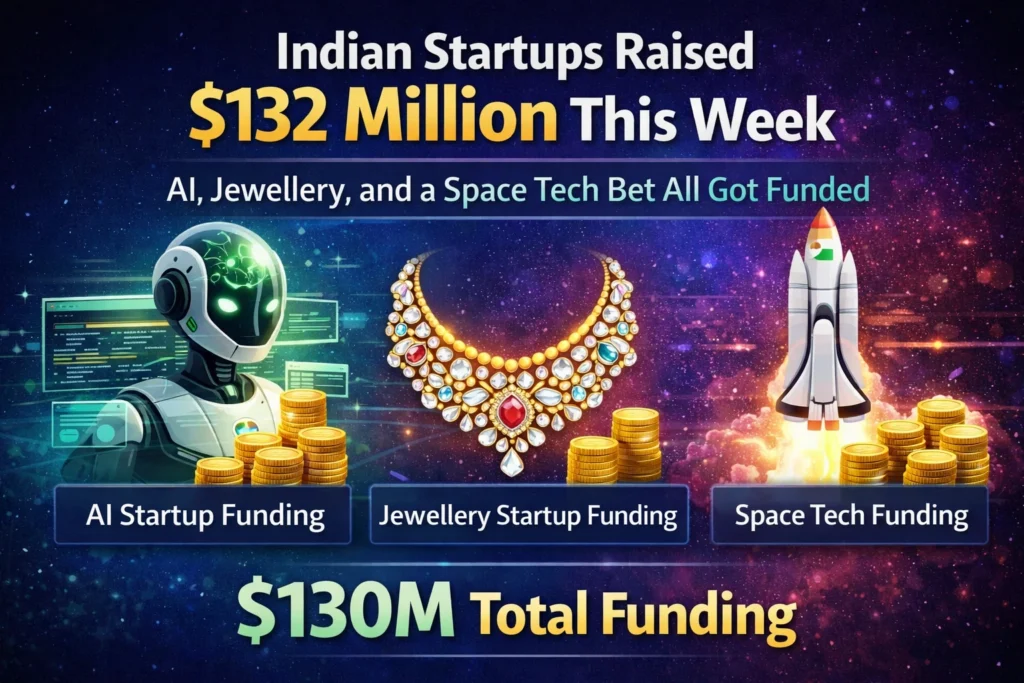
In the final week of March and the opening days of April 2026, the Indian startup ecosystem demonstrated remarkable resilience. Despite heightened geopolitical tensions in West Asia and volatility in global public markets, startups across the country raised over $132 million in a single week .
While this figure represented a moderation from the blockbuster $343 million raised in the previous week (March 23–27), the steady capital inflow signals that investor confidence in India’s innovation economy remains strong . The week was characterized by a healthy mix of early-stage and growth-stage deals across fintech, enterprise tech, climate tech, and D2C consumer brands.
| Metric | Value |
|---|---|
| Total Raised (Late March–Early April) | $132+ million |
| Previous Week (March 23–27) | $343 million |
| Deal Count | 20+ transactions |
| Most Active Stages | Pre-Series A, Series A, Seed |
| Key Sectors | Fintech, Enterprise Tech, Climate Tech, D2C |
The Week’s Largest Rounds
Euler Motors: $73.6 Million Series E for EV Expansion
The week’s standout deal came from New Delhi-based electric vehicle manufacturer Euler Motors, which raised $73.6 million in a Series E round led by Lightrock, with participation from Hero MotoCorp and Blume Ventures . The round also included debt financing from BlackSoil, Trifecta Capital, InnoVen Capital, and Alteria Capital.
Euler Motors, known for its HiLoad electric three-wheeler and the recently launched Turbo EV1000 four-wheeler, plans to use the funds to expand manufacturing capacity, scale its sales and service network to 100 cities, and invest in R&D for batteries and software . The company currently produces approximately 1,000 vehicles per month and aims to double that capacity with the fresh capital.
Swish: $38 Million Series B in Quick Commerce
Bengaluru-based quick commerce startup Swish raised $38 million in a Series B round co-led by Hara Global and Bain Capital Ventures, with participation from existing investor Accel . The round also included venture debt from Alteria Capital and Stride Ventures.
Swish operates a vertically integrated 10-minute food delivery model, owning its own cloud kitchens and managing its own delivery fleet. The company currently processes over 20,000 orders daily across Bengaluru neighborhoods, with average order values between ₹200 and ₹250 . The fresh capital will be used to expand into new cities, including Delhi-NCR and Mumbai, and to invest in kitchen automation.
Plum: $20.4 Million Series B for Insurtech
Health insurance platform Plum raised $20.4 million in a Series B round led by Peak XV Partners (formerly Sequoia India), with participation from Tanglin Venture Partners and GMO Venture Partners . The round valued the company at approximately $125 million, nearly double its previous valuation.
Plum serves over 6,000 organizations and 600,000 employees, offering group health insurance with AI-powered claims processing. The company has reduced median cashless hospital discharge time from 180 minutes in 2019 to 47 minutes, and median reimbursement time from 25 days to 1.5 days . The funds will be used to expand its healthcare stack into preventive care, primary care, and mental wellness.
The Broader Funding Pipeline
Beyond the headline deals, the late March–early April period saw sustained activity across the funding spectrum:
| Date | Startup | Sector | Round Size | Round Type |
|---|---|---|---|---|
| Mar 27 | Rocketlane | Enterprise Tech / SaaS | $60 million | Series C |
| Mar 27 | CureFit | Health Tech / Fitness | $47.2 million | Series G |
| Mar 27 | Fullife Healthcare | Ecommerce / D2C | $32 million | Series D |
| Mar 27 | Deccan AI | AI / Infrastructure | $25 million | — |
| Mar 27 | Pranos Fusion | Climate Tech | $6.8 million | Seed |
| Mar 27 | Canvaloop | Climate Tech | $1.5 million | Seed |
| Mar 26 | OZi | Ecommerce | $6.2 million | Series A |
| Mar 26 | Bidso | Enterprise Services | $6.8 million | Series A |
| Mar 26 | LetzRyd | Travel Tech | $4 million | — |
| Mar 26 | Kidbea | Ecommerce / D2C | $3.2 million | Series A |
Early-Stage Resilience: The Seed and Pre-Series A Pipeline
While growth-stage rounds dominated the headlines, the seed and pre-Series A segments remained active, reflecting the continued health of India’s startup pipeline.
According to Qubit Capital’s seed funding roundups, Indian seed-stage startups raised approximately $14.9 million across 4 deals in the week of March 10–17 , and $24.9 million across 10 deals in the week of March 14–21 . The standout seed deals included:
- Newtrace: $6.3 million pre-Series A for green hydrogen electrolyser technology, backed by HDFC Bank and Mitsui Sumitomo Insurance Venture Capital
- BambooBox: $6.6 million seed for managed ABM platform, led by Peak XV Partners’ Surge accelerator
- Velmenni: $3.5 million pre-Series A for Li-Fi and free-space optics technology, led by pi Ventures
- Coreworks AI: $5 million seed for enterprise analytics platform, led by Together Fund
These deals demonstrate that even as late-stage funding faces headwinds, early-stage investors continue to back technical founders building IP-rich, defensible businesses.
Sector Diversity: Where the Money Flowed
The funding activity of late March–early April 2026 was distributed across multiple sectors, reflecting the breadth of India’s innovation economy.
Fintech led the sectoral funding trends on the back of large rounds from Neo Group ($53.4 million) and Ecofy ($42 million) in the preceding week . Plum’s $20.4 million Series B added to the fintech momentum .
Enterprise Tech and SaaS continued to attract significant capital, with Rocketlane’s $60 million Series C and Deccan AI’s $25 million round leading the segment . The seed-stage SaaS ecosystem also remained active, with BambooBox ($6.6 million), Coreworks AI ($5 million), and CometChat ($6.5 million) closing rounds in March .
Climate Tech and Clean Tech saw sustained interest, with Euler Motors ($73.6 million), Pranos Fusion ($6.8 million), and Canvaloop ($1.5 million) raising capital . Newtrace’s $6.3 million pre-Series A in mid-March further underscored investor appetite for green hydrogen and clean energy solutions .
Ecommerce and D2C remained active, with Fullife Healthcare ($32 million), OZi ($6.2 million), Kidbea ($3.2 million), and several smaller D2C brands closing rounds .
The Geopolitical Context: Resilience Amid Uncertainty
The funding activity of late March–early April 2026 occurred against a backdrop of significant global uncertainty. The ongoing conflict in West Asia has rattled global financial markets, with the Indian rupee slumping nearly 10% against the US dollar and foreign portfolio investors withdrawing record amounts from Indian equities .
Yet, despite these headwinds, domestic venture capital activity remained resilient. According to YourStory’s analysis of the first week of April, while total funding declined compared to the previous week due to the absence of high-value transactions, the number of deals remained consistent . The decline was attributed to a lower number of high-value transactions rather than a broad-based retreat by investors.
As one industry observer noted, the continued flow of capital into Indian startups despite global volatility reflects the fundamental strength of the ecosystem—a large domestic market, a deep pool of engineering talent, and a growing base of domestic institutional investors.
What This Means for the Ecosystem
The sustained funding momentum of late March–early April 2026 carries several important signals for India’s startup ecosystem:
1. Resilience Is the New Normal
The ecosystem has now weathered multiple cycles—the funding winter of 2024-25, the West Asia conflict, global interest rate volatility—and continues to attract capital. This resilience is a testament to the maturity of both founders and investors.
2. Sector Diversity Is a Strength
Unlike previous cycles where capital concentrated in a single sector (consumer internet in 2015, edtech in 2021), the current funding landscape is broadly diversified across fintech, enterprise tech, climate tech, healthtech, and D2C. This diversity insulates the ecosystem from sector-specific shocks.
3. Early-Stage Funding Remains Healthy
The continued activity at the seed and pre-Series A levels ensures that the pipeline of future growth-stage companies remains full. As long as early-stage investors continue to back new founders, the ecosystem’s long-term trajectory remains positive.
4. Domestic Capital Is Stepping Up
While global macro headwinds have affected foreign portfolio flows, domestic investors—family offices, high-net-worth individuals, and India-focused funds—continue to write checks. This deepening pool of domestic capital reduces the ecosystem’s reliance on global liquidity cycles.
The Road Ahead
The first week of April 2026 saw total funding of approximately $117 million across 20 transactions . While this represented a decline from the previous week, the number of deals remained stable, suggesting that investor interest persists even as the size of individual rounds moderates.
Looking ahead, several factors will shape the funding landscape for the remainder of Q2 2026:
- Geopolitical developments: The trajectory of the West Asia conflict will influence global risk appetite and capital flows into emerging markets.
- Domestic policy continuity: The upcoming election results and the formation of the new government will determine the pace of policy implementation across key sectors.
- IPO pipeline: The performance of upcoming public listings—including those of Zetwerk, Cashify, and others—will influence investor sentiment toward late-stage startups.
- AI adoption: As enterprises accelerate AI adoption, startups building AI-native solutions across verticals will continue to attract capital.
Despite the near-term uncertainties, the underlying momentum of India’s startup ecosystem remains positive. The $132+ million raised in a single week during late March–early April 2026 is a testament to that enduring strength.
The Final Word
The Indian startup ecosystem raised over $132 million in a single week during late March–early April 2026, demonstrating remarkable resilience amid global uncertainty. While the figure moderated from the previous week’s $343 million, the steady capital inflow—supported by a healthy mix of growth-stage and early-stage deals—reflects sustained investor confidence.
From Euler Motors’ $73.6 million Series E to Swish’s $38 million Series B to Plum’s $20.4 million Series B, the week’s deals spanned fintech, enterprise tech, climate tech, and consumer brands. The continued activity at the seed and pre-Series A levels ensures that the pipeline of future growth-stage companies remains full.
As the ecosystem navigates geopolitical headwinds, the message from the funding data is clear: investors remain committed to India’s innovation economy. The startups that will thrive in this environment are those that combine strong fundamentals, capital efficiency, and a clear path to profitability—the hallmarks of a maturing ecosystem.