
Articulus Surgical’s Seed Funding: A Scalpel for Change in India’s Surgical Landscape
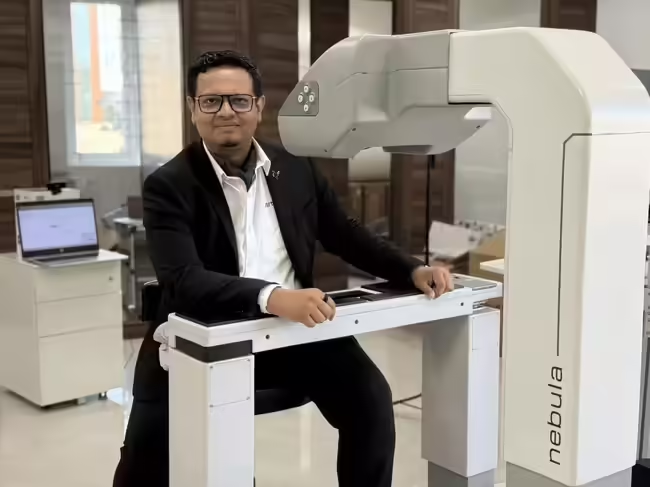
In a significant stride for India’s sovereign medtech capabilities, Bengaluru-based Articulus Surgical has secured a major seed funding round led by Kalaari Capital. The startup is developing minimally invasive robotic surgery systems specifically engineered for the unique demands and constraints of the Indian healthcare ecosystem. This investment is more than financial backing; it’s a strategic endorsement of a critical mission: to democratize access to high-precision surgical care by building affordable, adaptable, and locally relevant robotic platforms.
The involvement of Kalaari Capital, a firm with a formidable history of backing category-defining Indian tech companies, sends a powerful signal. It validates the thesis that India can and must create its own deep-tech solutions for its most pressing healthcare challenges, rather than relying on prohibitively expensive imported systems designed for Western hospital infrastructures.
The Articulus Vision: Precision Meets Pragmatism
Articulus is tackling a multifaceted problem:
- The Surgical Accessibility Gap: India faces a severe shortage of surgeons, especially in rural and tier-2/3 cities, and a massive backlog of elective surgeries. Robotic systems can augment a surgeon’s capability, enabling complex procedures to be performed with greater consistency and potentially by a broader pool of trained practitioners.
- The Cost Conundrum: Existing robotic surgery systems (like the da Vinci) are capital-intensive, leading to high procedure costs that are out of reach for most Indians. Articulus aims for radical affordability through modular design, local manufacturing, and frugal engineering.
- The “India-First” Design Philosophy: Unlike imported systems, Articulus is building for India’s reality:
- Robustness & Power Resilience: Systems that can handle voltage fluctuations and operate reliably in diverse hospital settings.
- Multilingual & Intuitive Interfaces: Lowering the training barrier for surgeons across the country.
- AI-Assisted Navigation: Incorporating intelligence to enhance precision and potentially reduce surgeon cognitive load, compensating for the high-volume, high-pressure operating environments common in India.
The Kalaari Bet: Why This Sector, This Startup
Kalaari’s leadership indicates a deep conviction in several converging trends:
- The Medtech Inflection Point: Indian healthcare is transitioning from importer to innovator. Government push (via schemes like PLI for medical devices), a growing pool of biomedical engineering talent, and increased hospital willingness to adopt new technology create a fertile ground.
- The Deep-Tech Health Thesis: After successes in diagnostics and telemedicine, investor focus is shifting to complex, IP-driven therapeutic and surgical interventions. Robotic surgery sits at the apex of this—a high-margin, high-impact, defensible business.
- Articulus’s Foundational Approach: By controlling the full stack—robotics, AI software, haptics, and modular hardware—Articulus isn’t just assembling components; it’s building sovereign intellectual property that can be iterated and optimized for local needs.
The Roadmap: From Lab to Operating Theatre
The seed funding will be catalytic for several critical phases:
- Clinical Validation & Regulatory Pathway: Navigating the CDSCO (Central Drugs Standard Control Organization) approval process with robust clinical trials is paramount. This capital funds the rigorous studies needed to prove safety and efficacy.
- Manufacturing Scale-Up: Moving from prototypes to GMP (Good Manufacturing Practice) certified production is a capital-intensive step crucial for reliability and cost control.
- Pioneering Partnerships: Securing design wins with leading hospital chains and government medical institutions for pilot deployments. Success here will provide invaluable real-world data and build the credibility needed for broader adoption.
The Bigger Picture: A Blueprint for Sovereign Medtech
Articulus’s journey, if successful, provides a blueprint for other Indian deep-tech health ventures:
- Identify a High-Impact, High-Cost Gap: Target areas where import dependency creates prohibitive costs for the masses.
- Engineer for Context, Not Just Specs: Build for India’s infrastructure, cost sensitivity, and user diversity.
- Secure Patient, Knowledgeable Capital: Partner with investors who understand the long R&D and regulatory cycles of medtech.
- Align with National Priorities: Position the venture within missions like Ayushman Bharat and the National Digital Health Mission, aiming for scale through public-health integration.
Challenges on the Sterile Field
The path is fraught with challenges: the long and uncertain regulatory timeline, the difficulty of changing deep-seated surgical practices, competition from global giants who may eventually launch lower-cost models, and the ultimate test of achieving clinical outcomes superior to skilled laparoscopic surgery at a compelling price point.