Meine Electric’s Iron-Air Battery Breakthrough Is Rewriting India’s Energy Storage Story
Lithium-ion has become the default choice for energy storage, but beneath the dominance lies a fundamental limitation: it cannot store renewable energy for more than a few hours at a cost that makes economic sense. Indian deep-tech startup Meine Electric is challenging this status quo. The company has announced the successful independent validation of its proprietary Fast Charge Long Discharge (FCLD) Iron-Air battery technology by Customized Energy Solutions (CES) , the US-based parent organisation of the India Energy Storage Alliance (IESA) .
Faster Charging, Longer Storage
The validation tested two iron-air electrochemical cells under a structured protocol designed to assess electrochemical performance, capacity retention, and operational stability . The results confirmed what Meine Electric had been building toward: an iron-air battery that charges in 6 hours and discharges continuously for more than 18 hours . The system demonstrated operational stability under an asymmetric duty cycle comprising rapid charging followed by sustained discharge .
This matters because conventional iron-air technologies, such as those developed by Form Energy (US) and Ore Energy (Europe), are designed for multi-day storage applications with charge and discharge cycles extending up to 100 hours . While suitable for seasonal or extended storage, these longer cycles make them largely incompatible with the daily balancing requirements of solar-dominated grids .
“Traditional iron-air systems are restricted to multi-day cycles, making them largely incompatible with the intermittent nature of renewable energy generation,” said Priyansh Mohan, Co-founder and CEO of Meine Electric . “Unlike regions that require seasonal storage, the renewable challenge across Asia and MEA is fundamentally a daily balancing problem. By engineering our system to capture a full charge within a tight 6-to-8-hour window, we are finally turning iron-air batteries from a sluggish backup chemistry into a foundational, daily-cycling asset” .
What Makes Iron-Air Different
The technology operates on a process known as “reversible rusting.” During discharge, iron reacts with oxygen to form rust, releasing electricity. When the battery is charged, the reaction reverses, turning the rust back into metallic iron . This chemistry offers three fundamental advantages over lithium-ion :
- Cost Efficiency: The proprietary technology delivers a levelised cost of storage (LCOS) of less than $0.05/kWh (approximately ₹5/kWh) .
- Safety: The system is inherently non-flammable .
- Abundant Materials: Iron, air, and water replace the rare minerals required for lithium-ion batteries .
The Strategic Context
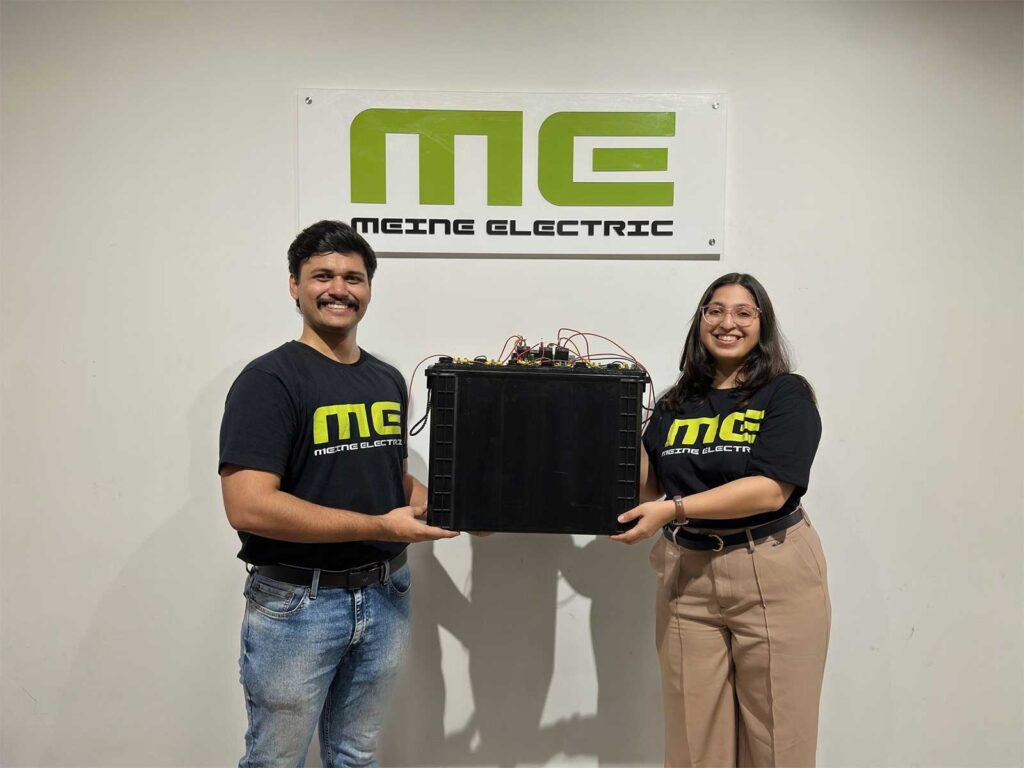
Founded in 2023 by Priyansh Mohan and Stuti Kakkar, Meine Electric is the first company in the Asia-Pacific region and the third globally to develop iron-air long-duration energy storage technology . The company has already raised $750,000 (approximately ₹6.7 crore) in pre-seed capital from investors including Antler, Rebalance, Venture Catalysts, gradCapital, and the AIC-AU Incubation Foundation .
The CES validation adds independent, third-party credibility as the company moves toward larger-scale demonstrations, pilot deployments, and continued development of indigenous energy storage solutions to support India’s renewable energy transition . The company aims to deliver turnkey, containerised iron-air battery systems by 2027 .
India’s Clean-Energy Imperative
As India races toward its 500 GW renewable energy capacity target by 2030, long-duration energy storage is no longer optional—it is infrastructure . The grid demands technologies that can capture excess solar generation during the day and discharge it reliably overnight. Meine Electric’s iron-air batteries are engineered to do precisely this, complementing lithium-ion systems to unlock round-the-clock renewable power .
“The energy industry prioritizes lower costs and higher reliability, and iron-air technology is structurally positioned to deliver on both,” said Stuti Kakkar, Co-founder and COO of Meine Electric . “We are betting on iron-air as a foundational infrastructure play to support the renewable grid” .
With this independent validation, Meine Electric has taken a significant step toward proving that deep-tech innovation from India can compete globally in the clean-energy race, turning one of the country’s most abundant resources—iron—into the backbone of its renewable future.