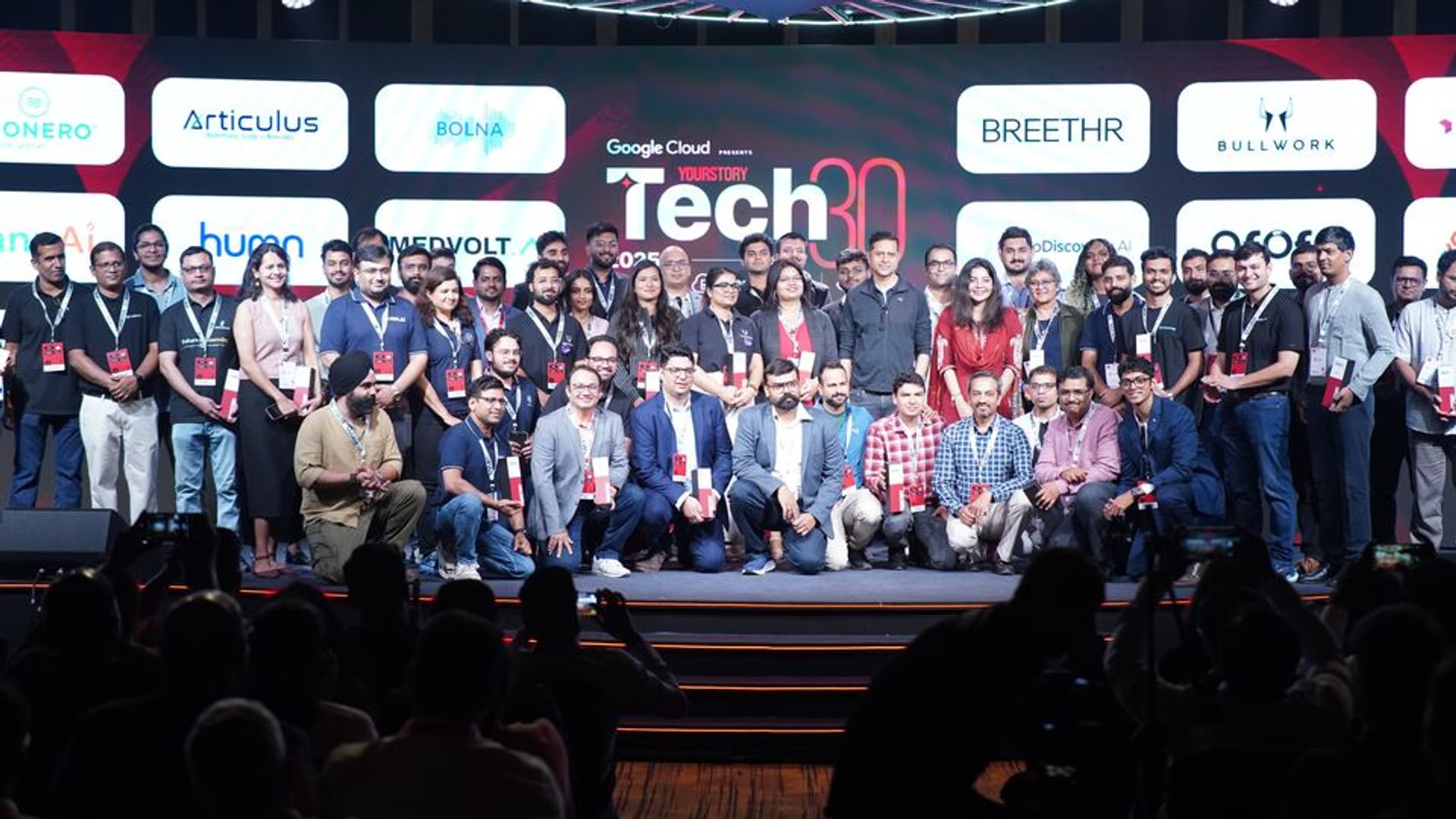
India’s Startup Ecosystem Accelerates Growth
India has firmly established itself as one of the world’s fastest-growing startup ecosystems, driven by a powerful convergence of government support, international partnerships, and rising private investment. The numbers tell a compelling story: from around 350-400 startups in 2014, the country has expanded to over 2.3 lakh recognised startups today, making it the world’s third-largest startup ecosystem.
📊 The Scale of India’s Startup Transformation
In FY 2025-26 alone, over 55,200 startups were recognised—the highest annual addition since the Startup India initiative launched in 2016, representing a 51.6% year-on-year increase. Cumulatively, these startups have generated more than 23.36 lakh direct jobs, with nearly 5 lakh jobs added in a single year.
Nearly 48% of recognised startups have at least one woman director, reflecting the deepening inclusivity of the ecosystem. Innovation is also spreading geographically, with more than 50% of startups now coming from Tier-2 and Tier-3 cities. India’s position in the Global Innovation Index has improved dramatically, rising from 80th in 2014 to 38th place, while the country has climbed to sixth place globally in patent filings.
📈 Funding and Valuation
- Hurun Global Unicorn Index 2026: India ranks 4th globally with 61 unicorns
- Total valuation of unicorns: Over $350 billion
- Tech funding in H1 2026: $7.2 billion, a 12% increase year-on-year
- Average cheque sizes nearly doubled—the market has “traded breadth for depth”
🚀 Key Drivers of Acceleration
1. Policy Stability and Government Support
Industry leaders credit the government’s stable governance framework and systematic removal of regulatory hurdles for the ecosystem’s growth. Over 25,000 compliances have been dropped to improve the ease of doing business, and the removal of Angel Tax has significantly helped young startups raise funds from angel investors.
Flagship government initiatives include:
| Scheme | Corpus | Impact |
|---|---|---|
| Fund of Funds for Startups | ₹10,000 crore | ₹25,500+ crore invested in 1,370+ startups via 140+ AIFs |
| Startup India Fund of Funds 2.0 | ₹10,000 crore | Approved to fuel the next wave of innovation |
| Credit Guarantee Scheme | — | 410+ loans worth ₹1,250+ crore guaranteed |
| Startup India Seed Fund Scheme | ₹945 crore | 215+ incubators supporting early-stage startups |
Initiatives like Startup India, the Atal Innovation Mission (AIM), the India AI Mission, and the National Quantum Mission have created a full-lifecycle support system spanning ideation, funding, mentorship, and scale-up.
2. Deep-Tech Focus
The ecosystem is undergoing a decisive shift toward deep-tech and research-led ventures. According to the Campus Fund report, deep-tech has emerged as the single largest category among student-led ventures, accounting for 16.87% of the startup funnel—a dramatic rise from its position outside the top five in 2021.
Key developments:
- Government extended recognition for deep-tech startups to 20 years, acknowledging longer R&D timelines
- The ₹1 lakh crore Research, Development & Innovation Fund supports the 15-20 year timelines required for semiconductors, advanced biotech, and materials science
- Defence, semiconductors, renewable energy, and precision manufacturing are seeing startups build indigenous solutions
- Over 3,600 deeptech startups now operate in India, up from negligible numbers a decade ago
- PHD founders in the startup funnel rose nearly seven-fold, from 35 in 2020-21 to 237 in 2024-25
As the Campus Fund report noted: “Five years ago, a typical investment committee conversation was about whether a team could ship. Today, it is about whether they can defend”.
3. International Partnerships and Global Ambition
India’s startup ecosystem is increasingly global in ambition. Research shows that 40% of Indian startups receiving seed funding are building for global markets, spanning software, B2B commerce, and international consumer brands.
Policy stability has provided a key advantage. As Nikhil Kamath, Co-Founder of Zerodha, noted, the “India story has been narrated so well abroad” that Western investors remain “sanguine“ about India even while being critical of other major economies.
🔮 The Road Ahead: From Services to Deep-Tech Leadership
India’s startup journey has moved through clear waves: from IT services and BPO in the 1990s and 2000s, to the internet economy and e-commerce boom, and now to deep-tech and AI-driven innovation. The ecosystem has transitioned from a services-heavy model that exported talent and time to becoming a product and manufacturing story.
However, sustaining this progress will require action on several fronts:
- Unblocking capital disbursement—grants exist but must flow on time and at scale
- Creating demand certitude through publicly committed five-year roadmaps for government procurement
- Building the middle layer—vocational skilling, industry apprenticeships, and supply chain development
As India moves from “digital India to a powerful deeptech India,” this transition will represent a crucial maturity milestone, signalling to global venture capital and research consortia that India is ready to co-author the future of foundational technology. The next decade will determine whether India can sustain this momentum and emerge as a true global innovation powerhouse.