The $500 Million Bet: How Deepinder Goyal’s Temple Is Redefining India’s Wearable Tech Ambitions
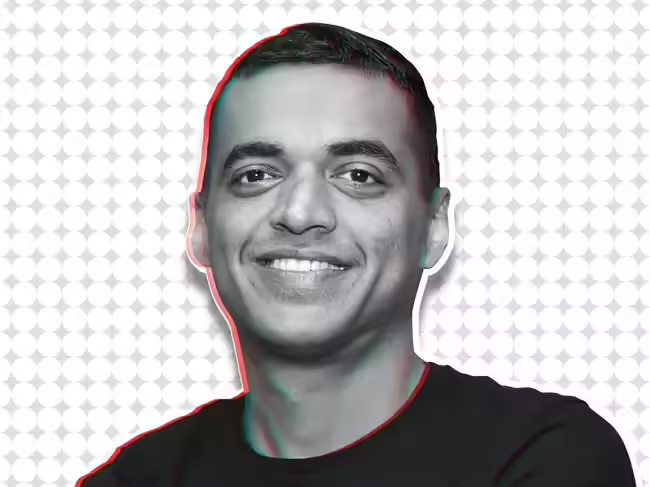
A small metallic clip stuck to the side of a founder’s head sparked speculation across the internet in late 2025 . By mid-2026, that curiosity has evolved into one of India’s most anticipated deep-tech hardware plays: a forehead-worn wearable called Temple, priced at approximately ₹80,000 (around $1,000), targeting a valuation of $500 million in its upcoming funding round .
A Vision Born from Personal Curiosity
What began as a personal science project to understand cerebral blood flow has transformed into a full-fledged venture. Deepinder Goyal, the founder of Zomato and Eternal, has invested substantial personal capital—$25 million into the underlying research at Continue—to explore what he calls the “Gravity Ageing Hypothesis”: the theory that gravity chronically reduces blood flow to the brain over time, potentially accelerating neurological ageing .
The Temple device, worn on the side of the forehead near the temples, measures blood-flow-related signals from an area with dense blood supply . The startup claims this offers richer physiological insights than conventional wrist- or finger-based wearables. At the core of the platform is a proprietary metric called Entropy—a score on a scale of 1 to 250 that updates every second to reflect the body’s physiological state and metabolic rate in real time . Lower scores at rest are considered healthier, with the metric rising during physical or mental demand and falling during recovery .
From $190 Million to $500 Million in Months
The startup has already demonstrated exceptional fundraising momentum. Temple raised $54 million in a friends-and-family round** at a post-money valuation of approximately **$190 million in February 2026, with participation from a distinguished roster of founders and investors including Kunal Shah, Vijay Shekhar Sharma, the Kamath brothers, and early Zomato backers such as Peak XV Partners, Steadview Capital, and Info Edge Ventures . More than 30 Temple employees also participated at par valuation, a rare signal of internal conviction in a pre-revenue hardware venture .
Now, the company is preparing to raise fresh capital at a **$500 million valuation**—more than doubling its value in under six months . According to a memo from Goyal to employees, the company is seeing strong interest from external investors at this level, and a partial ESOP buyback has already been launched at a $375 million valuation to allow employees to realise some value .
Beyond a Product: A Recruitment Philosophy
Temple’s ambition is not limited to the device itself. The company’s hiring approach has drawn widespread attention, with Goyal making a controversial but deliberate move: requiring applicants to have body fat below 16% (for men) and 26% (for women), or committing to achieving that within three months on probation . This reflects the company’s positioning—building for elite performance athletes and high-performing professionals who themselves embody peak fitness .
The technical roles being recruited span analog engineering, embedded AI, brain-computer interfaces, neural decoding, deep learning for physiological metrics, computer vision, and neuroimaging—a convergence of advanced electronics, sensors, and AI that requires long R&D cycles and significant upfront capital .
A Signal for India’s Hardware Ambitions
Temple’s rise is more than a single startup story. It reflects a broader shift in India’s startup ecosystem: the expansion from software-led ventures into capital-intensive, IP-led hardware innovation. At a price point of ₹80,000 and a valuation trajectory that rivals the fastest-growing software startups, Temple is positioning itself as a premium, globally competitive wearable brand—one that aims to stand alongside the world’s best.
“We will launch it as a wellness device with peer-reviewed studies and everything,” Goyal has stated . While the science behind Entropy has yet to be validated by independent scientists, the device has already cleared one of the most difficult hurdles in hardware entrepreneurship: proving that enough investors, and enough employees, believe the bet is worth making.