Indian Startup Funding Surges to $1.91 Billion in June
India’s startup ecosystem staged a powerful recovery in June 2026, with funding surging to $1.91 billion across 80 rounds – a 91% year-on-year increase . The rebound was driven by two blockbuster deals at CRED and Sarvam AI, which together accounted for over half of the month’s total capital, reigniting investor sentiment after a subdued April and May.
🚀 The Mega Rounds That Drove the Surge
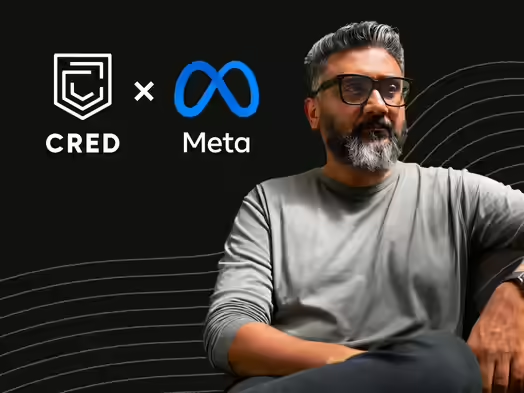
CRED: $900 Million from Meta
In the largest deal of the month, fintech platform CRED raised $900 million** in a Series H round led by **Meta**, marking one of the biggest startup investments by the social media giant in India . The round valued CRED at a **post-money valuation of $4.5 billion .
The investment was structured as a combination of primary and secondary share purchases, with Meta joining as a minority investor . In a significant leadership transition, founder Kunal Shah stepped down as CEO to join Meta’s global leadership team, with Miten Sampat appointed as interim CEO .
CRED processes over 40% of India’s credit card bill payments and has 17 million monthly active members, with its lending business managing ₹24,000 crore ($2.5 billion) in assets . The fresh capital will be used to accelerate growth and strengthen its position across payments, lending, insurance, wealth, and lifestyle segments.
Sarvam AI: $234 Million at $1.5 Billion Valuation
Bengaluru-based sovereign AI startup Sarvam raised **$234 million** in the first close of its $300 million Series B round at a post-money valuation of $1.5 billion**, making it one of the largest funding rounds for an Indian AI startup . **HCLTech** invested **$150 million as the lead strategic investor, acquiring a 10.46% stake, with participation from Bessemer Venture Partners and continued support from Khosla Ventures and Peak XV Partners .
Sarvam’s models are scaling rapidly :
- 10 million daily API calls – tripling in three months
- 2 million daily interactions – doubling in two months
- 35 million+ pages digitised through its Vision model
- 17 million farmers reached via multilingual voice agents for the Ministry of Agriculture
- 45 million policyholders supported for a leading insurer
“We are clear that research-led innovation to create AI that works at India’s scale is a very large opportunity. That means models that understand our voices, read our documents, and serve intelligence at a cost every enterprise and government can afford.” – Pratyush Kumar, Co-founder, Sarvam
📊 June Funding by the Numbers
| Metric | Value |
|---|---|
| Total June Funding | $1.91 billion |
| Year-on-Year Growth | 91% |
| Late-Stage Share | 65.1% |
| Early-Stage Share | 30.7% |
| Seed-Stage Share | 4.2% |
📈 H1 2026 Context: Bigger Cheques, Fewer Deals
June’s rebound contributed to a broader H1 2026 trend. Indian tech startups raised $7.2 billion – a 12% year-on-year increase – but the number of funding rounds declined sharply by 43% . This reflects a structural shift where investors are deploying larger cheques into fewer, higher-conviction deals.
- Five new unicorns emerged, with AI startups Neysa and Sarvam achieving unicorn status in under three years – significantly faster than the 8-12 years taken by others
- 13 tech IPOs were completed, up from 12 in H1 2025
- Average time from first funding to IPO dropped to 8.1 years, from 14.5 years earlier
- Three mega deals – CRED ($900M), Nxtra ($710M), Neysa ($600M) – accounted for 31% of all capital
The shift toward AI infrastructure, deep-tech, and enterprise software reflects a maturing investment landscape where capital increasingly flows to startups with defensible technology moats .
🔮 What This Means for the Ecosystem
June’s funding momentum could set the tone for the second half of 2026. The concentration of capital in mega rounds – CRED and Sarvam accounted for over 50% of June’s total – indicates that investors are writing bigger cheques into fewer, high-conviction opportunities rather than spreading capital across a broad set of startups .
Early-stage funding remains under pressure, with first-time funded startups declining 31% in H1 2026 . However, the strong performance of AI and infrastructure startups suggests that India’s innovation economy is evolving from consumer-led growth to deep-tech and enterprise-driven scalability.
As Neha Singh, Co-founder of Tracxn, noted: “These transactions suggest that investors are increasingly prioritizing domain-specific and application-driven innovation over broad, horizontal technology propositions” .