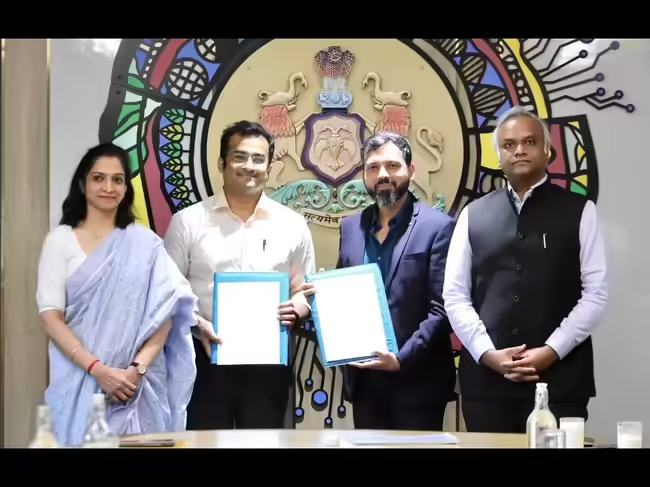
SatLeo Labs Raises $2.2 Million Led by Unicorn India Ventures to Advance Thermal Satellite Mission
When Shravan Bhati was working on a digital agriculture project in 2019, he encountered a frustrating problem: the temperature data available to him was too coarse and infrequent to be useful. He brought this to the attention of Dr. Ranendu Ghosh, a former ISRO scientist heading a government committee overseeing the project.
The two realised that accurate, high-resolution thermal data could solve problems far beyond agriculture—from detecting greenhouse gas emissions to mapping urban heat islands and predicting crop yields with far greater accuracy. That realisation, born from a practical fieldwork challenge, led to the founding of SatLeo Labs in 2023 .
Now, that vision has attracted significant investor backing. The Ahmedabad-based spacetech startup has raised $2.2 million in a seed funding round led by Unicorn India Ventures, taking its total funding to $5.5 million to date . The round also saw participation from existing investors Merak Ventures, Java Capital, IIMA-CIIE, and deep-tech investor Manish Gandhi .
The Numbers: From Pre-Seed to Seed
SatLeo Labs has demonstrated impressive growth across multiple dimensions over the past year:
| Metric | Value |
|---|---|
| Total Funding | $5.5 million (pre-seed + seed) |
| Latest Round | $2.2 million seed led by Unicorn India Ventures |
| LOI Pipeline | $42+ million (up from $15 million within a year) |
| Citizens Impacted (Pilots) | 400,000+ |
| Payload Development Time | 6–8 months (with IN-SPACe support) |
| Satellite Constellation | 12 microsatellites planned |
| Imaging Resolution | 5m thermal, 2.5m electro-optical |
| Revisit Frequency | Twice daily |
| Team Size | ~20 employees |
The company has built a strong commercial pipeline, with Letters of Intent (LOIs) growing from approximately $15 million to over $42 million within the year, reflecting strong market demand for SatLeo’s space-based thermal intelligence solutions .
The Technology: Dual-Band Thermal Imaging from LEO
SatLeo Labs is building a multi-spectral satellite constellation that combines thermal (infrared) and visible imaging to deliver high-resolution Earth observation data from Low Earth Orbit (LEO) .
The company’s satellites capture data in two infrared bands:
| Band | Application |
|---|---|
| Mid-Wave Infrared (MWIR) | Urban heat islands, defence surveillance, industrial zone monitoring, forest fire detection |
| Long-Wave Infrared (LWIR) | Land surface temperature, agriculture, environmental monitoring |
The constellation is designed to provide sub-10-metre resolution thermal imagery with twice-daily revisit frequency—a dramatic improvement over current publicly available thermal data, which typically offers 300-metre resolution every 18–21 days .
The company’s first experimental payload, named TAPAS-1 (Thermal Access Platform for Analytics and Solution)—which means “heat” in Sanskrit—has completed testing and calibration . The payload is designed to provide 5-metre resolution thermal imagery and 2.5-metre resolution electro-optical imagery .
The IN-SPACe Advantage: Building in 6 Months
One of SatLeo’s most remarkable achievements is its development speed. According to CEO Shravan Bhati, the company has been able to build its payload in six to eight months—a timeline that would be impossible without institutional support .
The key enabler is IN-SPACe (Indian National Space Promotion and Authorisation Centre), India’s single-window agency for private space activities. SatLeo is incubated at IN-SPACe, which provides access to sophisticated testing facilities, expert scientists and engineers, and a supportive regulatory environment .
Bhati explains the significance: “If you own a spacetech company, the facility itself will cost around ₹15-20 crore and you will have to raise funding just to get started. With IN-SPACe supporting us, we were able to bypass that problem completely as the facilities were already available. They also provide people during testing, and the expert-led environment is a major advantage” .
For technologies not available at IN-SPACe, the startup heads to the Space Applications Centre: ISRO Bopal Technical Campus, where the government, through IN-SPACe, provides the company the opportunity to rent required facilities .
Real-World Impact: Pilots in Tumakuru and Ahmedabad
SatLeo has already translated its technology into real-world deployments through commercial pilot projects.
Tumakuru, Karnataka:
In collaboration with the Tumakuru City Corporation, SatLeo is conducting thermal mapping of a 40-acre unmanaged waste dump to identify urban heat islands and detect hazardous greenhouse gases like methane, sulphur dioxide, and carbon dioxide . The central government has advised municipalities to monitor air pollutants around solid waste dumps, but many have not conducted them due to lack of technology. SatLeo is filling that gap .
Ahmedabad, Gujarat:
The company has also undertaken urban heat island and air-pollution monitoring initiatives with the city of Ahmedabad, impacting more than 400,000 citizens .
Rajasthan:
The startup has signed an MoU with the Rajasthan government for an undisclosed project .
International:
SatLeo is in talks with Dubai Municipality and undisclosed bodies in Saudi Arabia to solve heat island problems in the region .
The Market Opportunity: Why Thermal Intelligence Matters
Accurate thermal imagery is becoming more important than ever because of climate change. As Bhati notes, “Temperature and heat is changing the entire world and changing our behavior” .
Government agencies and employers need to know where and when it is unsafe to perform construction or farm work. But measurements for an entire city are not useful, since temperatures vary dramatically from residential areas and parks to industrial centres or densely populated urban areas .
By providing high-resolution thermal data, SatLeo enables:
| Sector | Application |
|---|---|
| Agriculture | Early detection of water stress and disease, yield prediction (up to 35% higher accuracy) |
| Urban Planning | Mapping urban heat islands, identifying cooling infrastructure needs |
| Disaster Management | Early warning for forest fires, monitoring landfill emissions |
| Energy | Detecting overheating transformers and infrastructure before failure |
| Defence | Surveillance and target detection using thermal signatures |
Co-founder Urmil Bakhai notes that Earth Observation (EO) data is projected to exceed $700 billion by 2030, contributing $3.8 trillion to global GDP . Beyond economics, thermal EO can help cut 2 gigatonnes of GHG emissions annually and drive nature-positive action .
The Road Ahead: Experimental and Commercial Missions
SatLeo has a clear two-mission roadmap :
Experimental Mission (Q1 2026):
- Launch of the TAPAS-1 tech demonstrator
- Focus on agricultural applications—early detection of water stress and disease in broad-acre crops
- Resolution will be lower than the main mission but still refined compared to many competitors
Main Mission (Q4 2026):
- Launch of the first commercial satellite (130–150 kg)
- Kickstart of commercial data services across urban cooling, agriculture, and energy
- The company is in talks with ISRO for launch
Long-Term Vision (by 2028):
- Full constellation of 12 microsatellites
- Global coverage with twice-daily revisit
- API-first delivery of thermal analytics via subscription platform
The Team: From ISRO to Industry
SatLeo Labs was co-founded by a team with deep expertise across space technology, satellite engineering, and business development :
| Founder | Role | Background |
|---|---|---|
| Shravan Bhati | CEO | Satellite and geospatial specialist; digital agriculture project lead |
| Dr. Ranendu Ghosh | CTO | Retired ISRO scientist; former committee head for Gujarat government |
| Urmil Bakhai | CSO | Former business development head at Amnex Technologies |
The company has also brought in scientists and engineers from ISRO, leveraging India’s deep talent pool in space technology. Bhati notes that the team is always looking for “bright minds with expertise in physics and data science—a fairly rare combination” .
What This Means for India’s Spacetech Ecosystem
SatLeo Labs’ successful seed round carries several important signals for India’s spacetech landscape:
1. Thermal Intelligence Is a Recognised Commercial Category
The $42 million LOI pipeline demonstrates that government and corporate buyers are willing to pay for high-resolution thermal data—not just optical imagery. This validates a market segment that was previously underdeveloped.
2. IN-SPACe Incubation Works
SatLeo’s ability to develop its payload in six to eight months, rather than years, is directly attributable to IN-SPACe’s support. This model of public-private partnership is enabling a new generation of space startups to emerge.
3. The Transition from Development to Execution Is Underway
With TAPAS-1 at TRL-8 and a commercial satellite planned for Q4 2026, SatLeo is moving from the “build” phase to the “fly” phase—a transition where many spacetech startups falter.
4. Climate Applications Are Driving Commercial Demand
The pilots in Tumakuru and Ahmedabad demonstrate that municipal corporations—not just defence and agriculture clients—are willing to pay for thermal intelligence. As climate adaptation becomes a governance priority, this market will only expand.
The Final Word
SatLeo Labs’ $2.2 million seed funding round, led by Unicorn India Ventures, is a testament to the growing maturity of India’s spacetech ecosystem. The startup has demonstrated that thermal intelligence from space—processed through AI and delivered as actionable insights—has real-world applications that municipalities, agriculture firms, and government agencies are willing to pay for.
With a team that brings together ISRO expertise and industry experience, a commercial pipeline that has grown to $42 million, and a flagship payload that has achieved readiness for launch, SatLeo is moving from the “promise” phase to the “execution” phase.
As global temperatures continue to rise and climate risks multiply, the demand for thermal intelligence will only intensify. SatLeo Labs is positioning itself to meet that demand—from space, with precision, and on a timeline that would have been unthinkable for an Indian startup just a few years ago.