PARAM Robot Debuts at India AI Impact Summit: A Quadruped Leap for Indian Robotics
Amidst the glitz of imported technology at global summits, a four-legged marvel stole the show—and it was Made in India.
At the India AI Impact Summit 2026 in New Delhi, while discussions swirled around foreign robotics solutions on display, one machine captured the imagination of attendees and proved that India’s deep-tech ecosystem has arrived: PARAM, a state-of-the-art quadruped robot developed entirely by a Bengaluru-based deep-tech team .
PARAM wasn’t just another exhibit. With live demonstrations of dynamic locomotion, onboard AI perception, and modular versatility, it stood as a powerful symbol of rising domestic capability in advanced robotics and hardware innovation—a counterpoint to debates over foreign tech dominance and a tangible validation of the Atmanirbhar Bharat vision in one of the most complex engineering domains .
What Is PARAM? A Made-in-India Robotics Marvel
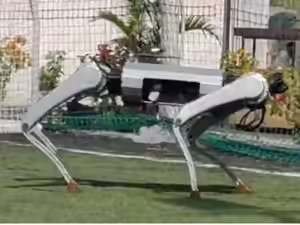
PARAM is a quadruped robot—a four-legged machine designed for agility, stability, and autonomy in unstructured environments. Unlike wheeled robots that struggle with uneven terrain, PARAM’s legs enable it to navigate the kinds of environments that humans and animals navigate naturally: stairs, rubble, slopes, and tight spaces.
But what truly sets PARAM apart is its comprehensive indigenization. Every critical component—from the design and electronics to actuators, perception stack, and control systems—has been developed in India by a dedicated Bengaluru-based team . This isn’t assembly of imported parts; this is true Indian R&D translating into a world-class product.
Key Capabilities Showcased at the Summit
During live demos at Bharat Mandapam, PARAM demonstrated capabilities that rival leading global quadruped platforms:
1. Dynamic Locomotion
PARAM’s mobility suite includes:
- Walking and trotting at variable speeds
- Climbing stairs with stability and precision
- Recovering from external pushes—maintaining balance even when perturbed
- Navigating uneven terrain including rocks, slopes, and obstacles
This level of dynamic stability requires sophisticated control algorithms and real-time sensor fusion—capabilities that only a handful of teams worldwide have mastered .
2. Onboard AI & Perception
PARAM isn’t just a remote-controlled machine; it’s an intelligent autonomous system featuring:
- Real-time SLAM (Simultaneous Localization and Mapping) for navigation in unknown environments
- Obstacle detection and avoidance using LiDAR and depth cameras
- Object detection for identifying specific targets or hazards
- Basic manipulation capabilities for interacting with the environment
All of this runs on edge AI processing, meaning PARAM makes decisions onboard without relying on cloud connectivity—critical for applications in remote or infrastructure-compromised locations .
3. Modular Design
One of PARAM’s most practical features is its modular architecture:
- Swappable payloads allow the same robot to perform different missions
- Quick-change interfaces for sensors, cameras, manipulators, or delivery modules
- Adaptable to diverse use cases without redesigning the base platform
4. Indigenous Components
PARAM’s development team prioritized domestic sourcing and manufacturing:
- Made-in-India motors and actuators—the “muscles” that power movement
- Indigenous sensors for perception and navigation
- Local compute hardware running homegrown software stacks
This reduces supply chain dependencies, enhances security, and aligns perfectly with the government’s Atmanirbhar Bharat (Self-Reliant India) initiative .
Why PARAM Matters: A Counterpoint to Foreign Tech Dominance
The debut of PARAM at the India AI Impact Summit carried significance far beyond the technical specifications. It arrived at a moment when the global robotics conversation is dominated by a few major players—primarily from the US and China—with products like Boston Dynamics’ Spot or Unitree’s robots often showcased as the gold standard.
PARAM proved that Indian innovation can compete at this level.
1. Cost-Competitive Excellence
While pricing details are yet to be announced, Indian-developed robotics platforms typically offer significant cost advantages over imported equivalents—without compromising on capabilities. This makes PARAM attractive for domestic applications and potentially competitive in global markets.
2. Sovereign Capability
For defense, disaster response, and critical infrastructure applications, relying on imported robots raises concerns about supply chains, software backdoors, and maintenance dependencies. PARAM offers a trusted alternative—developed in India, controlled by Indian entities, and customizable for Indian requirements.
3. Ecosystem Validation
PARAM’s success validates the broader Indian deep-tech ecosystem. The team behind it has leveraged growing institutional support including:
- IN-SPACe for space and defense applications
- DRDO collaborations for ruggedization and mission-critical requirements
- NIDHI grants from the Department of Science and Technology
- Upcoming deep-tech incentives from the government
As one summit attendee noted: “We’ve talked about Indian innovation for years. PARAM is the proof—walking, climbing, and perceiving right in front of us” .
Potential Applications: Where PARAM Can Make a Difference
PARAM’s combination of mobility, autonomy, and modularity opens up diverse applications across sectors:
1. Inspection & Surveillance
- Industrial plant inspections in hazardous environments
- Perimeter security for critical infrastructure
- Pipeline and tunnel monitoring
- Power grid and telecom tower inspections
2. Disaster Response
- Search and rescue in collapsed structures
- Hazardous material site reconnaissance
- Flood and earthquake damage assessment
- Delivery of emergency supplies to inaccessible areas
3. Defense & Security
- Reconnaissance in hostile terrain
- Perimeter patrol at sensitive installations
- Explosive ordnance disposal support
- Logistics assistance in challenging environments
4. Research & Education
- Robotics research platform for universities
- Algorithm development and testing
- STEM education and outreach
5. Commercial Applications
- Last-mile delivery in campus environments
- Warehouse automation for non-uniform terrain
- Agriculture monitoring in uneven fields
- Construction site progress tracking
The Team Behind PARAM
While the specific startup behind PARAM is still emerging from relative stealth mode, the Bengaluru-based deep-tech team brings together expertise from:
- Robotics research at leading Indian institutions
- Embedded systems development
- AI and computer vision engineering
- Motor control and actuation design
Their holistic approach—developing everything from the metal legs to the perception stack—demonstrates the depth of talent now available in India’s deep-tech ecosystem .
Supporting Ecosystem: India’s Robotics Momentum
PARAM’s debut didn’t happen in isolation. It reflects a broader surge in Indian robotics and hardware innovation:
Government Support
- IN-SPACe’s ₹6 crore AI seed fund for space-tech startups (announced just days earlier)
- DRDO collaborations for defense robotics applications
- NIDHI grants supporting hardware prototyping and incubation
- Upcoming deep-tech incentives expected in future policy announcements
Institutional Infrastructure
- IITs and IISc producing world-class robotics researchers
- Research parks and incubators supporting hardware startups
- Testing and validation facilities becoming more accessible
Market Demand
- Industry 4.0 adoption driving automation interest
- Defense modernization creating demand for indigenous solutions
- Disaster management agencies seeking advanced capabilities
- Private sector exploring robotics for efficiency and safety
Challenges Ahead: The Road to Scale
While PARAM’s debut is cause for celebration, the journey from impressive prototype to scalable product involves familiar challenges for Indian hardware startups:
1. Manufacturing Scale
Moving from lab-built units to production-scale manufacturing requires capital, facilities, and supply chain maturity. Component sourcing—even for indigenous designs—remains complex.
2. Talent Retention
Deep-tech robotics teams are in high demand globally. Retaining talent as the company scales requires compelling vision, culture, and compensation.
3. Market Education
Many potential customers still view robotics as experimental. Building trust through successful deployments takes time and patience.
4. Global Competition
Established players have head starts in brand recognition and customer relationships. PARAM will need to differentiate clearly on cost, customization, and local support.
The Bigger Picture: India’s Deep-Tech Rising
PARAM’s debut at the India AI Impact Summit 2026 is part of a larger narrative playing out across the Indian innovation landscape:
- Sarvam AI unveiled its 105B-parameter foundation model, outperforming global giants on Indic benchmarks
- Yotta announced a $2 billion GPU supercluster with NVIDIA Blackwell Ultra chips
- IN-SPACe launched dedicated funding for space-AI convergence
- NVIDIA partnered with AIGI to catalyze 10,000+ AI builders
- PM Modi unveiled the MANAV Vision for ethical, inclusive AI
Each of these developments reinforces the others. Compute infrastructure enables model training. Model training creates demand for robotics AI. Robotics AI requires hardware innovation. Hardware innovation attracts talent and investment. And all of it is guided by a policy framework that prioritizes sovereignty, inclusion, and ethical development.
PARAM is proof that this virtuous cycle is now producing tangible, world-class products.
Conclusion: Walking Tall for Indian Innovation
As the India AI Impact Summit 2026 draws to a close, PARAM stands as one of its most memorable symbols. In a week of announcements about compute clusters, foundation models, and policy frameworks, this four-legged robot reminded everyone that Indian innovation can walk, climb, and perceive—and do it with components designed and built at home.
For the Bengaluru team behind PARAM, this debut is just the beginning. For the Indian robotics ecosystem, it’s validation that the path they’re on leads to global competitiveness. And for the world, it’s a signal: when it comes to deep-tech innovation, India is no longer just following—it’s leading.
“This moment at the summit was more than a demo,” one attendee reflected. “It was a statement: India’s deep-tech ecosystem is delivering tangible, world-class robotics solutions right here at home.”
Watch this space—and these four legs—for more breakthroughs to come.