India’s Fintech Ecosystem Shifts Toward Strategic Exits
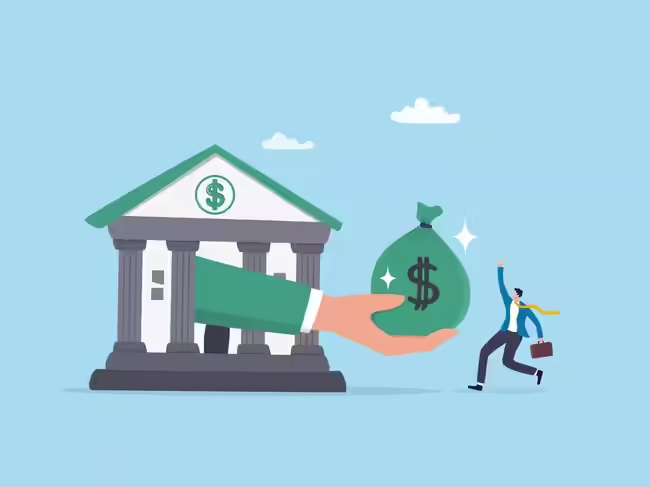
India’s fintech ecosystem is undergoing a fundamental transformation. The era of rapid, unchecked growth is giving way to a more mature phase defined by strategic acquisitions, secondary sales, and rigorous IPO preparation. This shift is creating diverse liquidity pathways for founders and investors—a sign of a maturing market rather than a slowdown .
📊 The IPO Market Becomes More Selective
For years, the Indian startup ecosystem viewed the Initial Public Offering as the ultimate validation milestone. That aspiration remains intact. However, the environment in which companies approach public markets has changed significantly .
India entered 2026 with one of the largest IPO pipelines in its history—more than 190 companies reportedly preparing to go public, collectively targeting over ₹2.5 lakh crore in fundraising. Yet, listing activity has moderated amid global volatility, geopolitical uncertainty, and selective investor sentiment .
What has changed: Market participants are increasingly conscious of valuation discipline, governance standards, and post-listing performance, rather than simply rewarding growth narratives. For fintech companies, this shift is creating a new reality where liquidity can arrive through multiple routes, not just IPOs .
🤝 Strategic Acquisitions Surge
The trend of strategic acquisitions in India’s fintech space is unmistakable. According to Tracxn data, India’s BFSI sector recorded 54 acquisitions in FY26, compared with 36 in FY25—a 50% year-on-year increase .
Recent notable deals include:
Industry executives say the revival reflects both a maturing startup ecosystem and a growing appetite among strategic buyers looking to acquire capabilities rather than build them from scratch .
As one executive noted, “The interest among strategic acquirers in new-age consumer brands is at an all-time high” . “We’re seeing a renewed willingness among both global and Indian buyers to invest in or acquire these companies.”
💰 Secondary Sales Gain Traction
Secondary transactions are emerging as an important liquidity route, allowing early investors, employees, and founders to realise partial gains without requiring companies to enter public markets prematurely .
Prominent secondary deals in 2026 include:
- Meta’s investment in CRED: The $900 million funding included approximately **$400 million in secondary share sales**, allowing early investors to partially exit . The deal is expected to trigger one of the largest employee liquidity events in India’s startup ecosystem .
- Groww: Early investors Peak XV, Ribbit Capital, and Y Combinator sold a combined 4.71% stake for approximately ₹5,326 crore via bulk deals .
- IDfy: The regulatory technology platform raised ₹476 crore in a Series F round with a secondary component providing liquidity to early investors and employees .
- Kissht: Founders acquired shares worth over ₹400 crore through secondary transactions ahead of the company’s IPO .
🔮 A Maturing Ecosystem
This shift should be viewed as a sign of ecosystem sophistication. The presence of multiple liquidity options reduces dependence on market timing and allows businesses to choose the pathway that best aligns with their long-term objectives .
What this means for the ecosystem:
- Founder liquidity – secondary sales allow early entrepreneurs to realise gains while staying engaged
- Investor confidence – exits validate long-term bets on India’s digital finance sector
- Consolidation wave – acquisitions strengthen larger players while integrating innovative startups
- Global competitiveness – successful exits attract more international capital and partnerships
“India’s fintech story is not entering a period of slowdown; it is entering a period of maturity,” wrote Sagar Agarwal, Managing Partner at Beams Fintech Fund . “The next generation of fintech leaders will likely be built not only on innovation and growth, but also on governance, profitability, and strategic flexibility.”
The next generation of exits may emerge through a combination of IPOs, strategic transactions, and secondary liquidity, rather than a single dominant pathway. That may make the journey less linear than before, but it will also make the ecosystem stronger, more resilient, and ultimately more valuable .