
The Tide Has Turned: How 2025 Marked the Resilient Comeback of India’s Startup Ecosystem
After navigating a prolonged period of valuation corrections and capital caution, India’s startup ecosystem has staged a powerful comeback in
Read More
After navigating a prolonged period of valuation corrections and capital caution, India’s startup ecosystem has staged a powerful comeback in
Read More
The closure of prominent startups like Hike and the operational scaling back of BluSmart in 2025 serve as a sobering
Read More
As 2025 draws to a close, India’s startup ecosystem stands transformed. The breakneck, hype-driven growth of past years has given way to a more deliberate, resilient, and mature phase. The narrative has shifted from chasing unicorns at any cost to building sustainable ventures that solve hard problems, leveraging deep technology, and fostering inclusive growth. This evolution—marked by disciplined capital, AI-led innovation, and a powerful geographic and sectoral diversification—positions India not just as a large market, but as a foundational player in the global technology landscape of the future.
Read More
Recent trends reveal a seismic shift in India’s startup narrative: the center of gravity is moving beyond the metropolitan hubs of Bengaluru, Mumbai, and Delhi-NCR. In late 2025, a vibrant, decentralized innovation ecosystem is taking root, driven by ambitious state-level policies and funding that is empowering entrepreneurs in Tier-2 and Tier-3 cities to build globally relevant solutions. This state-led surge, targeting diverse sectors from agri-tech to deep-tech, is transforming India’s innovation map and laying a resilient foundation for sustained, inclusive growth under the Atmanirbhar Bharat and Digital India visions.
Read More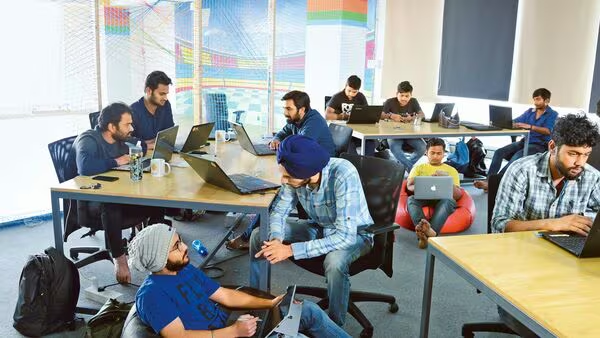
In a clear sign of a market coming of age, an estimated 730 Indian startups closed their doors in 2025. While this number represents thousands of entrepreneurial journeys concluding, it marks a significant and positive trend: a notable decline of roughly 20-30% from the annual closure rates of 900-1,000+ seen in previous years. This lower count is not a sign of stagnation but of growing strength. It reflects a more resilient ecosystem where better-prepared founders, more selective capital, and robust support systems are helping startups navigate challenges and either find a path to viability or exit more gracefully.
Read More
In a significant move to consolidate its leadership in the booming artificial intelligence market, NVIDIA has entered into a major licensing partnership with AI inference chip startup Groq, securing access to its pioneering Language Processing Unit (LPU) architecture. The deal, announced on December 26, 2025, goes beyond intellectual property, as NVIDIA will also absorb Groq’s founder and CEO, Jonathan Ross, along with key members of his engineering team. This strategic acquisition of both technology and talent underscores a pivotal moment in the AI hardware landscape: the intensifying battle for dominance not just in AI training but, critically, in the high-stakes, real-time world of AI inference.
Read More
In a significant move for India’s electric mobility infrastructure, Bengaluru-based deep-tech startup Naxatra Labs has raised $3 million in a funding
Read More
In a powerful affirmation of India’s ascendant role in the global technology landscape, San Francisco-based AI DevOps leader Harness is launching a massive expansion of its India operations, with plans to hire over 1,000 engineers in the coming years. This strategic move, centered on the company’s Bengaluru R&D hub, is a direct response to a seismic shift in software development: the explosion of AI-generated code. Founded by Indian-American serial entrepreneur Jyoti Bansal, creator of the multi-billion dollar success AppDynamics, Harness is positioning its Indian team not as a support center but as the core engine for its next phase of AI innovation.
Read More
The technology industry has always been a powerful engine of wealth creation, but the current Artificial Intelligence (AI) revolution is accelerating this process at an unprecedented rate. A new cohort of founders, many still in their twenties, has reached billionaire status not over decades, but in a handful of years. This phenomenon is fueled by a potent mix of technological democratization, massive capital influx, and a market that rewards foundational innovation in the AI stack. Their stories highlight a seismic shift where age and traditional experience are less relevant than vision, technical depth, and the ability to execute at the frontier of AI.
Read More