
Startup Spotlights

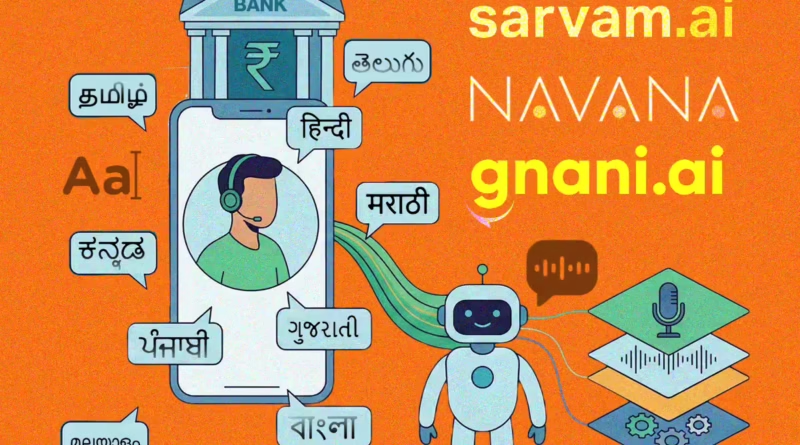
Beyond the LLM Hype: Why India is Poised to Become the World’s Capital of Applied AI

For the past two years, the global artificial intelligence conversation has been dominated by a single narrative: the race to build the biggest, most powerful foundational model. From OpenAI’s GPT-4 to Google’s Gemini and Meta’s Llama, the tech world has been obsessed with the “engines”—the massive compute clusters, the billions of parameters, and the cutting-edge research papers emerging from Silicon Valley.

Read More

The Pioneer’s Paradox: From Delivering Biryani to Optimizing Brains

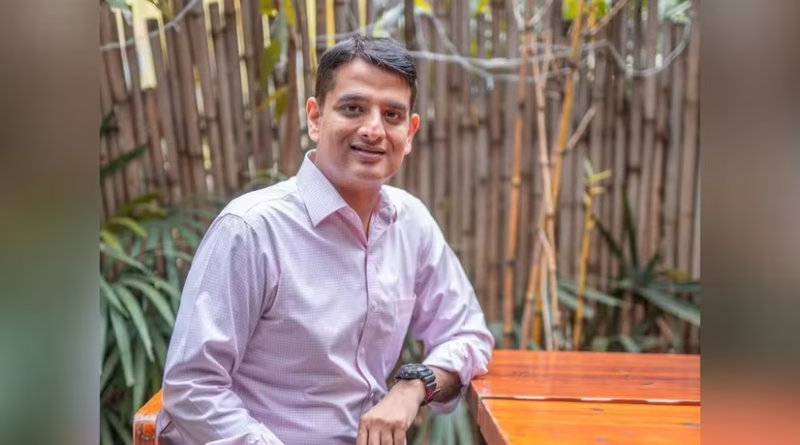
When you hear the name Deepinder Goyal, your mind likely jumps to late-night food cravings, lightning-fast deliveries, and the ubiquitous Zomato logo. As the founder of one of India’s most disruptive consumer internet companies, Goyal has been synonymous with the hyperlocal revolution. But if the startup ecosystem has taught us anything, it’s that the best founders are never satisfied with the status quo.

Read More

AI in Indian Fintech: From Buzzword to Core Engine Driving the Next Growth Phase

Recent developments across the ecosystem show how quickly AI is being woven into financial services startups, delivering real improvements in efficiency, security, and user experience. From customer support chatbots to fraud detection algorithms, from credit underwriting to regulatory compliance, AI is fundamentally reshaping how financial services are delivered to India’s 1.4 billion people .

Venture funds are clearly voting with their capital: Lightspeed reports approximately 60% of its recent Indian portfolio deals are in applied AI, with fintech being one of the heaviest verticals . Peak XV, Accel, and General Catalyst (with its $5 billion India pledge) continue to write large checks into AI-native or AI-transformed financial platforms .

Read More

India’s ‘Bodyguard Satellites’: Private Startups to Protect National Assets in Orbit

According to multiple reports, security agencies are in advanced discussions with private companies to build satellites capable of escorting, protecting, and countering orbital threats to high-value Indian spacecraft . The initiative represents a significant milestone in India’s evolving space policy, shifting from purely government-led missions to deep public-private collaboration in national security applications .

Private players are now being trusted with sensitive, high-stakes defence-adjacent technologies, reflecting growing confidence in the domestic New Space ecosystem. The first test satellite is expected to launch in the first half of 2026, with additional launches planned by the end of this year or early next year .

Read More

Inside Temple’s Controversial Hiring Criteria: Why Deepinder Goyal Wants Engineers Who Are Also Athletes

Temple, which is building a cutting-edge wearable to track cerebral blood flow and other biomarkers for elite athletes, is recruiting engineers with an unusual twist: candidates must meet specific physical fitness benchmarks, including body fat percentages, alongside strong coding skills .

Those who don’t meet the fitness criteria can still join but will remain on probation until requirements are met. The move has ignited conversations about inclusivity, discrimination, corporate culture, and what it means to build products for high-performance users .

Read More

Indian Founder Forced to Leave Sweden Sparks Debate: Is Europe Losing Global Talent to Bureaucracy?

Abhijith Nag Balasubamanya, founder and CEO of Hydro Space Sweden AB—an agri-tech startup focused on microgreens production to enhance local food security—announced on LinkedIn that he is being forced to leave the country by the end of February 2026. He has sold the company and is returning to India, describing the situation as an “eviction” rather than a voluntary exit .

In a detailed, widely shared post that has resonated across global founder communities, Abhijith accused Sweden’s Migration Agency (Migrationsverket) of operating a “hostile,” “dysfunctional,” and increasingly “xenophobic” system toward foreign entrepreneurs .

Read More

India’s Startup Layoffs Cross 4,500 Since July 2025

India’s startup ecosystem is navigating a tough phase of recalibration. According to aggregated data from industry trackers, media reports, and startup disclosures, over 4,500 employees have been laid off across various companies since July 2025.

This wave of job cuts reflects ongoing cost optimization, restructuring, and a sharper focus on profitability and sustainable unit economics amid tighter global funding conditions, slower growth in certain consumer segments, and rising operational costs .

Read More

CoRover Launches Kanha Ji: India’s First Voice-First, Screen-Free AI Companion for Children Powered by BharatGPT

In a landmark move for India’s voice AI ecosystem, CoRover—the company behind the indigenous BharatGPT platform—has unveiled Kanha Ji, a screen-free, voice-first AI companion designed specifically for early childhood development.

Launched on February 26, 2026, Kanha Ji leverages CoRover’s homegrown BharatGPT (their sovereign, multilingual large language model) to create a safe, engaging, and culturally rooted learning buddy that speaks naturally in Hindi, English, and regional Indian languages .

Read More

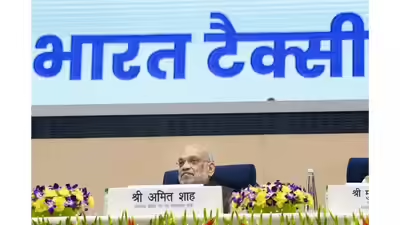
Bharat Taxi Launches: Amit Shah Inaugurates India’s First Driver-Owned Cooperative Mobility Platform

In a landmark move that could redefine the gig economy, Union Home Minister Amit Shah today inaugurated Bharat Taxi—a revolutionary cooperative mobility startup built on a driver-owner model that empowers cab drivers to become co-owners with an entry point of just ₹500.

Launched under the cooperative framework and backed by government initiatives for inclusive growth, Bharat Taxi flips the traditional ride-hailing model on its head. Instead of drivers working purely for corporate platforms, earning a fixed or commission-based share, Bharat Taxi allows drivers to invest a nominal amount to gain ownership stakes in the cooperative .

This initiative represents a fundamental shift in power dynamics within India’s gig economy—moving profits and decision-making from large corporations to the workers themselves .

Read More