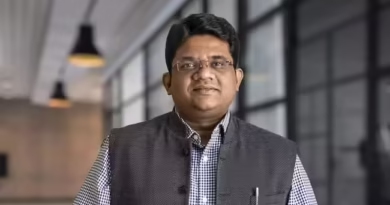
The Tractor That Could Change Everything: Why This Bengaluru Engineer Said No to Tesla

It started with a question nobody in the room could answer. A group of friends from Bengaluru had driven out to visit a farm. At some point, someone asked something almost embarrassingly simple: farm electricity in India is free, so why does every tractor in the country still run on diesel?
Anoop Srikantaswamy couldn’t stop thinking about it on the drive back. That conversation eventually became Moonrider—a Bengaluru startup now trying to do for tractors what Tesla did for cars, except the roads here are muddy fields, not highways, and the customer isn’t a tech enthusiast with disposable income. It’s a farmer counting every rupee spent on diesel.
The Engineer Who Walked Away
By any conventional measure, Srikantaswamy had already made it. He trained as a mechanical engineer, sharpened his management chops at Cornell, and spent over a decade inside some of the biggest names in the auto industry—starting at Toyota Kirloskar Motor, followed by more than nine years at Volvo Group, a stint at Accenture, and finally a leadership role heading product development at Ola.
He could have joined Tesla. Instead, in 2023, he walked away from the corporate ladder entirely. He wasn’t alone. Ravi Kulkarni, a former colleague from his Volvo days, co-founded Moonrider with him. Together they picked a problem that most of the EV industry had quietly ignored: India sells more tractors than any nation on earth, yet almost none of them are electric.
Designed Differently for India’s Farms
Building an electric tractor isn’t just a smaller, muddier version of building an electric car. Tractors work in dust, heat, and constant vibration for hours at a stretch, often far from any reliable power supply. A battery that overheats or degrades quickly is worse than useless to a farmer whose entire season depends on the machine running.
Moonrider’s answer was to design the vehicle from the ground up—rather than retrofit an existing tractor with a battery. The company built its own battery pack in-house, along with a patented refrigerated thermal management system built specifically for tractors. The result is a machine that can run for six to seven hours on a single charge, with rapid charging taking about 40 minutes.
The tractors come in 27 HP, 50 HP, and 75 HP variants, with features like over-the-air software updates and app-based monitoring—borrowed straight from the EV car playbook. The engineering team reportedly took a working prototype from a blank sheet to a functioning machine in under 40 days.
The Economics That Matter
Perhaps the most striking detail is the price. Unlike most EVs that cost 1.5 to 2 times their internal combustion counterparts, Moonrider has achieved price parity with diesel tractors. A ₹21 lakh Moonrider tractor costs the same as a comparable John Deere.
But the real savings come from operations. Farmers spend ₹1,000–1,500 per hour on diesel for a 75 HP tractor. With Moonrider, it costs about ₹300 per hour. The company claims its tractors can reduce the cost of land preparation and farming activities by up to 80%.
What Investors Are Betting On
Moonrider has raised approximately $8.4 million across seed and Series A rounds, with the Series A led by deep-tech investor pi Ventures, backed by Singularity AMC, AdvantEdge Founders, and Micelio Fund. The capital is being deployed to transition from pilot operations to commercial deployment—the company has already begun deliveries and signed commitments for nearly 6,000 tractors over the next three years.
Instead of traditional dealerships, Moonrider is partnering with large rental fleet operators—described as “Uber for tractors”—to drive early adoption. The company has already signed one partnership in East Africa and three in India.
A Different Kind of Innovation Story
Bengaluru has no shortage of engineers who left big jobs to build electric scooters, electric cars, or EV charging networks. Srikantaswamy went the other way—toward a market that rarely makes it into startup pitch decks despite touching the livelihood of hundreds of millions of Indians.
His bet is a quiet one: that the next major shift in Indian mobility won’t happen on an expressway showroom floor, but on a farm, where a machine that used to run on diesel might soon run on nothing but the free electricity that started this whole story in the first place.