Mission Aagaman to ‘Made in Bharat’ Chips: India’s Space Revolution Accelerates
On July 18, 2026, a seven-storey rocket lifted off from Sriharikota, carrying not just satellites but the weight of a nation’s ambition. Within 15 minutes, the Vikram-1 had injected its payloads into a 450-kilometre orbit, making India only the third country to achieve orbital launch capability through private enterprise . The moment was captured in a simple yet powerful declaration from Skyroot Aerospace: “Hello space, we have arrived!” .
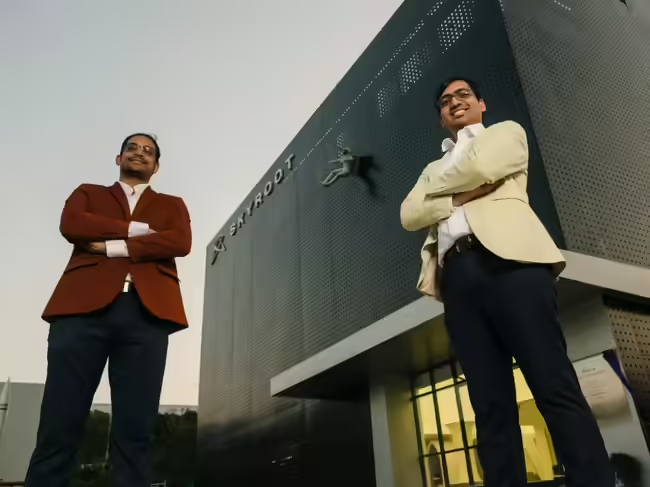
This success is the culmination of a journey that began in 2018, when a small team of former ISRO engineers and entrepreneurs founded Skyroot Aerospace . At the time, India’s space sector was still largely a government monopoly. The liberalisation of 2020 changed everything, opening the doors for private companies to build rockets, satellites, and launch services . Now, with a $1.1 billion valuation, Skyroot stands at the forefront of a new space economy .
The Vikram-1: Engineering India’s Cab to Space
Named after Vikram Sarabhai, the father of India’s space programme, Vikram-1 is designed as a cost-effective solution for the growing small satellite market . Standing about 22 metres tall, the rocket can carry payloads of up to 350 kilograms into low-Earth orbit . Its design incorporates several firsts for India: an all-carbon composite structure, three solid-fuel stages, and a liquid-fuel orbital adjustment module powered by a 3D-printed engine .
For Pawan Kumar Chandana, Skyroot’s co-founder and CEO, the vision is clear: “We have the capacity to build one rocket every month at our factory in Hyderabad” . The company plans to conduct more test flights before transitioning to routine commercial operations next year .
Semiconductor Sovereignty Takes Flight
Skyroot’s achievement is being matched by parallel progress in another critical frontier: indigenous semiconductor development. On July 28, just days after the Vikram-1 mission, Union Minister Ashwini Vaishnaw met with Skyroot’s founders and announced that India’s rockets will soon be powered by homegrown chips .
“‘Made in Bharat’ chips for our rockets… soon!” Vaishnaw posted on X, a statement that Skyroot welcomed with equal enthusiasm: “We look forward to the day India-built chips fly on our rockets” .
This commitment builds on significant progress already made. India has developed its first fully indigenous 32-bit space-grade microprocessor, VIKRAM3201, through a collaboration between ISRO’s Vikram Sarabhai Space Centre and the Semiconductor Laboratory (SCL) in Chandigarh . Unveiled at Semicon India 2025, the chip has been validated in space aboard the PSLV Orbital Experimental Module (POEM-4) and is designed to function under extreme conditions, withstanding temperatures from -55°C to 125°C .
A New Era for India’s Deep-Tech Ecosystem
The convergence of these developments—Skyroot’s private orbital success and the semiconductor push—signals a broader transformation in India’s innovation economy. The government’s India Semiconductor Mission, the Design Linked Incentive (DLI) scheme, and the liberalised space policy are building the infrastructure for deep-tech self-reliance .
The impact is already measurable. India’s space economy, currently valued at approximately $8 billion, is targeted to grow to $44 billion by 2033 . The private sector, once a peripheral player, is now expected to be the driving force in this expansion .
Prime Minister Narendra Modi, who met with Skyroot’s founders, described their achievement as “a defining moment in India’s space journey” . Their energy and ambition, he added, “reflect the vibrant spirit of our private space ecosystem” .
As India strengthens its position in the global space race, the path ahead is taking shape. The Vikram-1 has proven that India can build and launch orbital-class rockets. The VIKRAM3201 has shown that the country can design and fabricate space-grade semiconductors. The next step is to bring these capabilities together—a goal that is no longer a distant vision but a near-term reality.
For the young engineers, entrepreneurs, and dreamers watching from classrooms and laboratories across India, the message is clear: India’s space sovereignty is not just a government ambition—it is a mission being built by startups, powered by homegrown chips, and driven by a generation unwilling to wait.