
Yantur: A New Dawn for India’s Private Defence Propulsion
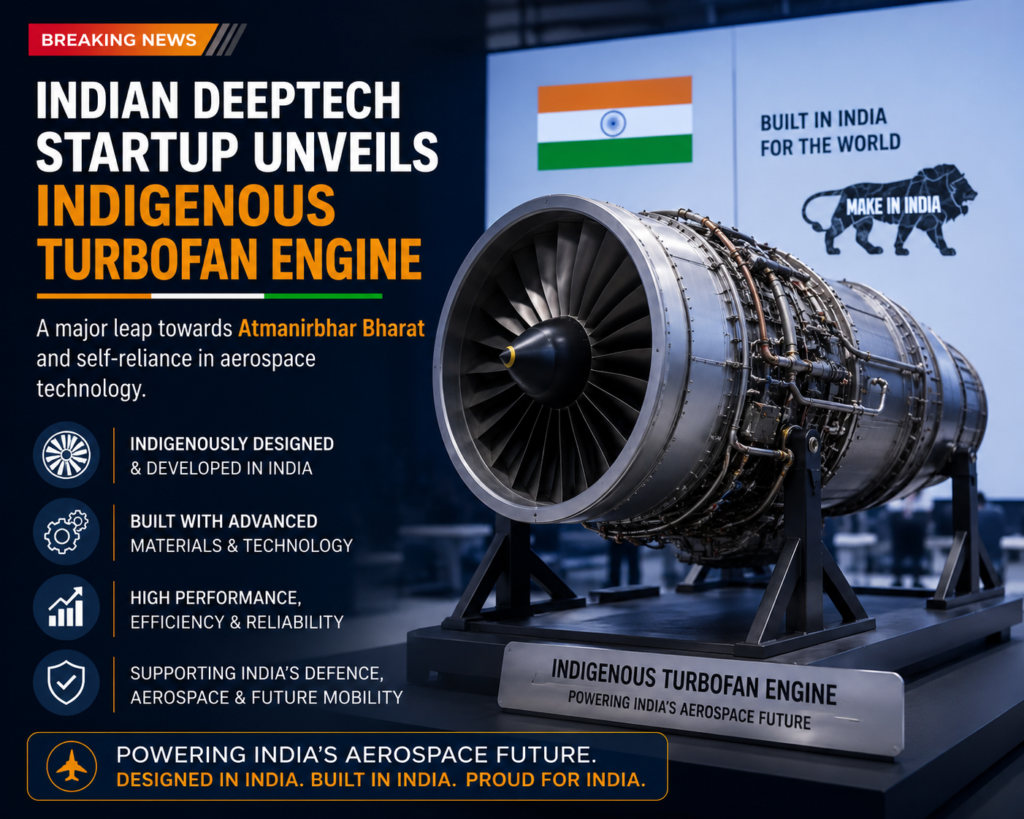
For decades, India’s quest for self-reliance in aerospace propulsion has been a story of ambition meeting formidable technical challenges. The Kaveri engine project, launched in the 1980s, struggled for years before being formally delinked from the Tejas fighter program in 2008 . Even state-owned Hindustan Aeronautics Limited’s (HAL) 25 kN HTFE-25 turbofan engine, initiated in 2013, remains in active development with its certification timeline now pushed to 2027-2028 . This is the demanding context in which a Hyderabad-based deeptech startup has announced a breakthrough that could rewrite India’s propulsion story.
The Yantur Programme
Paninian India Private Ltd has unveiled the Yantur 4.5 kN turbofan engine programme, which the company describes as India’s first private-sector turbofan development in its class . The engine is being developed to power the Svayatt L1, a long-range autonomous cruise missile platform designed to meet the operational requirements of the defence ministry’s Make-I programme for the Long-Range Land Attack Cruise Missile (LRLACM) .
What distinguishes the Yantur programme is its comprehensive scope. Five patent claims have been filed covering engine family architecture, combustor and diffuser-nozzle design, compressor technology, digital-twin health monitoring, and advanced manufacturing techniques . The programme has already completed its conceptual and detailed design phases and is now progressing towards subsystem testing, validation, and full engine certification .
Strategic Significance
The Yantur programme represents more than a single engine; it aims to establish a scalable family of propulsion systems. The same engine core can be expanded to produce 12.5 kN of thrust, sufficient to power future Collaborative Combat Aerial Vehicles (CCAV) . This modular approach is strategically significant, as it allows the company to address multiple defence requirements from a single foundational design.
Dr G. Gouda, former Group Director (Propulsion) at the Centre for Military Airworthiness and Certification (CEMILAC), who has overseen certification of numerous propulsion systems including the GE404 and GE414 for India’s LCA programme, described Yantur as “an important step towards establishing sovereign Indian capability in compact turbofan propulsion, engine controls, accessory systems, advanced manufacturing and propulsion-airframe integration” .
The Road Ahead
To accelerate the next phase of development, Paninian is initiating a $3 million funding round to support subsystem testing, engine validation, and integration with the Svayatt L1 platform . The company’s advisory team includes propulsion specialists and former certification authorities, bringing decades of experience to the programme .
However, aero-engine development is widely regarded as one of the most challenging fields in aerospace engineering, requiring sustained investment, specialised infrastructure, and years of iterative testing . The transition from a detailed design to a certified, flight-worthy engine will require rigorous ground testing, endurance trials, and eventual flight integration.
A New Chapter in Tech Sovereignty
Paninian’s Yantur programme is part of a broader ecosystem shift. Other private players like Nabhdrishti Aerospace are developing indigenous turbojet engines for UAV applications , and DG Propulsion has demonstrated dual-engine micro-turbojet tests . Even consumer-tech entrepreneurs are entering the fray—Deepinder Goyal’s LAT Aerospace has established a dedicated propulsion research centre in Bengaluru to develop indigenous gas turbine engines from scratch .
The Yantur programme is a symbol of what India’s private sector can achieve when given the opportunity to solve complex engineering challenges. If successfully certified, it could help simplify India’s defence supply chain, reduce reliance on foreign propulsion technologies, and support the country’s broader Aatmanirbhar Bharat and Make in India ambitions . For the young engineering team behind it, this is not just an engine—it is a step towards strengthening India’s sovereign defence manufacturing capabilities.