
Beyond Hardware: Lenovo’s Qira and the New Era of Sovereign Enterprise AI in India
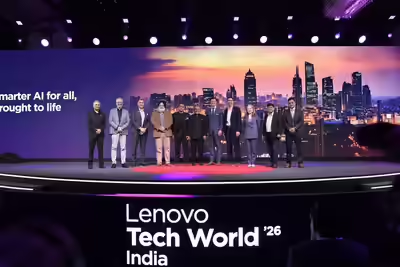
The recently concluded Lenovo Tech World ’26 India in New Delhi was more than a product showcase; it was a strategic declaration. The global technology giant chose India as the launchpad for Qira, its new ambient AI system built specifically for the Indian enterprise, signaling a profound shift in how global tech players now approach the Indian market. This is no longer about selling hardware configured elsewhere; it is about co-creating intelligent, sovereign, and deeply localized AI solutions for the world’s most dynamic digital economy.
Qira, an “always-on” digital assistant designed to seamlessly integrate across devices and enterprise data sources, embodies this new philosophy. By emphasizing hybrid deployment (on-premise, edge, cloud) and explicit alignment with India’s Digital Personal Data Protection (DPDP) Act, Lenovo is directly addressing the two most critical concerns of Indian CIOs: data sovereignty and operational resilience.
Decoding Qira: Ambient Intelligence for the Indian Enterprise
Qira represents a mature, pragmatic approach to enterprise AI. It’s not a flashy, standalone application but an intelligent layer designed to:
- Orchestrate Workflows: Automate routine, cross-departmental tasks, freeing human capital for higher-value strategic work.
- Unify Data Silos: Act as a smart intermediary, pulling insights from disparate databases and applications without requiring a complex, costly migration to a single platform.
- Respect Sovereignty by Design: Its hybrid architecture allows sensitive data to remain on-premise or at the edge, with only non-critical processing leveraging the cloud—a direct response to the DPDP Act’s emphasis on data localization and purpose limitation.
- Enhance Decision-Making: Provide contextual, real-time intelligence to managers and executives, embedded directly into their existing workflows and devices (AI PCs, edge servers).
The Strategic Shift: From “Made for India” to “Built with India”
Lenovo’s announcements at Tech World ’26 reflect a broader, more significant trend among global technology leaders:
- Localization is Non-Negotiable: Generic global AI models fail in India’s complex, multilingual, and regulation-dense environment. Qira’s development path, involving local engineers and enterprise pilots, acknowledges that effective AI for India must be trained on Indian data, for Indian problems, within Indian regulatory frameworks.
- The Rise of the Ecosystem Approach: Lenovo’s expanded startup collaboration programs—co-innovation labs, pilot access, and go-to-market support—recognize that agility and vertical expertise often reside in the startup community. This creates a symbiotic loop: global scale meets local innovation.
- Sectors as the New Segments: The focus on vertical solutions for banking, manufacturing, healthcare, and governance moves the conversation away from generic “digital transformation” to solving specific, high-impact operational challenges. This is where AI delivers tangible ROI.
The Opportunity for Indian Startups and Enterprises
This pivot creates a fertile ground for Indian players:
- For Startups: The invitation to partner with Lenovo is a potential accelerator for go-to-market. Access to a global enterprise sales channel, pilot programs with large customers, and co-development resources can compress years of growth into months. Startups building vertical AI solutions (e.g., in agri-tech, fintech compliance, or healthcare diagnostics) are the most natural partners.
- For Enterprises: The availability of a sovereign, hybrid AI stack like Qira, integrated with familiar hardware, reduces the friction and risk of AI adoption. It allows CIOs to experiment and scale AI initiatives within a compliant, secure, and manageable framework.
The Bigger Picture: India as the World’s Enterprise AI Lab
Lenovo’s focus on India is not incidental. The country offers a unique combination: a massive, digitally native market, a complex regulatory environment, a deep pool of AI talent, and an increasingly confident startup ecosystem. For global tech firms, succeeding in India requires solving problems of scale, diversity, and inclusion that are, in themselves, a blueprint for success in other emerging markets.
By embedding itself in this environment, Lenovo is effectively using India as a “living lab” to refine its enterprise AI offerings for the rest of the world. The solutions stress-tested in Mumbai or Chennai may well become the default for enterprises in Jakarta, Nairobi, or São Paulo.
The Hybrid, Sovereign, Collaborative Era is Here
Lenovo Tech World ’26 India was a powerful signal that the era of generic, cloud-only, foreign-first enterprise IT is receding. In its place, a new model is emerging: hybrid by design, sovereign by compliance, and collaborative by necessity.
For the Indian tech ecosystem, this represents a profound opportunity. It’s a chance to move beyond being a market for global products to becoming a co-architect of global enterprise AI. The infrastructure—from Qira to co-innovation labs—is now being laid. The onus is on Indian enterprises and startups to seize it, building the solutions that will power the next decade of Indian economic growth and, in doing so, shaping the future of work for the world.
Stay tuned to Startup Point for in-depth coverage of enterprise AI adoption, startup-corporate partnerships, and the evolution of India’s sovereign tech stack.