
Pixxel: From No Internet to NASA Contract
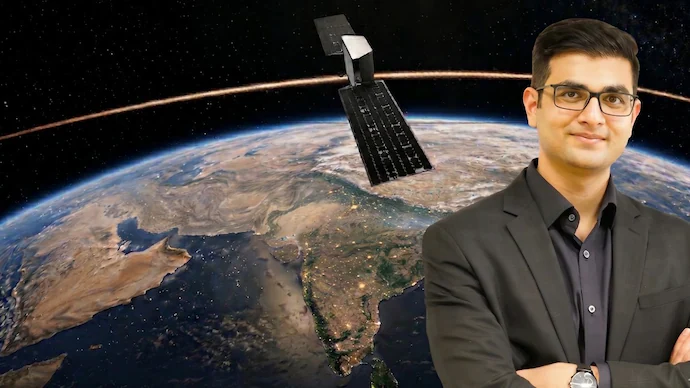
A founder who grew up without internet access has built Pixxel into a globally recognized space-tech startup, earning a prestigious NASA contract and inspiring the next generation of Indian innovators.
☕ From Coffee Plantations to SpaceX Headquarters
Awais Ahmed’s journey to building one of India’s leading space startups began without the advantages many students enjoy today. Raised in Aldur village in Karnataka’s Chikmagalur district—a region famous for its coffee plantations—he spent much of his childhood without internet access or a smartphone [12]. Instead, his father nurtured his interest in science by bringing home encyclopaedias that sparked his fascination with space.
That passion eventually led him to BITS Pilani, where he studied Mathematics and participated in Team Anant, the institute’s satellite initiative in collaboration with ISRO . He also led Hyperloop India during the SpaceX Hyperloop Pod Competition, gaining valuable engineering experience and a pivotal moment: standing inside SpaceX headquarters, surrounded by modern aerospace ambition, Ahmed realised his true calling .
“It was actually right there at the SpaceX headquarters that I decided I wanted to build something in space technology, one way or another.” — Awais Ahmed, Co-founder & CEO, Pixxel
🛰️ The Turning Point: Building Their Own Satellite Company
The turning point came during the IBM Watson AI Challenge in 2018. Alongside fellow student Kshitij Khandelwal, Ahmed needed hyperspectral satellite data for a crop-monitoring project but realised such data was unavailable. Rather than abandoning the idea, they decided to build their own satellite company .
Founded in 2019 using borrowed funds and modest personal savings [11], the company is now 5 years into a 50-year mission that seeks to help humanity eventually settle amongst the stars . The name “Pixxel” was chosen because pixels are the fundamental building blocks of any image—and since the company was imaging the planet through hyperspectral pixels, the name made sense .
🚀 Technology That Sees the Unseen
Pixxel’s satellites now provide advanced Earth observation by capturing more than 250 spectral bands, enabling industries to monitor crop health, detect methane leaks, identify illegal mining, and track pollution [6]. Unlike standard optical imagery that captures only what the human eye can see, hyperspectral sensors divide the electromagnetic spectrum into hundreds of narrow, continuous bands, allowing satellites to capture the unique chemical fingerprint of every object on Earth .
The upcoming Fireflies constellation features 5-metre resolution hyperspectral satellites—the highest-resolution hyperspectral satellites ever launched—with a 40 km swath width and 24-hour revisit frequency anywhere on the planet [6].
🏆 Global Recognition and NASA Contract
Pixxel’s achievements have received worldwide recognition. The company became the first Indian private space startup to secure a NASA contract, cementing its place in the global space industry . Under this contract, Pixxel will provide NASA and US government and academic partners with hyperspectral Earth observation data, supporting Earth science research and application activities [6].
The startup has also secured a contract from the National Reconnaissance Office (NRO) , a secretive US military division—one of very few companies based outside the US to achieve this .
Additional recognition includes:
- TIME named Pixxel among its Best Inventions in 2023
- World Economic Forum selected it as a Technology Pioneer in 2024
- iDEX Prime (Space) grant to manufacture miniaturized satellites for the Indian Air Force
- Google, Lightspeed, and Accenture among its investors [10]
📊 Impact on India’s Space Ecosystem
Pixxel’s journey reflects the rise of deep-tech startups in India, where founders are pushing boundaries in satellite imaging and AI-driven analytics. As one observer noted: “Only a handful of countries have a constellation of private commercial satellites and India is now one of them” . The startup now has a diverse client base of approximately 65 organizations, including industry leaders such as Rio Tinto and British Petroleum .
The company’s story is also playing out against the backdrop of a changing zeitgeist for private spacetech in India, where India’s national space programme has been boosted by the ingenuity and boldness of private entrepreneurs now getting involved at every corner of the space value chain . With the upcoming launch of six Fireflies satellites and plans to expand its constellation to 24 satellites [7], Pixxel is well-positioned to become a key player in the global space economy.
From no internet access to a NASA contract, Pixxel’s story is a powerful reminder that India’s startup ecosystem is not just growing—it’s inspiring a new generation to dream bigger and aim higher .