The Great Convergence: How India’s Startup Ecosystem is Forging a New Global Identity in 2026
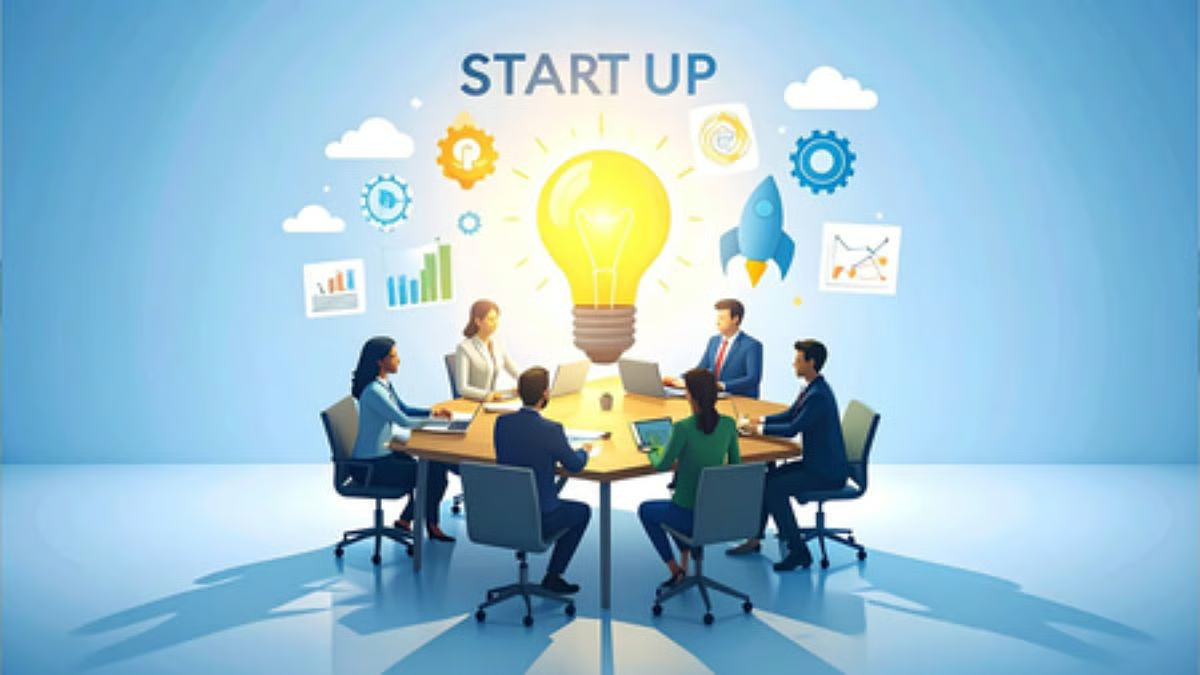
A powerful new narrative is crystallizing for India’s technology landscape in 2026. It’s a story not of isolated successes, but of a profound convergence—where private capital, public policy, foundational infrastructure, and global strategic interest are aligning to propel the ecosystem into a new league of maturity and impact. The explosive first week of funding, where startups raised $268.6 million, is not an outlier; it is the first visible tremor of this larger seismic shift.
The Pillars of a Maturing Ecosystem
This new phase is built upon four interconnected pillars that have solidified over the past year:
1. The Exit Flywheel is Spinning: The record 20 VC-backed IPOs in 2025 did more than create wealth; they activated a virtuous cycle of liquidity. Successful exits have returned capital to venture funds, empowering them to reinvest boldly in the next generation. They have also provided a tangible roadmap for founders, proving that building sustainably profitable companies in India can lead to prestigious public market success. This has fundamentally altered the founder-investor mindset towards unit economics and governance from day one.
2. Capital is Getting “Smarter” and More Strategic: The funding surge of early 2026 reveals a sophisticated capital apparatus. Investors are no longer spraying capital at buzzwords. The money is flowing toward execution-stage companies with proven models, like Pee Safe and Sukino, and increasingly, into deep, hard-tech infrastructure. Blackstone’s controlling stake in AI infrastructure startup Neysa is the archetype of this shift—global capital is no longer just betting on Indian consumers, but on India’s capacity to build and own the core technologies of the future.
3. The Infrastructure Leap: From Policy to Platform: The launch of Uttar Pradesh’s seven Centres of Excellence (CoEs) in AI, drones, and meditech exemplifies a critical evolution. State governments are no longer just offering tax breaks; they are acting as ecosystem architects, providing the physical labs, testing beds, and industry linkages that de-risk innovation for startups. This sub-national competition to build quality infrastructure decentralizes opportunity, moving the innovation engine beyond traditional metros and creating a distributed network of talent and entrepreneurship.
4. The Global Talent & Leadership Magnet: The strategic hiring of Microsoft veteran Irina Ghose by Anthropic to lead its India charge is a seminal event. It signifies that the world’s most advanced AI firms now view India as a strategic hub for both market and talent, requiring leadership with deep local enterprise expertise. This mirrors a broader trend where global corporations and investment firms are placing their most experienced executives in India, not to oversee back-office operations, but to lead global innovation and strategic bets from the ground.
The Convergence in Action
The interplay between these pillars creates a powerful, self-reinforcing dynamic. Consider the trajectory of a deep-tech startup:
- It can now be incubated in a state-funded CoE in Lucknow or Kanpur, accessing subsidized high-end lab equipment.
- It can then scale its compute needs on sovereign infrastructure like Neysa’s, ensuring data privacy and control.
- As it grows, it attracts growth capital from investors who have seen similar deep-tech bets pay off in public markets.
- Its success, in turn, attracts more global strategic players like Anthropic to partner, acquire, or compete, raising the bar for everyone.
- Finally, a profitable exit via IPO provides the liquidity to fund the next cycle.
The Emerging Identity: Sovereign Builders
This convergence is forging a new identity for Indian startups: Sovereign Builders. The ecosystem is moving beyond adapting global models for India (“India for India”) to building globally competitive, often foundational, technologies from India (“India for the World”). This is evident in sectors like AI infrastructure, spacetech, SaaS, and advanced manufacturing.
Challenges on the Horizon
This promising landscape is not without its tests. The ecosystem must navigate global macroeconomic volatility, the intense competition for seasoned talent, and the need for continuous regulatory agility to support rapidly evolving sectors like AI and blockchain. Ensuring that the benefits of this growth are widely distributed across regions and societal layers remains a crucial challenge.
Conclusion: A Defining Inflection Point
The signals from early 2026—the funding surge, the strategic acquisitions, the policy implementations, and the leadership appointments—collectively point to an inflection point. India’s startup ecosystem is transitioning from a high-potential, high-growth story to a mature, structurally sound, and globally integrated innovation economy. It is becoming a place where the world comes not just to sell, but to source, to build, and to bet on the future. The convergence is here, and it is reshaping India’s technological destiny on the global stage.