The $100 Million Question: Can Tech Fix the Trust Deficit at Home?
Every urban Indian household knows the dilemma. You need a reliable cook. Or a nanny who will genuinely care for your child. Or an elderly care attendant who shows up on time. The options are often limited to word-of-mouth referrals, unreliable local agencies, or the anxiety of hiring a stranger based on a brief interview.
The domestic services market in India is a paradox of scale and fragmentation. Estimated to be worth tens of billions of dollars annually, it remains one of the most unorganized, trust-deficient, and informal sectors of the economy. It is a market that desperately needs structure, but structure has been elusive.
Until now.
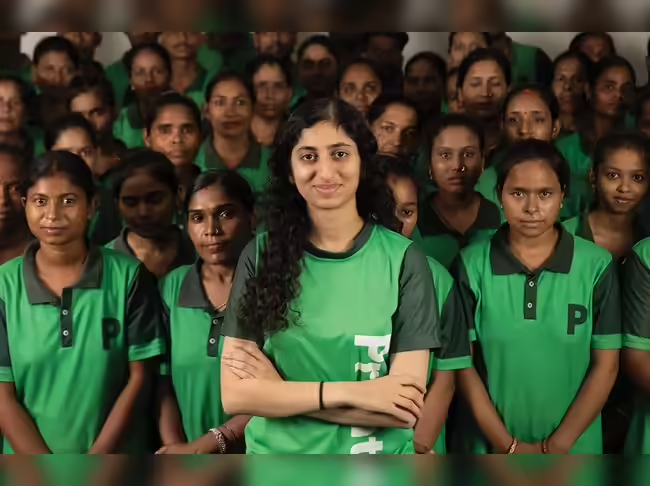
Pronto, the Bengaluru-based home services platform, has just crossed a monumental threshold: a $100 million valuation in record time. And at the helm of this rocket ship is founder Anjali Sardana, whose vision extends far beyond just connecting customers with helpers. She is building a platform that formalizes livelihoods, restores dignity to gig work, and solves the trust deficit that has plagued Indian households for generations.
Beyond the “Urban Company” Narrative: What Makes Pronto Different
The home services space in India is not empty. Players like Urban Company have pioneered the organized, premium end of the market. But Pronto is carving out its own distinct niche by focusing on the everyday, essential, and recurring nature of domestic help—maids, cooks, nannies, and elderly care attendants.
This is not about booking a one-time AC repair or a party makeup artist. This is about the daily rhythm of an Indian home.
The Pronto Promise: Trust, Speed, and Dignity
So, how does a startup earn the trust of millions of households while simultaneously uplifting the lives of its workers? Pronto’s model rests on three pillars:
1. Verification and Training at Scale
Every professional on the Pronto platform undergoes rigorous background verification. But Pronto goes a step further: they invest heavily in skill training and ongoing upskilling. A cook isn’t just someone who knows how to make food; they are trained in hygiene protocols, punctuality, and communication. This investment in quality ensures that when a Pronto professional walks through your door, they represent a standard, not a gamble.
2. The Worker-First Model
This is the heart of the Pronto philosophy. In the unorganized sector, a domestic worker has zero leverage. They have unpredictable income, no safety net, and no career path. Pronto dismantles this precarity by offering:
- Structured Shifts and Predictable Earnings: No more waiting by the phone.
- Insurance Coverage: A safety net that formal workers take for granted.
- Faster Payouts: Digital payments mean no delays.
- Career Progression: Paths to move from general cleaning to specialized roles, increasing their earning potential.
By treating workers as partners, Pronto ensures they are motivated, reliable, and committed to the platform.
3. Customer Obsession
For the customer, Pronto delivers the kind of experience they expect from modern consumer tech. Instant booking with 60–90 minute response times in many cities. Real-time tracking so you know exactly when help will arrive. Transparent pricing with no last-minute haggling. And a satisfaction guarantee that ensures if you’re not happy, the platform makes it right.
The Growth Trajectory: From Bengaluru to the Nation
Pronto’s journey to a $100 million valuation is a testament to the power of product-market fit in a massive, underserved market.
- Daily Bookings: The platform is now processing thousands of bookings daily, with impressive repeat usage rates. Once a household experiences the reliability of Pronto, going back to the chaos of the unorganized market becomes unthinkable.
- Geographic Expansion: After establishing a fortress in Bengaluru and Hyderabad, Pronto has aggressively expanded into Delhi-NCR, Mumbai, Pune, Chennai, and Ahmedabad. The roadmap for 2026 includes a deeper push into Tier-2 cities, where the need for organized domestic help is even more acute.
- Tech-First Operations: Behind the scenes, Pronto is an AI and data science powerhouse. Algorithms optimize for matching, scheduling, and route planning, ensuring that professionals spend less time traveling and more time earning.
The Founder Story: Anjali Sardana’s Vision
In a startup ecosystem often dominated by male founders in fintech and SaaS, Anjali Sardana’s rise with Pronto is particularly inspiring. She identified a pain point she understood intimately: the struggle of urban households to find reliable, trustworthy help.
But her genius lies in looking at the problem from both sides. She didn’t just build a better “matching” app. She built a system that addresses the structural inequities of the domestic work market.
Sardana’s approach is proof that deep market understanding, combined with empathetic leadership, can build massive value in traditional, underserved sectors. She is inspiring a new generation of founders—particularly women—to tackle problems that are not just commercially viable but socially transformative.
Why the $100 Million Valuation Matters
Achieving a nine-figure valuation in record time sends a powerful signal to the market. It tells investors that the home services category has the same explosive potential as quick-commerce. The drivers are clear:
- Rising Urban Dual-Income Households: More money, less time.
- Time Scarcity: The premium on convenience has never been higher.
- Demand for Reliability: Post-pandemic, households want vetted, trusted professionals, not strangers from a local market.
Investors are betting that Pronto can capture a significant share of this fragmented, high-demand sector by being the organized, tech-enabled alternative to informal referrals and unreliable local agencies.
The Road Ahead: Formalizing Livelihoods at Scale
Pronto’s mission is ambitious: to become the operating system for domestic help in India. With a $100 million valuation, a rapidly expanding city footprint, and a worker-first model that ensures a sticky supply of high-quality professionals, they are well on their way.
But the true measure of success for Pronto will not just be its valuation. It will be the number of lives it transforms—the cook who now has health insurance, the nanny who has a career path, the elderly attendant who is treated with dignity.
Anjali Sardana and Pronto are proving that Indian startups are not just digitizing commerce; they are formalizing livelihoods and creating structured opportunities at an unprecedented scale.