Solve for Tomorrow: How India’s Gen Z is Using AI to Build a Better Bharat
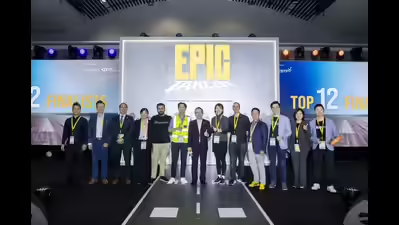
At a time when discussions about artificial intelligence often center on global tech giants and billion-dollar valuations, a quieter, more hopeful revolution is being led by India’s youth. The recent Samsung Solve for Tomorrow 2025 competition has underscored this shift, awarding ₹1 crore grants each to three student teams for designing AI-driven prototypes that tackle some of the nation’s most persistent challenges. These victories are not just about prize money; they signal a generational shift toward applied, empathetic technology and provide a powerful blueprint for how India’s deep-tech future will be built—from the ground up, by young minds who understand local problems firsthand.
The Winning Ideas: AI with a Heart and a Purpose
Selected from thousands of entries, the winning teams demonstrated a profound understanding of India’s unique societal fabric, blending technical skill with a clear mission for impact.
| Winning Team | Core Innovation | Targeted Societal Challenge | Potential Impact |
|---|---|---|---|
| Delhi | AI tool for early detection of learning disabilities in children. | Education & Healthcare: The lack of accessible, early diagnostic tools leads to delayed intervention, affecting a child’s academic and social development for years. | Enables early, low-cost screening, allowing for timely support and personalized learning plans, transforming educational outcomes for millions. |
| Kerala | Smart waste segregation system using computer vision. | Environment & Urban Management: Improper waste segregation at source cripples recycling efforts and leads to environmental pollution and public health hazards. | Automates and improves accuracy of waste sorting at homes/collection points, boosting recycling rates, reducing landfill burden, and creating cleaner cities. |
| Uttar Pradesh | AI-powered crop disease prediction for farmers. | Agriculture & Rural Livelihoods: Farmers often detect crop diseases too late, leading to devastating yield losses and financial ruin, exacerbating rural distress. | Provides farmers with early, hyper-local alerts via mobile devices, enabling preventive action, reducing pesticide overuse, and securing food production and income. |
These projects share a common DNA: they are deeply contextual, scalable, and leverage AI as a force multiplier for human expertise—not as a replacement.
Beyond the Grant: Fueling the Student-to-Founder Pipeline
The ₹1 crore grant is just the beginning. Samsung’s flagship CSR program, now in its third year, is designed as a comprehensive launchpad for deep-tech ventures. The support structure is critical to turning brilliant student ideas into viable solutions:
- Structured Mentorship: Teams gain access to industry experts, technologists, and business leaders who provide guidance on product development, business modeling, and ethical AI practices.
- Prototyping & Incubation Support: The grant funds are coupled with technical support to build functional prototypes, followed by potential incubation to refine the product-market fit.
- A Focus on “Bharat’s Problems”: The competition’s themes—Environment, Education, Healthcare, and Agriculture—are deliberately chosen to channel innovation toward India’s most pressing, large-scale development challenges. This aligns perfectly with national missions like Atmanirbhar Bharat and the IndiaAI Mission, which aim to foster homegrown technology for sovereign problem-solving.
This pipeline is essential. It intercepts raw talent at the university level and provides the resources and confidence to see themselves as founders, not just students. Many of today’s leading deep-tech founders began with similar collegiate innovation challenges.
The Bigger Picture: A Vote of Confidence in India’s Youth-Led Deep-Tech Surge
The Solve for Tomorrow winners are emblematic of a much larger trend energizing India’s startup ecosystem.
- The $1.55 Billion Deep-Tech Momentum: These student projects exist within the context of a record $1.55 billion invested in Indian deep-tech startups in 2025. Investors are increasingly backing ventures that combine advanced technology with tangible impact, exactly the thesis these student teams are proving.
- Gen Z’s “Empathy-First” Approach: Unlike previous generations that may have prioritized purely commercial or entertainment applications, India’s Gen Z innovators show a strong inclination to use technology for social good. They are “blending AI with empathy,” as Samsung India noted, which often leads to more sustainable and widely-adopted solutions.
- Decentralizing Innovation: The winners hail from Delhi, Kerala, and Uttar Pradesh, demonstrating that breakthrough ideas are emerging from across the country, not just traditional metro hubs. This geographical diversity is crucial for building solutions that work for all of India.
A Message to Future Founders: Your Tomorrow Starts Today
For students and young innovators across India, the message from Solve for Tomorrow 2025 is unequivocal: the tools to change your world are in your hands, and the ecosystem is ready to support you.
The competition proves that you don’t need a corporate title or decades of experience to identify a critical problem and engineer a solution. What you need is curiosity, technical skill, and a deep connection to the community you wish to serve. The future of Indian deep-tech will be written by those who look at a classroom, a farmland, or a waste bin and see not just a problem, but an opportunity for intelligent, compassionate innovation.