Skyroot Aerospace Targets ₹977 Crore Revenue by FY27, Aims to Become India’s First Private Space Giant
Skyroot Aerospace, India’s first space-tech unicorn, has set an ambitious revenue target of ₹977 crore by FY27, according to a KPMG valuation report . The Hyderabad-based startup, which recently raised $60 million at a $1.1 billion valuation, is preparing for the maiden orbital launch of its Vikram-1 rocket—a mission that could reshape India’s commercial space landscape .
📊 The Numbers: Skyroot’s Growth Trajectory
Sources: KPMG valuation report via Economic Times
The startup plans to grow its headcount from 1,163 employees to 5,749 by FY32, positioning itself as one of the largest private employers in India’s emerging commercial space sector . The company is targeting EBITDA positivity by FY29 (₹285 crore), compared to a loss of ₹130.3 crore in FY26, reflecting the capital-intensive nature of launch vehicle development .
🛰️ The Vikram-1 Mission: India’s First Private Orbital Rocket
Skyroot’s flagship Vikram-1 rocket is designed to carry payloads of up to 350 kg to low Earth orbit—the kind of payload class that competes directly with international small-satellite launch providers like Rocket Lab .
Key technical specifications:
- All-carbon composite structure: Five times lighter than steel, more fuel efficient
- 3D-printed upper stage: Advanced manufacturing reducing production time
- 95% indigenous content: Built largely with domestic components and expertise
- Target launch window: June 2026 (pending final clearances from ISRO and IN-SPACe)
*”We at Skyroot are excited about the upcoming Vikram-1 launch, India’s first private orbital rocket, marking a significant milestone both for India and the global space sector.”*
— Pawan Kumar Chandana, Co-founder & CEO, Skyroot Aerospace
💰 Revenue Model: Two Engines of Growth
1. Space Systems Division (Already generating revenue):
- Manufactures satellite structures, payload adaptors, propulsion systems, composite motor cases, actuators, nozzles
- Clocked ₹100.6 crore in FY26 (first year of monetisation)
- Order book: ₹605.4 crore scheduled for execution over the next 18 months
2. Launch Services (Primary growth engine):
- Expected to comprise about 79% of revenues by FY32
- Revenue per launch: Estimated **~$5 million** (≈ double the $2-3 million cost of making a rocket)
- Target cadence: One launch every month from 2027
- ~90% of customers are from outside India (US, Europe, Southeast Asia)
“Even with the launch production capacity we are planning, we may not be able to fully meet the demand right now… Once we demonstrate the capability to reach orbit consistently, the contract book is expected to build up strongly.”
— Pawan Kumar Chandana, Co-founder & CEO, Skyroot Aerospace
🌍 Unicorn Status & Investor Backing
Skyroot achieved unicorn status on May 6, 2026, raising $60 million at a pre-money valuation of $1.1 billion . The round was co-led by:
Total funding raised to date: $160 million, making Skyroot India’s most-funded private space firm .
🚀 Beyond Vikram-1: The Vikram-2 Vision
The fresh capital is also being deployed to develop Vikram-2, a heavier-lift launch vehicle with:
- 1-tonne payload capacity to low Earth orbit
- Advanced cryogenic upper stage for higher energy missions
- Expected completion: 2027
🔮 What This Means for India’s Space Economy
Skyroot’s rise reflects a broader transformation in India’s space sector since regulatory liberalisation in 2020. The Indian government opened the space sector to private companies that year, enabling startups to build rockets, satellites, and ground systems .
Key milestones in context:
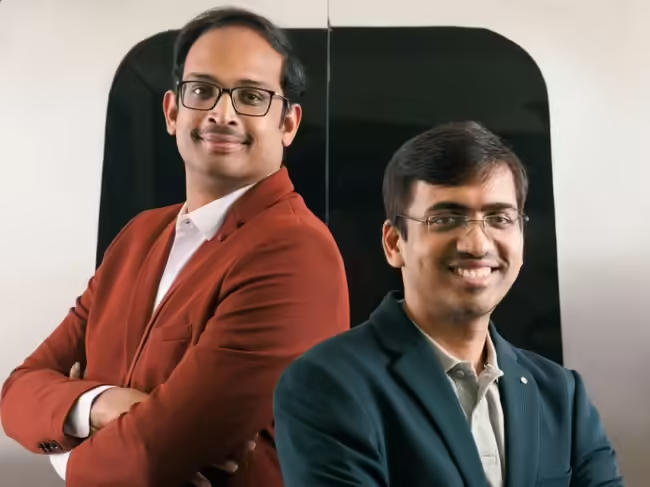
Skyroot’s journey from a 2018 startup founded by two former ISRO scientists to a $1.1 billion unicorn preparing for India’s first private orbital launch is a powerful signal. The country is not just a consumer of global launch services—it is building its own sovereign capability to serve the rapidly growing small satellite market.
For more updates on India’s space-tech ecosystem and startup funding, keep it locked on StartupPoint.in.
#SkyrootAerospace #Vikram1 #Spacetech #IndianStartups #FundingNews #SatelliteLaunch #TechInIndia #SpaceEconomy #InnovationEconomy #UnicornStartups