Deep-Tech and AI Are Shaping India’s Viksit Bharat 2047
The vision of Viksit Bharat 2047—transforming India into a developed nation by its centenary of independence—is being built on a foundation of deep-tech innovation, artificial intelligence, and an inclusive, democratized startup culture. Recent high-level discussions and policy announcements have cemented the role of AI and deep-tech as the primary engines for this long-term economic transformation.
AI as a Cross-Cutting Enabler
At the heart of this vision is the recognition that artificial intelligence is not a sector but a horizontal, cross-cutting technology that can accelerate progress across every domain of national development . Shri S. Krishnan, Secretary of MeitY, underscored this by stating that India has a unique opportunity to leverage AI to ensure the country is firmly on the path to becoming Viksit Bharat by 2047 . The government’s IndiaAI Mission, with its comprehensive seven-pillar strategy, is creating the foundational ecosystem—from accessible compute infrastructure and quality datasets to indigenous foundation models and startup support—to enable India to catch up with the best in the world .
A significant component of this mission is the development of sovereign AI capabilities. As Krishnan emphasized, “Sovereignty is a very important issue. We need AI models where nobody else has the kill switch; it must remain with us” . The government has actively invested in indigenous AI systems through initiatives like BharatGen to ensure that Indian data, languages, and cultural context are accurately represented . This is not merely about building large language models but creating practical tools for critical sectors such as agriculture, science, and manufacturing .
Deep-Tech: The Foundation of a “Product Nation”
Experts agree that India’s journey to becoming a developed nation hinges on its ability to transition from a service-led economy to a “product nation” rooted in deep-tech innovation . Infosys co-founder Kris Gopalakrishnan has been a vocal advocate for this shift, stating that “economic superiority will come after technological and scientific superiority” . Deep-tech startups, which are typically born from academic and laboratory research, are central to this transformation .
The creation of a robust deep-tech ecosystem, however, requires a fundamental shift in how India approaches research and development. There is a strong consensus that India must significantly increase its R&D spending, which currently stands at a mere 0.7% of GDP . Gopalakrishnan has called for a threefold increase to 3% of GDP over the next decade, with industry contributing a larger share .
Yogesh Pandit of the Foundation for Science, Innovation and Development (FSID) highlights that India’s low R&D investment, with nearly 70% coming from the government, leaves limited private-sector capability to support deep-tech commercialization . This scarcity makes structured funding models essential, where startups adopt a “gate-based” approach, seeking incremental capital to achieve specific milestones rather than asking for large sums upfront .
The Role of Startups in Nation-Building
India’s startup ecosystem is being positioned not just as an economic driver but as a foundational pillar for the Viksit Bharat vision . The focus is moving beyond valuation-led growth to value-led nation-building, where startups solve real problems at scale in areas like climate, energy, manufacturing, and financial inclusion .
A crucial dimension of this is the rise of Tier-2 and Tier-3 cities as the new frontier for Indian entrepreneurship . Experts note that these regions are no longer just talent pools but are emerging as demand centres for innovative solutions . Startups that build for and from these regions are seen as being uniquely positioned to create significant long-term impact by solving root-level systemic problems in governance, healthcare, and education . This aligns with the vision of inclusive growth, ensuring that the benefits of the innovation economy reach every part of the country .
Inclusive Innovation and the “More from Less for More” Philosophy
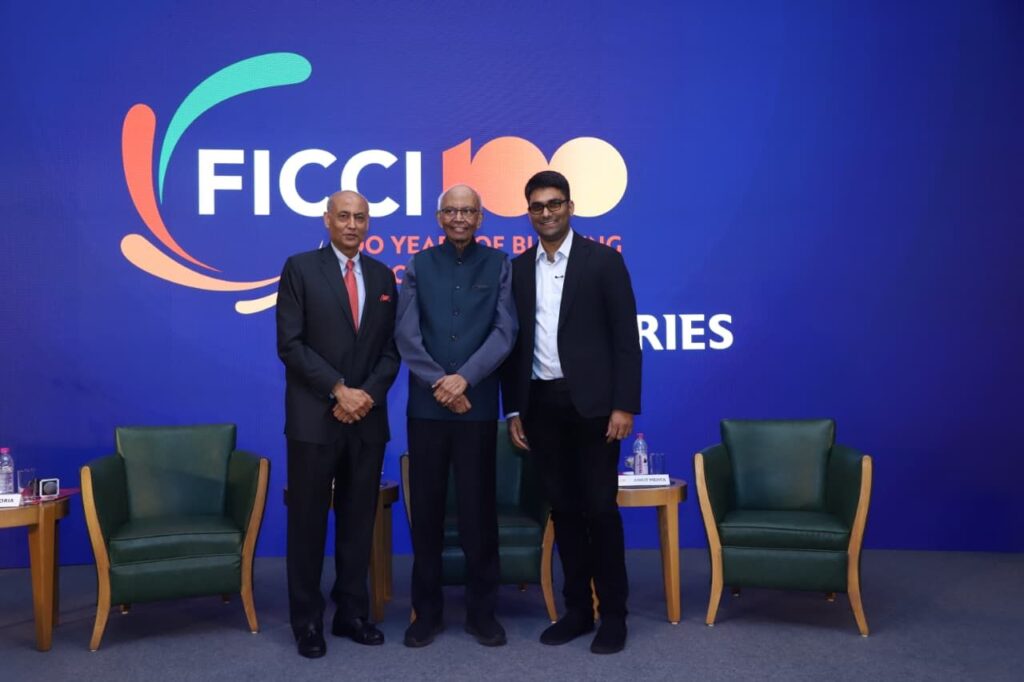
The Viksit Bharat 2047 vision is deeply intertwined with the concept of inclusive innovation. Dr. R.A. Mashelkar, addressing the FICCI Legends Series, articulated this as the “More from Less for More” philosophy—creating world-class products that deliver superior performance with fewer resources while making them affordable and accessible to millions . He stressed that India’s greatest opportunity lies in transitioning from a consumer of global technologies to a creator of world-leading innovations through deep science and AI .
This approach is already being validated by AI-driven innovations that bridge healthcare inequities, such as affordable breast cancer detection and AI-powered diagnostics . By focusing on creating solutions that benefit millions rather than a privileged few, India is setting a global benchmark for affordable excellence . The nation’s deep-tech journey requires sustained investment, strategic focus, and a culture that fosters resilience and collaboration. If executed effectively, India’s startup ecosystem is poised to shape the nation’s future as a global innovation leader .