
AI in Indian Fintech: From Buzzword to Core Engine Driving the Next Growth Phase
Artificial intelligence is no longer a buzzword in India’s fintech world—it’s becoming the core engine driving the next phase of growth.
Recent developments across the ecosystem show how quickly AI is being woven into financial services startups, delivering real improvements in efficiency, security, and user experience. From customer support chatbots to fraud detection algorithms, from credit underwriting to regulatory compliance, AI is fundamentally reshaping how financial services are delivered to India’s 1.4 billion people .
Venture funds are clearly voting with their capital: Lightspeed reports approximately 60% of its recent Indian portfolio deals are in applied AI, with fintech being one of the heaviest verticals . Peak XV, Accel, and General Catalyst (with its $5 billion India pledge) continue to write large checks into AI-native or AI-transformed financial platforms .
This isn’t just about cost savings—it’s about creating defensible competitive advantages in one of the world’s most dynamic fintech markets .
The AI Opportunity in Indian Fintech: Why Now?
India’s Unique Advantage
Several factors converge to make India a uniquely fertile ground for fintech AI innovation :
| Factor | Why It Matters |
|---|---|
| Massive digital transaction volume | UPI alone processes over 10 billion transactions monthly—rich data for AI models |
| Account Aggregator framework | Consent-based data sharing enables holistic financial profiles |
| Alternative data abundance | Digital footprints, utility payments, GST data create new credit signals |
| Sovereign AI capabilities | BharatGPT, Sarvam’s 105B model, Krutrim—India-specific language models |
| Regulatory sandbox | RBI’s framework encourages controlled experimentation |
| Young, tech-savvy population | 600 million+ internet users comfortable with digital finance |
The Structural Shift
Industry experts see this as the start of a structural shift :
| Phase | Characteristic |
|---|---|
| Phase 1 (Past) | AI as “nice-to-have” cost-saver |
| Phase 2 (Present) | AI as essential competitive advantage |
| Phase 3 (Future) | AI as core product in every fintech category |
The next 12–24 months could see AI become the defining factor in who wins (and who consolidates) in India’s fintech landscape .
Where AI Is Making the Biggest Impact Right Now
1. Customer Support & Engagement
The Transformation
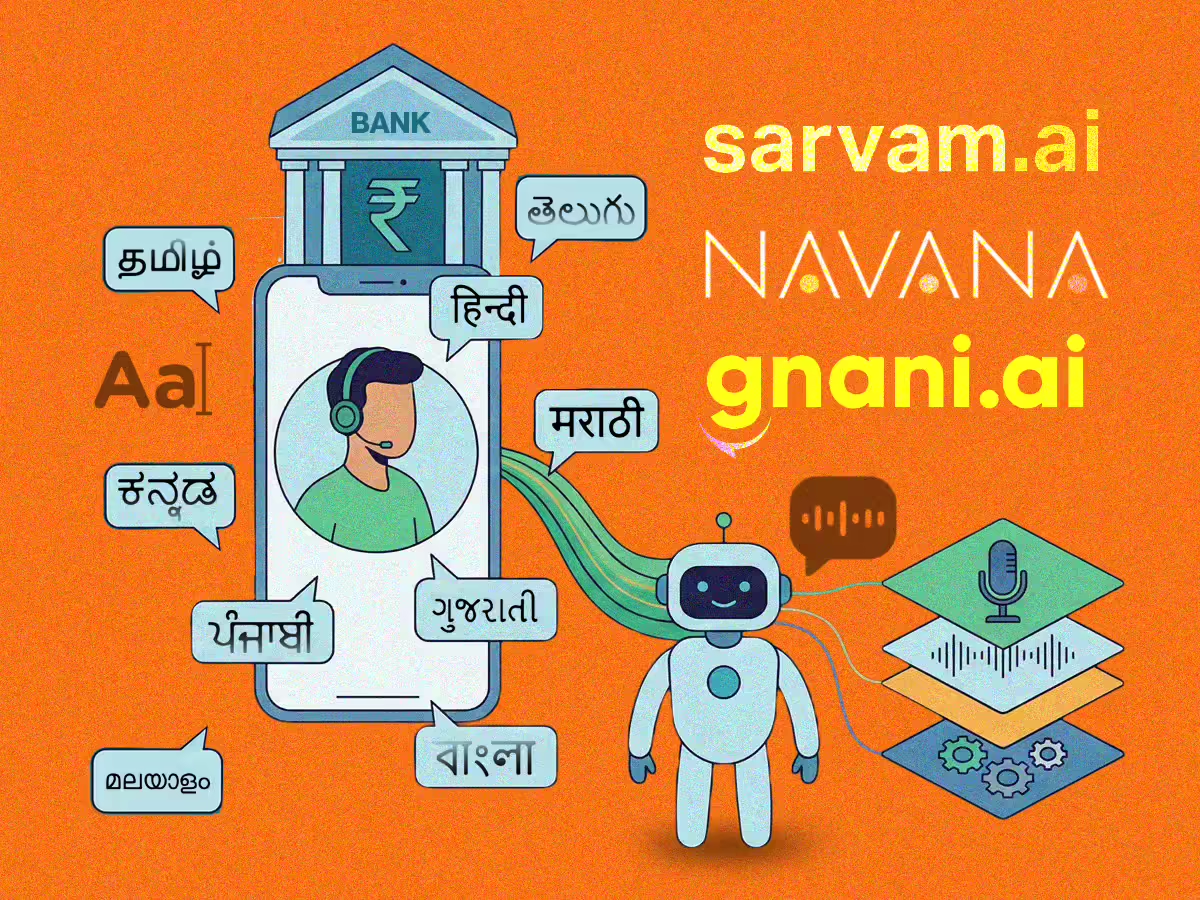
Voice-first and multilingual chatbots powered by models like BharatGPT or fine-tuned global LLMs are handling 70–80% of routine queries in many fintech apps. This reduces response time from minutes to seconds and cuts support costs dramatically.
Key Players
- CoRover: Enterprise bots now powering banks and insurers across India, handling millions of customer interactions daily
- Sarvam AI: Indic-optimized voice AI enabling natural conversations in multiple Indian languages, including code-mixed Hinglish and regional dialects
- Gnani.ai: Conversational AI platform for customer service automation
The Impact
According to CoRover founder Ankush Sabharwal, conversational AI can reduce customer support costs by up to 60% while improving satisfaction scores. For fintechs operating on thin margins, this is transformative .
2. Fraud Detection & Risk Assessment
The Transformation
Real-time transaction monitoring using behavioral biometrics, anomaly detection, and predictive scoring has become table stakes. Modern systems can flag suspicious activity in milliseconds, often before the transaction completes.
Key Players
- Idfy: Raised ₹476 crore in February 2026 for identity verification and fraud detection; combines AI with document verification and liveness detection
- Gnani.ai: Voice analytics to detect fraud patterns in call center interactions
- Several fintechs: Deploying behavioral biometrics that recognize how users type, swipe, and hold devices
The Impact
AI-powered fraud detection systems have slashed fraud losses by up to 40% for early adopters while simultaneously speeding up onboarding—since automated verification replaces manual reviews .
3. Credit Underwriting & Lending
The Transformation
Alternative data + AI models are enabling faster, fairer credit decisions for millions previously excluded from formal finance. By analyzing digital footprints, utility payments, GST data, and even smartphone usage patterns, AI can assess creditworthiness where traditional credit scores don’t exist.
Key Players
- Kreditbee: Pursuing $120 million pre-IPO round; uses AI for dynamic pricing, personalized loan offers, and collection optimization
- Olyv (formerly SmartCoin): Raised ~₹207 crore Series C in February 2026; deploys AI for underwriting small-ticket loans
- CredAble: Uses generative AI for working capital optimization
- Stable Money: Raised ~$25 million pre-Series C for fixed-income investments
The Impact
AI-driven underwriting has expanded India’s formal credit pool by an estimated 50-80 million new-to-credit customers . Approval times have dropped from days to minutes, and default rates remain manageable thanks to predictive models that continuously learn from repayment data .
4. Investment & Wealth Management
The Transformation
Robo-advisors and AI-driven portfolio tools are gaining traction among younger investors. Platforms are layering generative AI on top of traditional analytics to offer hyper-personalized advice, goal-based planning, and even conversational investment coaching.
Key Players
- Groww, Zerodha, Angel One: Incumbents integrating AI features
- Emerging startups: Building AI-native wealth platforms
- Smallcase: AI-powered portfolio recommendations
The Impact
For the first time, retail investors with modest capital can access advice previously reserved for high-net-worth individuals. AI enables democratization of wealth management—a category historically dominated by human advisors serving the wealthy .
5. Regulatory Compliance & Regtech
The Transformation
AI is automating KYC/AML checks, monitoring for suspicious patterns, and generating compliance reports—helping fintechs stay ahead of RBI guidelines while scaling fast.
Key Players
- Idfy: Leader in AI-powered identity verification
- Perfios: Financial data aggregation and analysis platform
- Signzy: Digital onboarding and compliance automation
The Impact
Compliance costs, which can consume 10-15% of operating expenses for financial institutions, are being dramatically reduced. Automated systems work 24/7, never miss a suspicious pattern, and generate audit-ready reports on demand .
Recent Funding Momentum: Investors Are Voting with Capital
February 2026 alone saw significant fintech AI deals :
| Startup | Amount | Focus |
|---|---|---|
| Idfy | ₹476 crore | Identity verification, fraud detection |
| Olyv | ~₹207 crore | Digital lending, AI underwriting |
| Stable Money | ~$25 million | Fixed-income investments |
| Xflow | $16.6 million | Cross-border payments |
| Freed | ~₹60 crore | Debt resolution |
The Investor Thesis
Lightspeed’s 60% applied AI allocation—with fintech as a primary vertical—reflects a broader conviction : domain-specific AI solutions with clear ROI are where the greatest returns lie.
As Lightspeed’s leadership noted: “India’s strength isn’t in racing to build the biggest LLM—it’s in building the most useful, affordable, and contextually relevant AI applications at scale.”
General Catalyst’s $5 billion India pledge (announced February 2026) explicitly targets fintech and AI as core investment areas . The firm’s leadership sees India as a “global innovation engine” for category-defining companies.
Peak XV’s $1.3 billion fund close similarly emphasizes AI across sectors, with fintech expected to be a major beneficiary .
The Technology Stack: From BharatGPT to Vertical Solutions
Sovereign Foundation Models
| Model | Capabilities | Fintech Relevance |
|---|---|---|
| Sarvam AI 105B | 22 Indian languages, code-mixing, cultural context | Voice-first banking, vernacular support, document processing |
| CoRover’s BharatGPT | Multilingual conversational AI | Customer service chatbots, voice assistants |
| Krutrim | Indian language models | Broader fintech applications |
Vertical AI Solutions
On top of these foundation models, specialized fintech AI solutions are emerging :
- Document AI: Processing KYC documents, bank statements, tax returns
- Voice AI: Conversational banking, call center automation
- Fraud AI: Real-time transaction monitoring, behavioral analytics
- Credit AI: Underwriting, pricing, collections optimization
- Compliance AI: AML screening, regulatory reporting
What This Means for Different Stakeholders
For Fintech Founders
- AI is no longer optional—it’s becoming table stakes. If you’re not integrating AI meaningfully, you’re falling behind.
- Domain expertise matters. The most valuable AI applications aren’t generic—they’re deeply embedded in specific workflows.
- Start with high-ROI use cases. Customer service automation and fraud detection often deliver immediate returns that fund broader AI investments.
- Leverage sovereign models. BharatGPT and Sarvam’s offerings are optimized for Indian languages and contexts—use them.
- Prepare for the next wave. The next 12-24 months will separate AI leaders from laggards.
For Investors
- Look beyond the AI label. The question isn’t “do you use AI?” but “how does AI create defensible advantage?”
- Evaluate domain depth. Generic AI solutions are easily replicated; vertical expertise creates moats.
- Track ROI metrics. AI should show measurable impact on unit economics, not just feature checklists.
- Support through scaling. AI integration requires talent, infrastructure, and change management—portfolio companies need help.
For Traditional Financial Institutions
- Partner or build. The choice is becoming urgent—fintechs are moving faster.
- Leverage incumbency advantages. Data, customer trust, and distribution remain valuable.
- Adopt agile approaches. Long development cycles won’t keep pace with AI-native competitors.
For Customers
- Better experiences. Faster service, more personalized recommendations, instant decisions.
- Increased access. AI underwriting means more people qualify for credit.
- Enhanced security. Real-time fraud detection protects your money.
- Lower costs. Automation reduces overhead, potentially lowering fees.
Challenges Ahead
1. Data Privacy and Security
With great data comes great responsibility. AI systems processing sensitive financial information must be:
- Secure against breaches and misuse
- Transparent about how data is used
- Compliant with DPDP Act and RBI guidelines
- Ethical in avoiding bias and discrimination
2. Model Risk
AI models can fail in unexpected ways:
- Bias against certain customer segments
- Drift as underlying patterns change
- Black box decisions difficult to explain
- Regulatory scrutiny when outcomes harm customers
3. Talent Competition
The best AI engineers are in high demand. Fintechs compete with:
- Global tech giants (Google, Microsoft, Amazon)
- Well-funded AI-first startups
- International opportunities
- Higher-paying sectors
4. Regulatory Evolution
RBI’s stance on AI in finance is still evolving. Fintechs must navigate:
- Algorithm accountability requirements
- Explainability expectations
- Consumer protection frameworks
- Cross-border data restrictions
The Road Ahead: 2026-2028
Near-Term (12 Months)
- Widespread adoption of AI customer service across fintech
- Generative AI for personalized financial advice gaining traction
- Voice-first banking becoming mainstream in multiple languages
- AI underwriting expanding to new customer segments
Medium-Term (24 Months)
- AI-native fintechs emerging as category leaders
- Consolidation as AI capabilities separate winners from also-rans
- Regulatory frameworks maturing around AI in finance
- Cross-sector convergence (fintech + insurtech + healthtech)
Long-Term (36+ Months)
- Autonomous finance where AI handles complex decisions
- Predictive financial health anticipating customer needs
- Democratized wealth management at population scale
- India as global hub for fintech AI innovation
Conclusion: The AI-First Fintech Era Has Arrived
The integration of AI into Indian fintech is no longer experimental—it’s existential. Startups that embrace AI across customer support, fraud detection, underwriting, and compliance are building durable competitive advantages. Those that treat AI as a buzzword rather than a core capability risk being left behind.
The numbers tell the story:
- 70-80% of routine queries now handled by AI
- 40% reduction in fraud losses for early adopters
- 50-80 million new-to-credit customers reached
- 60% of new VC deals in applied AI, with fintech leading
- $5 billion+ in fresh capital committed by global investors
As Lightspeed, Peak XV, General Catalyst, and others continue to back AI-native and AI-transformed financial platforms, the message is clear: AI is the defining factor in who wins in India’s fintech landscape.
For founders, the path forward is clear: embed AI deeply, focus on high-ROI use cases, leverage sovereign models, and build for scale. For investors, the opportunity is to back teams with domain depth and technical excellence. For customers, the future promises faster, cheaper, more personalized, and more accessible financial services.