Fewer Deals, Bigger Cheques: How India’s Startup Funding Is Evolving in 2026

India’s startup ecosystem has entered a new phase of maturity. In the first half of 2026, technology startups raised $7.2 billion across 652 funding rounds—a 12% increase compared to H1 2025 . This growth came despite a 43% decline in the number of deals, reflecting a fundamental shift in how investors deploy capital .
Capital Concentration Is Reshaping the Landscape
The numbers reveal a clear pattern: investors are writing larger cheques for fewer companies. The top three funding rounds alone—CRED’s $900 million raise, Nxtra’s $710 million round, and Neysa’s $600 million funding—accounted for **$2.2 billion**, or nearly one-third of all capital deployed during the half-year . This concentration reflects what Tracxn describes as a market that has “traded breadth for depth,” with funding increasingly flowing toward stronger, more mature companies .
The trend has persisted and strengthened every half-year since 2022, suggesting this is a structural shift rather than a temporary reaction to macroeconomic conditions . Late-stage funding reached $3.8 billion during H1 2026, even as the number of late-stage rounds fell to its lowest level, indicating institutional investors are making “larger, more deliberate bets rather than spreading capital across many positions” .
AI Emerges as the Defining Investment Theme
The most significant story of H1 2026 is the rise of artificial intelligence as the dominant investment theme. AI startups demonstrated remarkable growth, with funding soaring 317% year-on-year to $676 million across 57 deals . The momentum was driven in part by the government’s IndiaAI Mission, which strengthened investor confidence through support for compute infrastructure and indigenous AI development .
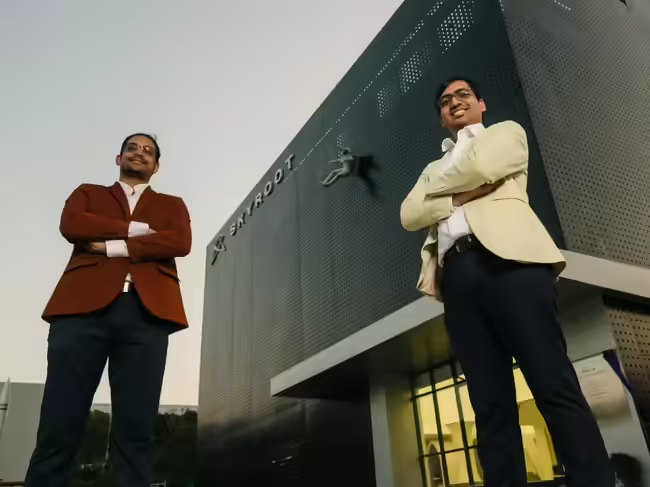
The emergence of AI unicorns has been particularly striking. Neysa and Sarvam, both founded in 2023, achieved unicorn status within 1.3 and 2.5 years, respectively . In contrast, the other three new unicorns—KreditBee, Skyroot, and Square Yards—took between eight and twelve years to reach the $1 billion valuation mark . As Tracxn noted, “where a company is building on top of established global AI infrastructure and serving large regulated Indian enterprises with known buying patterns, capital moves fast and at high valuation multiples” .
The Ecosystem Matures: More Unicorns, Faster IPOs
Despite the decline in deal volume, India added five new unicorns in H1 2026, up from four in the same period last year . The startups span artificial intelligence, fintech, spacetech, and proptech, reflecting the growing diversity of India’s startup ecosystem .
Public market activity also strengthened. Thirteen technology IPOs were completed during the period, with average market capitalisation at listing rising to **$297 million** from $162 million a year earlier . The average time from first funding to IPO declined significantly to 8.1 years from 14.5 years, indicating that newer startup cohorts are reaching public markets more quickly .
A Selective Funding Environment Reshapes Startup Creation
However, the selective funding environment has had a noticeable impact on startup formation. Only 314 tech startups were founded in H1 2026, compared with 3,222 in all of 2025 . First-time funded startups declined 31% year-on-year to 218, while additions to the Soonicorn Club fell 47% to 54 .
As Vikram Gupta, founder and managing partner at IvyCap Ventures, noted, “Investors today are prioritising startups with differentiated technology, strong execution, clear paths to profitability and the ability to scale globally” . The seed-stage pipeline is the “leading indicator to watch,” Tracxn noted, as today’s seed cohort will determine the Series A and IPO pipeline in the coming years .
India’s startup ecosystem is entering a more mature phase—one characterised by disciplined capital deployment, stronger fundamentals, and increasing investor preference for technology-led businesses capable of generating long-term value . The resilience shown in H1 2026 underscores that sectors like AI, fintech, and spacetech are powering long-term growth, even as the overall deal count declines.