India’s First Privately Built Orbital Rocket: Vikram-1 Set to Launch Between July 12 and August 4
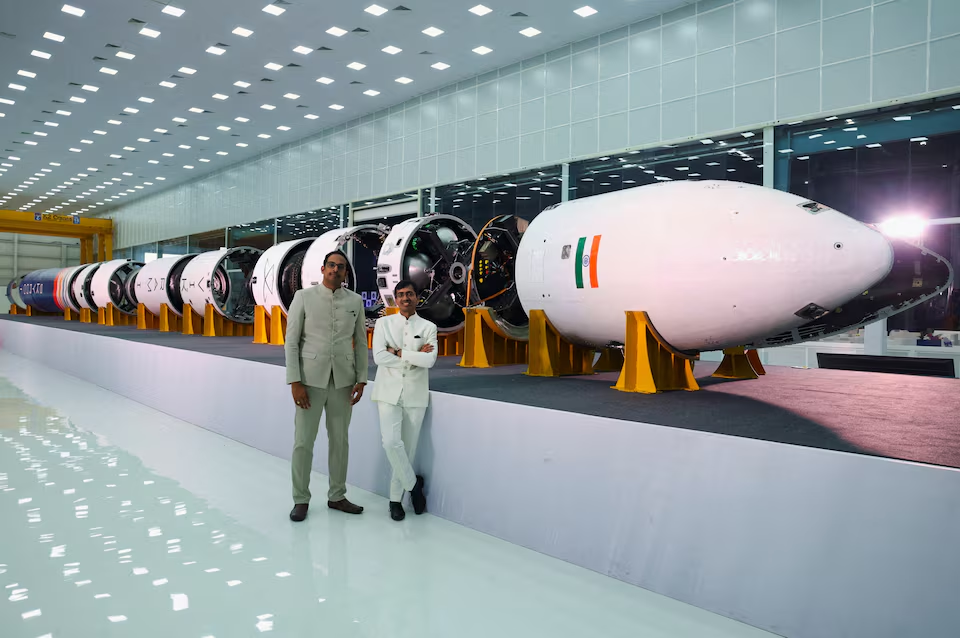
India’s private space industry is poised to cross a historic threshold this month. Hyderabad-based space-tech startup Skyroot Aerospace has officially opened the launch window for the maiden test flight of Vikram-1, the country’s first privately developed orbital-class rocket .
The mission, named “Mission Aagaman” —Sanskrit for “Arrival”—is scheduled for launch no earlier than July 12, 2026, with the window remaining open until August 4, subject to weather conditions, safety, and range clearance .
🛰️ From Suborbital Success to Orbital Ambition
Skyroot’s journey to this moment began on November 18, 2022, when its suborbital rocket Vikram-S became the first privately built rocket to reach space from Indian soil . Now, Vikram-1 aims to go further—much further.
The seven-storey-tall, multi-stage orbital launch vehicle is built with an all-carbon composite structure and powered by indigenously developed propulsion systems, including 3D-printed engines and high-thrust solid-fuel boosters .
📊 Vikram-1: Key Specifications
| Aspect | Details |
|---|---|
| Vehicle | Vikram-1 (multi-stage orbital launch vehicle) |
| Structure | All-carbon composite |
| Propulsion | In-house developed systems, including 3D-printed engines |
| Payload Capacity | Up to 350 kg to Low Earth Orbit (LEO) |
| Target Orbit | 450 km altitude at 60-degree inclination |
| Launch Site | First Launch Pad, Satish Dhawan Space Centre (SDSC-SHAR), Sriharikota |
| Mission Type | Technology demonstration & partially commercial |
🎯 Why Vikram-1 Matters
1. A Historic First for India’s Private Space Sector
The moment Vikram-1 lifts off, India’s private space industry will cross a threshold it has never crossed before. As Pawan Kumar Chandana, co-founder and CEO of Skyroot Aerospace, put it: “The single most important objective of Mission Aagaman is to capture the real in-flight performance data from every system on Vikram-1. This data cannot be fully replicated through ground testing” .
2. Building on ISRO’s Legacy with Private Innovation
Skyroot was founded in 2018 by IIT alumni and former ISRO scientists Pawan Chandana and Naga Bharath Daka . The launch has been enabled by IN-SPACe’s efforts to open India’s space sector and ISRO’s technical infrastructure . For India, the ability to reach orbit reliably and frequently is a strategic capability that only a handful of nations possess .
3. Commercial Opportunities and Global Competitiveness
The maiden mission will be partially commercial, carrying a mix of domestic and international customer payloads . Skyroot plans to commence full commercial flights after one or two successful orbital demonstrations . The company is positioning its “Cab to Space” model as a dedicated launch service for small satellite operators seeking precise and frequent access to orbit .
🌌 India’s Growing Space Economy
India’s space economy is projected to grow from approximately $8.4 billion** today to **$44 billion by 2033 . Indigenous launch capability will be a critical enabler of this growth, unlocking opportunities for India’s rapidly expanding private space ecosystem .
The emergence of companies like Skyroot—which recently became India’s first spacetech unicorn with a valuation exceeding $1.1 billion—signals both the scale of investor confidence in the sector and the growing maturity of the country’s commercial space ambitions .
🔭 The Road Ahead
With all stages of Vikram-1 fully integrated and stacked at the First Launch Pad in Sriharikota, the countdown to a new chapter in Indian spaceflight has begun . As Naga Bharath Daka, co-founder and COO of Skyroot, stated:
“With Vikram-S in 2022, we validated the foundation of our technology stack; with Vikram-1, we take our biggest step yet toward a reliable, high-cadence launch programme built in India, for India and the world” .
If successful, Vikram-1 will not only mark a technological breakthrough but also inspire the next wave of Indian space entrepreneurs to aim higher in the global race for space exploration.
For more updates on India’s space-tech ecosystem, startup funding, and deep-tech innovation, keep it locked on StartupPoint.in.
#Vikram1 #SpaceTech #IndianStartups #PrivateSpace #InnovationEconomy #ISRO #OrbitalLaunch