
Instant Service Apps Face Worker Crunch as Demand Surges: Can Urban Company, Pronto, and Snabbit Solve the Supply Gap?
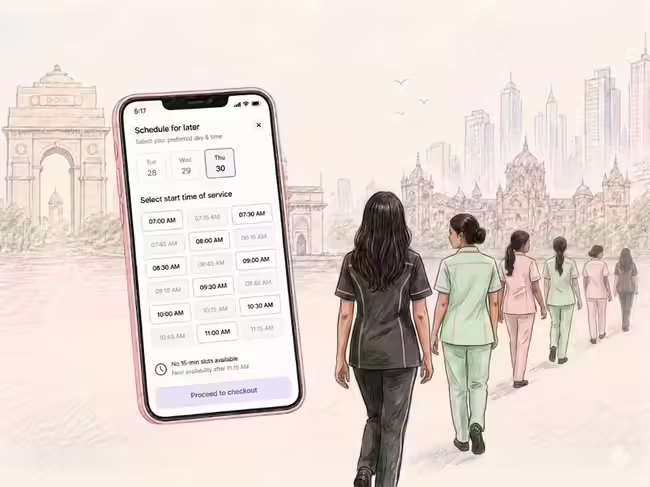
India’s instant home-service platforms are caught in a paradoxical squeeze: demand is booming, but worker availability is shrinking .
The segment, which started as an on-demand and ‘instant’ model, first saw an impact on some services in a few micro-markets as several workers returned home due to assembly elections in West Bengal, Assam, Tamil Nadu and Kerala, as well as for the harvest season in agrarian states .
According to a Morgan Stanley report, the segment clocked 10 million monthly users in March . However, across several micro-markets in Delhi-NCR, Mumbai, and Bengaluru, 15-minute bookings have become unavailable for days and even near-term slots have turned grey .
“Every platform is probably going through this — competition is not the problem. We are seeing some challenges in some cities,” said Aayush Agarwal, founder of Snabbit .
The Seasonal Disruption: Elections and Harvest Season
The timing is particularly damaging. Typically, quick commerce platforms see an uptick in demand during this period due to Indian Premier League (IPL) matches .
According to industry executives, the daily active gig workers on quick commerce platforms are currently running 10-12% below early-2026 levels . Order fulfillment for quick grocery delivery services in Delhi-NCR, Bengaluru and Mumbai is being delayed, while slots on platforms like Snabbit, Urban Company and Pronto are going dark in several pockets .
On-demand house help startup Pronto’s founder Anjali Sardana acknowledged the impact: “We expect to see some impact on supply in the upcoming weeks due to the West Bengal elections, especially in the northern cities where we have some professionals from West Bengal” .
Platform Responses: Full Capacity or Strategic Rationing?
Platforms have responded differently to the crunch. Pronto’s founder Anjali Sardana said the company is operating at full supply capacity and any regional unavailability is due to heavy bookings, not a supply shortage .
“We are currently doing about 23,000 bookings a day on weekdays and about 26,000 on weekends. We are fully booked, which is why slots are unavailable in some regions,” Sardana said, adding that demand is increasing by 20% week-on-week .
For instance, Zepto is offering its scheduled delivery option in some PIN codes where instant delivery is unavailable. Similarly, instant house help services are unavailable in multiple locations, with options only to schedule services after two-three days .
The Structural Challenge: 30-40% Monthly Attrition
Beyond seasonal fluctuations, the home-service sector faces deeper structural HR challenges. Monthly attrition rates of 30-40% are common across delivery and ride-hailing platforms, with some platforms seeing complete workforce turnover within 3-4 months .
The causes are straightforward but difficult to address:
- Earnings instability: Income fluctuates based on demand, weather, and algorithmic changes
- Physical demands: Long hours, traffic exposure, and safety concerns wear workers down
- Alternative opportunities: Low switching costs mean workers move between platforms freely
- Lack of career progression: No promotion pathway keeps workers searching for better options
Rahul Taneja, partner at Lightspeed, highlighted the supply chain challenge: “Supply chain is an important yet difficult problem to solve in this sector. Workers usually go to their hometowns for economic incentives during the harvest season. Platforms need to build the right workforce and incentivise them properly to manage such situations” .
The Algorithm as “Phantom Boss”
For many gig workers, the challenge is not just about earnings—it’s about the algorithm that governs their work lives. A protest in February 2026 saw gig workers gathering at Jantar Mantar, holding signs such as “We are not slaves of algorithms” and “Unblock our IDs, unlock our lives” .
Workers described the algorithm as an ever-present but inscrutable supervisor, one that assigns jobs, determines routes, sets incentives and quietly recalibrates pay, all without explanation . A dip in ratings, a delayed delivery, or even declining a task can trigger penalties that are neither clearly communicated nor easily contested .
Women Gig Workers Protest Unfair Policies
On Republic Day 2026, women gig workers across the country switched off their apps to protest against unfair policies, lack of safety, and the looming threat of IDs being blocked . The nationwide protest was called by the Gig & Platform Service Workers’ Union (GIPSWU), a women-led outfit.
Seema Singh, national president of the union and formerly a gig worker with Urban Company, outlined workers’ issues ranging from unfair rating systems to income security .
“Women workers face additional vulnerabilities related to safety, dignity, and legal protection. In many cases, when women workers demand fair payment, situations escalate into scuffles and physical assaults,” she said in a statement .
Workers risk having their IDs blocked if they have more than three strikes, which results from cancellation, not taking up work during scheduled ‘peak hours’, or taking up work offline . The union also called for a ‘red button’ feature in apps for medical emergencies, menstrual leaves, and immediate prohibition of arbitrary ID blocking .
Urban Company’s Earnings Reality
In February 2025, Urban Company released data on its workers’ earnings, with the headline-grabbing fact that top earners make more than Rs 50,000 a month—around 60% higher than entry-level IT salaries . However, that data also shows that for most workers on the platform, earnings remain clustered around a modest average rather than the top tier.
During the first nine months of FY26, active workers earned about Rs 28,322 a month on average . While the company highlights a small cohort earning upwards of Rs 40,000–50,000, these are limited to the top 20% and above, with the bulk of workers continuing to operate around the average band, often tied to demand fluctuations and hours logged .
The Financial Scale: InstaHelp’s Investment Phase
Urban Company’s rapid-response services vertical InstaHelp crossed 50,000 daily bookings less than a year after launch, reaching approximately 51,520 jobs on February 22, 2026 .
However, the rapid ramp-up comes even as the company continues to invest heavily in building out the new vertical. InstaHelp reported an adjusted EBITDA loss of Rs 61 crore in Q3 FY26, compared with a loss of Rs 44 crore in the September quarter and Rs 10 crore in its launch quarter, Q1 FY26 .
Crossing 50,000+ daily bookings reflects strong consumer demand for reliable, on-demand housekeeping services,” said Abhiraj Singh Bhal, CEO and co-founder of Urban Company. “We are investing to build a large, high-frequency category that deepens platform engagement and strengthens long-term growth” .
Urban Company expects InstaHelp to move towards breakeven once it achieves scale and higher average order values—estimated to be 1.8 to 2 times current levels .
The Competitive Landscape: A Three-Horse Race
The instant home-service market is heating up. Snabbit recently raised **56millioninfunding∗∗fromSusquehannaVentureCapital,UnicornGrowthFund,BertelsmannIndiaInvestmentsandothers,bringingitstotalfundsraisedto112 million . The latest round almost doubled its valuation to **350million∗∗from180 million just six months ago .
Pronto, meanwhile, raised **25millioninMarch2026∗∗andisreportedlyintalkstoraiseadditionalfundingthatwoulddoubleitsvaluationto200 million.
A Morgan Stanley report noted that “competitive intensity in the instant services segment (requiring higher investments to gain market share) is a key concern for Urban Company” .
The Road Ahead: Scaling Without Breaking
Snabbit’s founder Aayush Agarwal offered a more optimistic long-term view: “When food delivery was being built, there were times when it was difficult to have enough delivery riders. But over time, through various mechanisms, the platforms have evolved and now that’s not an issue. Over time, many seasonal fluctuations will start getting built into how we operate, it’s not a structural problem” .
To address the worker shortage crisis, platforms are exploring several solutions:
The question now is whether these solutions can scale fast enough to match the sector’s explosive growth—without alienating the workforce that makes it possible.