Indian Startups Raise $39 Million This Week as Early-Stage Resilience Defies Funding Slowdown
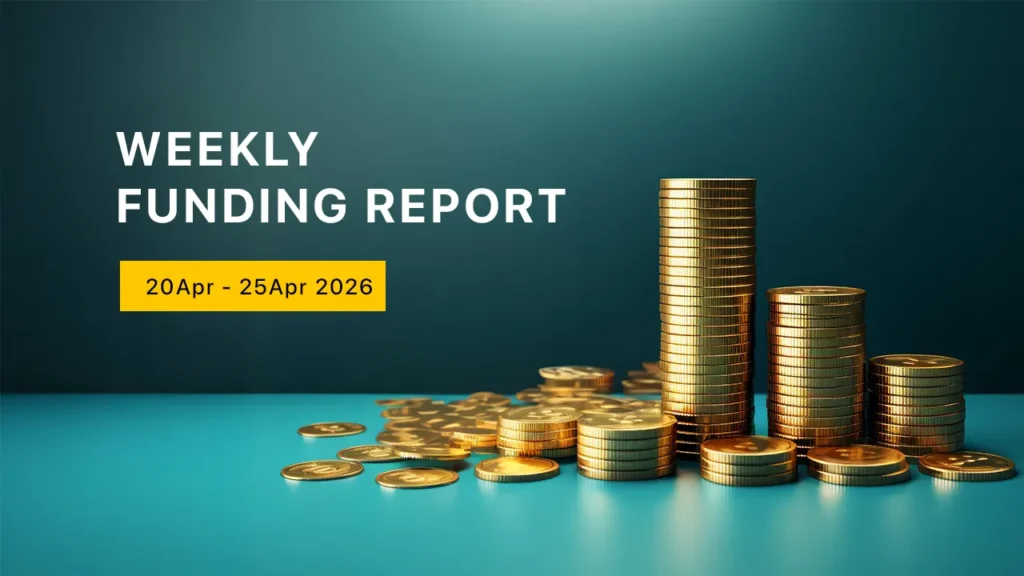
The Indian startup ecosystem witnessed another week of subdued funding activity between April 20 and 24, 2026, with companies raising just $39 million across 15 deals . This marks the lowest weekly total of 2026 so far, extending a trend of declining venture capital inflows that has characterized the month of April.
To put this in perspective, the previous week (April 13-17) saw $60 million raised across 15 deals . The week before that (April 6-10) had crossed $360 million, driven largely by KreditBee’s $280 million unicorn round . The sharp decline from $360 million to $39 million in just two weeks illustrates the volatile, deal-dependent nature of India’s current funding environment.
| Week | Total Funding | Deal Count |
|---|---|---|
| April 6-10, 2026 | $360.5 million | 23 |
| April 13-17, 2026 | $60.4 million | 15 |
| April 20-24, 2026 | $39 million | 15 |
This volatility reflects the absence of a clear investment theme in India. Globally, AI continues to dominate venture capital flows. In India, while AI startups are raising funds, the quantum remains modest compared to global benchmarks, and large, sporadic deals (like KreditBee’s $280 million round) create wild swings in weekly totals .
The Bright Spot: Early-Stage Resilience
Despite the subdued total, one trend stands out: seed-stage funding surged multifold to $17.8 million this week, compared with just $3.3 million raised at this stage last week . This suggests that while growth-stage and late-stage capital has become selective, investors continue to back new ideas and emerging founders.
Key Seed-Stage Deals This Week:
| Startup | Sector | Amount | Lead Investor(s) |
|---|---|---|---|
| M | Real Estate Tech | $8.8 million | Peak XV Partners, Blume Ventures, CRED |
| Spill Games | Gaming | $3.1 million | Centre Court Capital, PeerCapital, All In Capital |
| NudgeBee | AI | $3 million | Kalaari Capital |
| PrimeInvestor | Fintech | $2.1 million | Rainmatter |
| Açaí Theory | Foodtech | $424,000 | All In Capital |
| Clarity Labs | D2C | $424,000 | Artha Ventures |
The $17.8 million raised at seed stage this week represents a significant vote of confidence in new-age businesses. Investors are clearly willing to place early bets on differentiated models—whether in real estate tech, gaming, AI applications, or wealth management—even as they exercise caution on larger, later-stage rounds .
Sectoral Breakdown: Media & Entertainment Leads, AI Stays Active
The media and entertainment segment emerged as the most funded sector this week, driven largely by LightFury Games’ $11 million Pre-Series A round . The gaming startup, backed by Blume Ventures and a roster of Indian cricket stars including MS Dhoni, Jasprit Bumrah, and Hardik Pandya, is building a game-tech studio for the Indian market.
AI remained the most active sector by deal count, with three startups cumulatively securing $7 million . This is consistent with the broader global theme where artificial intelligence continues to attract consistent capital, even if the deal sizes are smaller than in Western markets.
| Sector | Key Deals | Total Raised |
|---|---|---|
| Media & Entertainment | LightFury Games ($11M), Spill Games ($3.1M) | $14.1M |
| AI | NudgeBee ($3M), Lawyered ($2.5M), Deep Algorithm ($1.7M) | $7.2M |
| Fintech | PrimeInvestor ($2.1M) | $2.1M |
| Real Estate Tech | M ($8.8M) | $8.8M |
| Enterprise Services | STCH ($5.5M) | $5.5M |
The Decline: No Large-Value Deals
The primary reason for the low weekly total is the absence of large-value transactions. Not a single deal crossed the $50 million mark this week, and only one—LightFury Games—exceeded $10 million .
This is in stark contrast to the first week of April, when KreditBee’s $280 million mega-round and Nava’s $22 million Series A had pushed weekly funding to $360 million . The uneven inflow of venture capital into Indian startups reveals the challenges the ecosystem continues to face in terms of having a steady flow of investments .
Factors Contributing to the Slowdown:
1. Global Macroeconomic Uncertainty
The ongoing tension between the US and Iran has stymied fund inflows across emerging markets . Venture capital, particularly from US-based funds, has become more cautious, and Indian startups are not immune to this pullback.
2. Sectoral Concentration of AI Capital
Globally, much of the VC money is flowing into artificial intelligence startups. However, in India, the number of AI startups remains low—though there has been some uptick in recent months . Until the Indian AI ecosystem matures, the country may not capture the same level of AI-focused capital that the US and Europe are seeing.
3. Shift in Investor Strategy
VCs are increasingly focusing on profitability and sustainable growth rather than aggressive scaling. This shift has led to longer due diligence cycles, smaller cheques, and a preference for revenue-generating startups over high-burn, high-growth ventures.
“The uncertain nature of the venture capital (VC) inflow into Indian startups has become evident, as the third week of April showed a very sharp decline in funding after crossing $500 million in the previous week. This uneven inflow… reveals the challenges that the ecosystem continues to face in terms of having a steady flow of investments.”
— YourStory Weekly Funding Roundup
Weekly Review: April 20-24, 2026
Top 5 Deals of the Week
| Rank | Startup | Sector | Amount | Round Type |
|---|---|---|---|---|
| 1 | LightFury Games | Media & Entertainment | $11 million | Pre-Series A |
| 2 | M | Real Estate Tech | $8.8 million | Seed |
| 3 | STCH | Enterprise Services | $5.5 million | Pre-Series A |
| 4 | Spill Games | Gaming | $3.1 million | Seed |
| 5 | NudgeBee | AI | $3 million | Seed |
LightFury Games’ $11 million raise was the standout deal of the week . The game-tech studio’s investor syndicate includes Blume Ventures, V3 Ventures, MIXI, Times Internet, and an impressive lineup of Indian cricketers—MS Dhoni, Jasprit Bumrah, Hardik Pandya, Shreyas Iyer, Ravindra Jadeja, Tilak Varma, and Sai Sudharsan. The involvement of celebrity athletes in a gaming startup signals the growing convergence of sports and interactive entertainment in India.
M, the new venture from Dunzo co-founder Kabeer Biswas, raised $8.8 million from Peak XV Partners, Blume Ventures, and CRED . The real estate tech startup is operating in stealth mode, but the high-profile backing suggests significant ambitions.
STCH, a textile tech startup, raised $5.5 million from Omnivore, Kae Capital, and WVC, continuing the momentum in enterprise services and B2B manufacturing tech .
Investor Activity: Rainmatter and Finvolve Lead
Rainmatter, the investment arm backed by Zerodha, was among the most active investors this week, backing two startups: PrimeInvestor ($2.1 million) and Lawyered ($2.5 million) . The fund has consistently invested in fintech and wealth management startups, and its continued activity signals confidence in the sector despite the broader slowdown.
Finvolve also backed two startups, while Blume Ventures emerged as the lead investor in both LightFury Games and M, demonstrating their continued conviction in the Indian startup ecosystem .
The Two-Track Market
April 2026’s weekly funding data reveals a two-track market in Indian venture capital.
On one track, growth-stage and late-stage funding has become highly selective. The absence of mega-rounds (except for KreditBee’s unicorn round in the first week of April) indicates that investors are reluctant to write large cheques without clear paths to profitability and sustainable unit economics.
On the other track, early-stage and seed-stage funding remains resilient. The seed-stage funding surge to $17.8 million this week, compared to just $3.3 million last week, demonstrates that investors continue to back new ideas and emerging founders . This is critical for the long-term health of the ecosystem—ensuring that the pipeline of future growth-stage companies remains full.
“This uneven inflow of VC into Indian startups reveals the challenges that the ecosystem continues to face in terms of having a steady flow of investments. It is primarily due to the uncertain global macroeconomic environment which is impeding the flow of funds.”
— YourStory
The Bigger Picture: India’s 2026 Funding Landscape
The weekly funding data for April 2026 must be understood within the broader context of India’s 2026 funding landscape.
According to the Tracxn India Tech Annual Funding Report 2026, Indian tech startups raised $11.7 billion in FY26 (April 2025–March 2026), ranking 4th globally . While this represents an 18% decline from FY25’s $14.3 billion, it is a 20% increase over FY24’s $9.7 billion.
The first quarter of the new fiscal year (April–June 2026) has begun with volatility. The first week of April saw a blockbuster $588 million, driven by KreditBee’s $280 million mega-round. The subsequent two weeks have seen funding drop below $100 million—$70 million and $81 million respectively—due to the absence of large-value deals .
This pattern suggests that the new normal for Indian startup funding is characterised by:
- Sporadic large deals that drive weekly totals
- Consistent early-stage activity that keeps the ecosystem healthy
- A selective, quality-focused approach from growth-stage investors
- Continued interest in AI, fintech, and enterprise tech as core investment themes
What This Means for Foundors
For founders navigating the current funding environment, several strategic implications emerge:
1. Early-Stage is Open—But Differentiated
The seed-stage surge to $17.8 million this week demonstrates that early-stage capital is available for founders with differentiated ideas and strong execution capability. However, generic “me-too” ideas will struggle to attract attention.
2. Growth-Stage Requires Proof
The absence of large growth-stage rounds (outside the KreditBee exception) signals that Series B and beyond now require demonstrated profitability, strong unit economics, and clear paths to scale.
3. Alternative Funding is Gaining Traction
Venture debt and revenue-based financing are becoming increasingly important tools for Indian founders. Euler Motors’ $73.6 million Series E round in March 2026 included significant debt participation from BlackSoil and Trifecta Capital, as did Swish’s $38 million Series B.
4. AI is a Strategic Imperative
Even in a slow funding environment, AI startups continue to raise capital. Founders across sectors should consider how AI can be integrated into their products and operations. NudgeBee, H2LooP, and Atlas—all AI-focused—raised significant seed rounds in April .
5. Be Prepared for Volatility
The swing from $588 million to $39 million in two weeks illustrates the unpredictability of current funding. Founders should not assume that a strong week signals a sustained trend, nor that a weak week signals a freeze.
The Road Ahead
The subdued funding of the last two weeks of April reflects the broader challenges facing the Indian startup ecosystem. However, the resilience of early-stage funding—and the consistent activity in AI, fintech, and enterprise tech—suggests that the ecosystem is not in crisis but in recalibration.
The hope is that the second half of 2026 will see a revival in VC funding. Two factors could drive this recovery:
1. Interest Rate Stabilisation
If the US Federal Reserve signals an end to the current rate hike cycle, global liquidity could improve, benefiting emerging markets like India.
2. Indian IPO Momentum
The successful listing of 47 tech IPOs in FY26 has demonstrated that Indian public markets can absorb new-age tech companies. If the IPO pipeline remains strong, it could attract more foreign capital into late-stage private rounds.
As one analyst noted, “The expectations are that this momentum will continue in the months ahead, but one is not quite sure as the global macroeconomic situation continues to remain tense and this will have a bearing on the fund inflow” .
The Final Word
The Indian startup ecosystem raised $39 million across 15 deals between April 20 and 24, 2026—the lowest weekly total of the year. The absence of large-value deals and the continued global macroeconomic uncertainty are the primary drivers of this slowdown.
Yet, beneath the headline number, early-stage resilience persists. Seed-stage funding surged multifold to $17.8 million, and AI startups remain active, with three deals totalling $7 million. Investors continue to back new ideas and emerging founders, ensuring that the pipeline of future growth-stage companies remains full.
The Indian startup ecosystem is not in crisis—it is in transition. The shift from “growth at all costs” to profitability and sustainable growth inevitably means a slower, more selective funding environment. But for founders building differentiated, capital-efficient, and scalable businesses, capital remains available.
The weekly totals will continue to swing. But the underlying health of the ecosystem—measured by the quality of early-stage deals and the resilience of sectoral activity—remains intact.