Beyond the Game: How India’s ‘Everyday Athlete’ Economy Is Fueling a Sports-Tech Boom
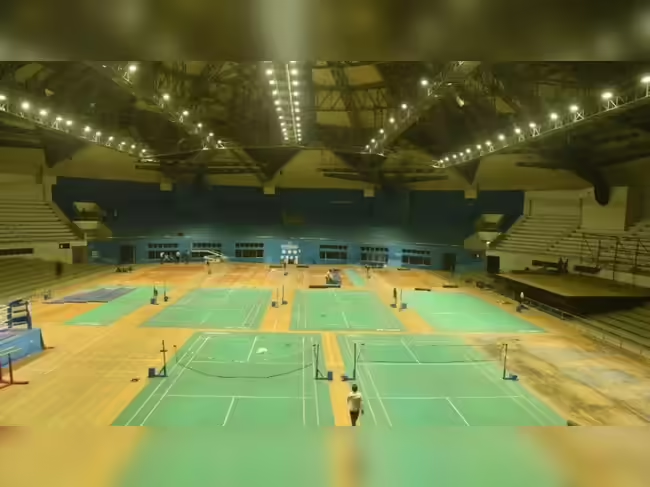
For decades, the Indian sporting landscape was defined by a binary: you either played professionally or you watched from the stands. The casual player—the “everyday athlete”—had few options beyond the local gully cricket match or a sporadic visit to a municipal badminton court. Booking a tennis court required phone tag with a coach. Finding a partner for a game of squash was a matter of luck, not logistics.
That era is ending.
A surge in sports participation across India is sparking a major boom in startups that cater to everyday athletes . These platforms, including Hudle, Playo, KheloMore, and Machaxi, are making it easier for people to book courts, find teams, and turn sports into a regular social habit rather than an occasional pastime . The trend, which accelerated after the COVID-19 pandemic as people sought outdoor social interactions, is now reshaping how millions of Indians engage with fitness and community .
“It’s less about competition and more about identity. This is where India is headed, much like the US did years ago, and that’s why we see a strong future for these experience-led fitness businesses.”
— Dilip Kumar, Investor, Rainmatter
The Numbers Game: A Sector Gaining Momentum
The sports-tech sector has seen fluctuating but sustained investor interest over the past several years. According to Tracxn data, funding in the segment rebounded sharply in 2024, the strongest year in the period, with $6.5 million raised across 10 rounds . In 2025, funding stood at $4.5 million across six rounds, while 2026 year-to-date has recorded nearly $774,800 from a single round .
But the real story lies in the operational metrics and revenue growth of the leading players.
Rainmatter, the Zerodha-backed venture fund, has emerged as a significant backer of this thesis, deploying around ₹100 crore in the segment . The fund has backed startups like Machaxi and KheloMore, betting on the long-term transformation of sports into a lifestyle category.
Beyond the Metros: Tier-2 and Tier-3 Cities Lead the Charge
Perhaps the most encouraging trend is the penetration of organized sports beyond India’s major metropolitan hubs. On KheloMore, nearly 25% of total bookings now come from smaller cities .
Hudle, which operates across 105 cities, is seeing even faster adoption in places such as Indore, Lucknow and Coimbatore, where limited alternatives like malls or multiplexes make organised sport one of the most attractive weekly activities .
This geographic expansion is being enabled by the unlocking of new supply. Many platforms are providing access to underutilised infrastructure, including school and university grounds, which are increasingly being opened for play after working hours and on weekends . This asset-light approach allows startups to scale without the massive capital expenditure of building their own facilities.
“If sports become part of everyday lifestyle, it evolves for both fitness and community in a far more meaningful way than gyms.”
— Gauravjeet Singh, Founder, Playo
The Experience Economy: From Play to Social Outing
The shift in consumer behaviour is profound. As Ujwal Deole, co-founder and COO of KheloMore, observed, “There has been a clear shift where playing itself has become a social outing, similar to going out to a bar or planning a weekend activity” .
This experience-led format extends well beyond racket games with friends after work or weekend court bookings. “Sports like badminton, tennis, or squash have always existed, but what’s emerging now is the rise of experience-led formats, marathons, Hyrox, and similar IPs,” noted Dilip Kumar of Rainmatter .
Content as the New Differentiator
Harsh Shah, founder of HiFy, a startup that installs cameras in courts and grounds so players can capture moments of themselves in action, articulated a key insight: “Content is the easiest and most scalable layer in sports because every game naturally creates moments worth sharing. At the end of every match, people don’t just play—they capture it” . Those clips go on to serve as social media content, bloopers, motivation, and highlights, creating a virtuous cycle of engagement and user acquisition.
The Opportunity Beyond Bookings
For startups, the monetisation opportunity extends well beyond simple court bookings. The ecosystem is opening avenues across:
- Coaching and Training: Structured programmes for children and adults, addressing the gap in quality coaching infrastructure.
- Events and Tournaments: Organised leagues and competitions that drive repeat engagement.
- Equipment and Apparel: A significant market for sports goods, with the government now pushing to position India as a global manufacturing hub for high-quality, affordable sports equipment .
- Community-Led Experiences: Subscription models, corporate events, and social leagues that build long-term customer loyalty.
The Union Budget 2026-27 has provided significant tailwinds to this transformation. The government announced a decade-long Khelo India Mission to overhaul the sports ecosystem, with a focus on creating an integrated talent development pathway, deeper integration of sports science and technology, and the creation of modern infrastructure for training and competition . The overall budget allocation for the Ministry of Youth Affairs and Sports was increased to ₹4,479.88 crore, a marked increase from the previous year .
The Path Ahead: From 1% to Scale
Despite the rapid growth, India’s sports adoption rate is still estimated to be below 1% , significantly behind markets such as the US and Australia . The valuation of India’s sports industry, however, is projected to cross ₹3.4 lakh crore by 2030, growing at a CAGR of 12-14% from ₹1.3 lakh crore in FY25, according to a KPMG report .
The runway is immense. As per capita incomes rise and access to infrastructure improves, founders believe the inflection point is only a matter of time. The goal is to build consistent participation and long-term habits, transforming India from a nation of spectators into a nation of players.
As India prepares to host the Commonwealth Games in 2030 and bids for the 2036 Olympic Games, the investments being made today in grassroots infrastructure and startup-led innovation will define the country’s sporting legacy for decades to come