From Shark Tank Crash to Y Combinator: How Vecros Built India’s First GPS-Free Autonomous Drone
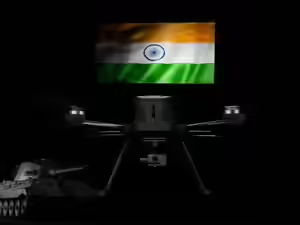
Two years ago, a moment of technical failure on national television nearly grounded the ambitions of a young drone startup. During their pitch on Shark Tank India Season 3, the Vecros drone lost its orientation and crashed while demonstrating obstacle avoidance—an unforgettable moment that could have ended their entrepreneurial journey .
Fast forward to 2026, and the narrative has completely shifted. Vecros, an Andhra Pradesh-registered deep-tech startup building autonomous spatial AI drones, has been selected for the Y Combinator (YC) Startup School—one of the world’s most prestigious startup accelerators that has launched giants like Airbnb, Dropbox, and Stripe .
This remarkable turnaround, from a televised technical failure to global validation, offers powerful lessons in resilience, deep-tech innovation, and the growing international recognition of India’s capabilities in “Physical AI.”
The Shark Tank Moment: A Crash That Became a Catalyst
In 2024, founders Prem Sai (IIT Delhi alumnus) and Rajashree Deotalu (NIT Nagpur robotics expert) walked onto the Shark Tank India set with a bold vision: to build autonomous drones that could fly without GPS, pilots, or cloud connectivity .
The demo went wrong. When Anupam Mittal approached the drone to test its obstacle avoidance, the AI—trained for a specific orientation—lost its bearings. The drone crashed into a wall, leaving the founders disheartened and the sharks alarmed. Zomato’s Deepinder Goyal called it “dangerous,” and boAt’s Aman Gupta admitted it was “risky” .
But the founders didn’t walk away empty-handed.
Despite the crash, Aman Gupta saw potential in their ambition. The founders revealed they had previously rejected a ₹15 crore acquisition offer for 70% of the company—a fact that impressed Gupta. He offered ₹20 lakh for 1% equity (valuing the company at ₹20 crore) along with ₹90 lakh as debt at 10% interest over three years .
It was a deal built on faith in the founders’ vision, not on a flawless demo. As Gupta said, “Aapki innocence aapki strength hai” (Your innocence is your strength) .
What Vecros Builds: GPS-Free, Pilot-Free, Cloud-Free Drones
The core innovation that caught Y Combinator’s attention is Vecros’ flagship product, Athera—India’s first spatial AI-powered drone capable of operating without GPS, pilots, or cloud connectivity .
Technical Specifications of Athera:
| Feature | Details |
|---|---|
| Processing Power | 21 trillion operations per second |
| Sensor Suite | 8 onboard cameras + LiDAR sensors |
| Navigation | GPS-denied, vision-based autonomous flight |
| Autonomy Level | Level 4 (fully autonomous in defined conditions) |
| Flight Time | 30 minutes (dual-swappable battery, redeploy in 5 mins) |
| Price | Approximately ₹2 million |
What makes Athera truly unique:
- No GPS required: Uses computer vision algorithms to navigate using visual landmarks, making it immune to GPS jamming—a critical feature for defence applications .
- No pilot needed: Operates autonomously with onboard AI processing, eliminating the need for skilled drone operators .
- No cloud dependency: All AI processing happens locally on the drone’s custom-built JetCore motherboard, ensuring data privacy and real-time decision-making .
- 360-degree obstacle avoidance: The JetPix Autonomy Engine processes data from 8 cameras and LiDAR to create real-time 3D maps and avoid obstacles .
The Technology Stack:
| Component | Description |
|---|---|
| JetPix Autonomy Engine | Proprietary software for real-time spatial AI processing |
| JetCore Motherboard | Custom-built board for power and communication management |
| Perception Suite | 8 cameras + LiDAR for 360-degree environmental sensing |
| Onboard GPU | 21 TOPS processor for local AI inference |
The startup also has an upcoming product called Jasper, a smaller variant designed for confined spaces like tunnels and pipelines .
Target Markets: Defence, Infrastructure, and Disaster Management
Vecros’ drones are designed for high-risk, GPS-denied environments where traditional drones fail.
Primary Applications:
| Sector | Use Cases |
|---|---|
| Defence | ISR missions, electronic warfare environments (immune to GPS jamming) |
| Infrastructure | Bridge inspection, pipeline monitoring, railway track assessment |
| Construction | 3D scanning, elevation mapping, site surveying |
| Disaster Management | Damage assessment in debris-filled areas, search and rescue |
| Agriculture | Crop health monitoring, multispectral data analysis |
The startup has already secured backing from IDEX Defence India, indicating strong interest from the defence sector in their GPS-free navigation technology .
Business Models:
- Direct enterprise sales with training for industrial clients
- Drone-as-a-Service (DaaS) subscription for fleet operators
- Service-based revenue (₹400,000-500,000 per month) for 3D scanning and terrain modelling
The Y Combinator Milestone: Global Validation
On April 19, 2026, Prem Sai announced on LinkedIn and X that Vecros had been selected for Y Combinator’s Startup School .
The selection was highly competitive: 2,000 builders selected from over 25,000 applications .
Prem Sai’s announcement carried a touch of wit regarding the achievement: “Thought YC was only for SaaS kids building chatbots… turns out they’re letting drone guys in now” .
He emphasized that while the world is obsessed with “AI note-taking apps,” Vecros is focused on Physical AI—drones that see, think, and act in the physical world without relying on GPS .
What YC Startup School means for Vecros:
- Elite mentorship from YC partners and successful founders
- Access to a global network of investors and industry experts
- A credential that serves as a precursor to significant venture capital interest
- Validation that India’s deep-tech capabilities are being recognized globally
The Founders: From IIT Delhi and NIT Nagpur to Global Recognition
Besta Prem Sai (CEO) is an IIT Delhi alumnus with hands-on experience building aerial robots. His technical foundation was developed through research and aeromodelling initiatives as early as 2018 .
Rajashree Deotalu (CTO) is a robotics expert from NIT Nagpur who shares Prem’s passion for autonomous flight .
Together, they have built Vecros into a company with:
- 15-20 patents filed, 10 granted (covering design and method patents)
- 22 employees
- Manufacturing and R&D facilities in Bengaluru with EMI/EMC testing, thrust stands, PCB soldering units
- Production capacity of approximately 10 drones per month
Key Support and Backing:
| Support Type | Details |
|---|---|
| Institutional Backing | IIT Delhi, NIT Nagpur |
| Accelerators | Nvidia Inception, Kalari Capital’s Build-It, Rebalance Accelerator |
| Defence Recognition | IDEX Defence India |
| Investor Backing | Rebalance Angel, Nirman Ventures, Sadev Ventures, TDV Partners |
| Shark Tank India | ₹1 crore deal (₹20 lakh equity + ₹80 lakh debt) from Aman Gupta |
Why This Matters for India’s Deep-Tech Ecosystem
Vecros’ journey carries several important signals for Indian startups:
1. Physical AI Is the Next Frontier
As Prem Sai noted, while global attention focuses on chatbots and AI note-taking apps, the real transformation will come from Physical AI—machines that see, think, and act in the real world. India has deep engineering talent that can compete in this space.
2. Failure on a Public Stage Is Not the End
The Shark Tank crash could have been the defining moment of Vecros’ story. Instead, it became a footnote in a larger narrative of resilience. The founders used the setback to refine their product, secure defence backing, and ultimately gain global recognition.
3. Deep-Tech Requires Patient Capital
Unlike software startups that can iterate quickly, hardware and robotics ventures require longer development cycles, substantial R&D investment, and patient investors willing to back technology risk. Vecros’ journey from 2018 research to 2026 YC selection spans nearly eight years.
4. Global Accelerators Are Betting on Indian Deep-Tech
Y Combinator’s selection of Vecros—a hardware startup building autonomous drones, not a software “SaaS kid”—signals that the world’s most influential accelerator sees India’s deep-tech potential beyond the consumer internet space .
5. Defence Applications Are a Growth Engine
Vecros’ GPS-free navigation technology has clear strategic value for defence, especially as electronic warfare makes GPS-dependent systems vulnerable. Government backing through IDEX Defence India validates this thesis.
The Road Ahead: What’s Next for Vecros
With Y Combinator Startup School acceptance, Vecros is positioned for accelerated growth.
Immediate Priorities:
- Refining the technology through YC mentorship and global network access
- Scaling manufacturing from 10 units per month to meet enterprise and defence demand
- Expanding trials with defence and enterprise clients
- Developing GPS- and radio-denied environments capabilities for modern warfare applications
Long-Term Vision:
- Launching drone variants for different use cases
- Exporting to global markets
- Transitioning from service-based revenue to product sales and SaaS monetisation
The Final Word
Vecros’ journey from a crashing drone on national television to selection for Y Combinator’s Startup School is one of the most compelling comeback stories in Indian deep-tech.
It demonstrates that Indian founders can build world-class hardware for global markets, that Physical AI is the next frontier of innovation, and that resilience in the face of public failure can lead to extraordinary outcomes.
As Prem Sai noted: “Thought YC was only for SaaS kids building chatbots… turns out they’re letting drone guys in now” .
They are. And India’s deep-tech ecosystem is all the stronger for it.