Razorpay to Confidentially File for IPO at $5–6 Billion Valuation, Targeting $600–700 Million Raise
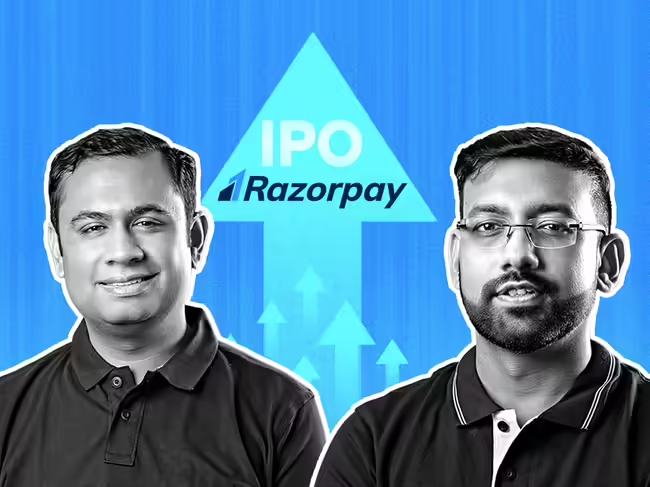
Razorpay, one of India’s most valuable fintech unicorns, is preparing to confidentially file for an initial public offering (IPO) within the next few weeks, according to multiple people familiar with the matter . The digital payments company is looking to raise between $600 million and $700 million, with an expected valuation of $5–6 billion—a significant markdown from its peak private valuation of $7.5 billion achieved more than four years ago .
The listing will be a crucial test of how public market investors now evaluate loss-making fintech firms. With markets turning increasingly selective, the bar for technology listings has risen considerably .
The Confidential Filing Route
Razorpay plans to use the confidential pre-filing route with the Securities and Exchange Board of India (SEBI), a mechanism that allows companies to submit draft IPO documents without immediately disclosing financials and other business information to the public . This approach has gained popularity among new-age Indian startups, with Swiggy, Groww, Meesho, and Zepto among those that have used the method in the recent past .
The confidential filing gives companies flexibility to time their public debut based on market conditions, a valuable option in the current environment of volatility and selective investor appetite .
Valuation Reset: From $7.5 Billion to $5–6 Billion
The expected valuation of $5–6 billion represents a clear reset from Razorpay’s last private peak . This adjustment reflects broader trends in India’s fintech ecosystem, where public market investors have grown increasingly cautious about loss-making startups and slowing growth in the digital payments sector .
Razorpay is not alone in facing valuation pressure. Walmart-backed PhonePe, India’s most widely used digital payments platform, paused its IPO plans in March 2026, citing geopolitical tensions stemming from the West Asia conflict . The decision reportedly also stemmed from the fact that the $7 billion valuation offered by public market investors was more than 50% below its on-paper valuation .
Key Valuation Context:
| Company | Peak Private Valuation | IPO Target/Expected | Status |
|---|---|---|---|
| Razorpay | $7.5 billion | $5–6 billion | Filing soon |
| PhonePe | $12 billion (2023) | $9–10.5 billion (IPO target) | Paused |
The valuation reset for both leading fintech players signals a broader market recalibration. As one person familiar with the matter noted, “With a number of new-age companies now listed, investors in the public markets are pricing startups more conservatively as the performance of a bunch of them hasn’t been great” . However, the same source added that exceptional growth can still command appetite: “But if you show exceptional growth while being loss-making, there is appetite for those assets at a particular price” .
Financial Performance: Revenue Growth Amid Losses
Razorpay’s financial trajectory reflects both the opportunity and the challenge facing Indian fintech. The company reported a 65% year-on-year jump in consolidated operating revenue to ₹3,783 crore in FY25 (year ended March 2025), up from ₹2,296 crore in the prior year .
However, the company also posted a net loss of ₹1,209 crore during the year, weighed down by employee stock option (ESOP) expenses and costs related to its domicile transition .
Razorpay Financial Snapshot (FY25):
| Metric | Value |
|---|---|
| Operating Revenue | ₹3,783 crore |
| Revenue Growth (YoY) | 65% |
| Net Loss | ₹1,209 crore |
| Total Payments Value Processed | $180 billion |
The loss is significant, but the company’s revenue growth trajectory remains strong. Concerns over growth sustainability and the road to profitability could weigh on the IPO’s pricing, according to people aware of the matter . Public market investors in India have grown increasingly selective, favouring companies with clear profitability timelines or clocking big growth numbers .
The Reverse Flip: Coming Home to India
Razorpay’s IPO preparations have been underway for some time. The company completed its reverse flip to India in May 2025, shifting its domicile from the US—a move that cost it about $150 million in taxes . The company also received board approval to convert itself into a public limited company, a key regulatory precondition for listing .
The reverse flip trend has gained momentum among Indian unicorns, with PhonePe, Groww, Meesho, and others also moving their domiciles back to India ahead of public listings. For Razorpay, the move not only simplifies the listing process but also aligns the company’s corporate structure with its primary market and regulatory environment.
Business Overview: Payments Infrastructure at Scale
Razorpay is authorised as a payment aggregator by the Reserve Bank of India (RBI) and offers online, offline, and cross-border payment solutions . The company primarily works with small and mid-size merchants, processing approximately $180 billion in total payments value as per the company’s disclosures . In 2023, Razorpay had reported processing $150 billion, up from $100 billion the previous year—demonstrating consistent growth .
The company also holds a cross-border payment aggregator license from the RBI, enabling it to handle inward and outward cross-border payments under RBI supervision . It serves international merchants including Agoda, Airbnb, Klook, Hostinger, and Shopify, offering payment options such as RuPay (India’s domestic card network), Unified Payments Interface (UPI), equated monthly installment plans, and net banking .
In a strategic move to expand beyond B2B payments, Razorpay entered the consumer payments space by acquiring a majority stake in Pop last year . However, the overall slowdown in the direct-to-consumer segment has impacted companies like Razorpay, which is one of the preferred payment service providers for new-age e-commerce companies .
Competitive Landscape: A Crowded Field
Razorpay competes with a range of established players in India’s digital payments ecosystem, including:
| Competitor | Key Strengths | IPO Status |
|---|---|---|
| PhonePe | Largest UPI market share; Walmart-backed | Paused |
| Paytm | Diversified financial services; listed | Public (₹20 billion IPO in 2021) |
| PayU | Global payments player | Not listed |
| Cashfree | B2B payments focus | Not listed |
The Indian fintech market has become increasingly crowded, with many companies offering similar services . Monetisation remains a key question, as digital payments in India remain a low-margin business—the government launched UPI in 2016 and does not allow companies to charge fees for most transactions .
Why This Matters for India’s Fintech Ecosystem
Razorpay’s IPO preparations carry several important signals for India’s fintech landscape:
1. A Crucial Test for Loss-Making Fintechs
The listing will be a crucial test of how public investors now look at loss-making fintech firms. Markets have turned choosier and want cleaner paths to profitability and unit economics .
2. Valuation Realism Is the New Norm
The $5–6 billion target represents a clear reset from Razorpay’s $7.5 billion peak. This reflects a broader market recalibration where sustainable growth and profitability are valued more than aggressive valuations.
3. The Reverse Flip Trend Continues
Razorpay’s successful reverse flip—despite the $150 million tax cost—demonstrates that Indian unicorns are willing to incur significant expenses to align their corporate structures for domestic listings.
4. Public Market Appetite Is Selective
The pause of PhonePe’s IPO and the valuation reset for Razorpay both point to the same reality: public market investors are pricing startups more conservatively than private investors. The performance of recently listed new-age companies has made investors more discerning .
5. Growth Alone Is Not Enough
While Razorpay’s 65% revenue growth is impressive, the ₹1,209 crore loss raises questions about the path to profitability. Investors are increasingly looking for companies that can demonstrate both growth and a credible timeline to profits .
The Road Ahead: What to Watch
Razorpay is expected to file its confidential IPO papers in the coming weeks. The timing of the actual listing will depend on market conditions, investor feedback during roadshows, and SEBI’s review process.
Key milestones to watch:
- Confidential filing submission: Expected within weeks
- SEBI review and observations: Typically takes 2–4 months
- Public filing of DRHP: After SEBI clearance
- Investor roadshows: Valuation and pricing will be tested
- Listing: Likely in late 2026 or early 2027, depending on market conditions
The IPO will be closely watched as a benchmark for Indian fintech companies entering public markets. If successful, it could pave the way for other fintech unicorns—including PhonePe, BharatPe, and others—to proceed with their listing plans. If it faces headwinds, it could signal further caution in the sector.
The Final Word
Razorpay’s preparation for a confidential IPO filing marks a significant moment for India’s fintech ecosystem. The $600–700 million raise at a $5–6 billion valuation represents a clear reset from the company’s $7.5 billion peak—a sign that valuation realism is taking hold in the sector.
With revenue jumping 65% to ₹3,783 crore but losses standing at ₹1,209 crore, Razorpay embodies the dual narrative of Indian fintech: impressive growth coupled with the challenge of achieving profitability. The company’s ability to articulate a credible path to profits will determine how public market investors receive the offering.
The timing is also significant. Coming just weeks after PhonePe paused its IPO plans, Razorpay’s move tests whether there is appetite for loss-making fintechs in the current market. If successful, it could reinvigorate the fintech IPO pipeline. If not, it could reinforce the caution that has settled over the sector.
As one observer noted, “The listing will be a crucial test of how public investors now look at loss-making fintech firms” . That test is now imminent.