
The Green Hydrogen Puzzle: Why Electrodes Matter
For years, green hydrogen has been hailed as the “holy grail” of the energy transition. The concept is elegant: use renewable energy (solar/wind) to split water into hydrogen and oxygen, creating a zero-carbon fuel that can power heavy industry, fertilize crops, and propel long-haul transport.
But there has always been a catch: the cost.
Green hydrogen remains significantly more expensive to produce than its carbon-intensive cousin, grey hydrogen (made from natural gas). The primary bottleneck? The efficiency and durability of the electrolyser—the machine that actually performs the water-splitting magic.
Enter Newtrace.
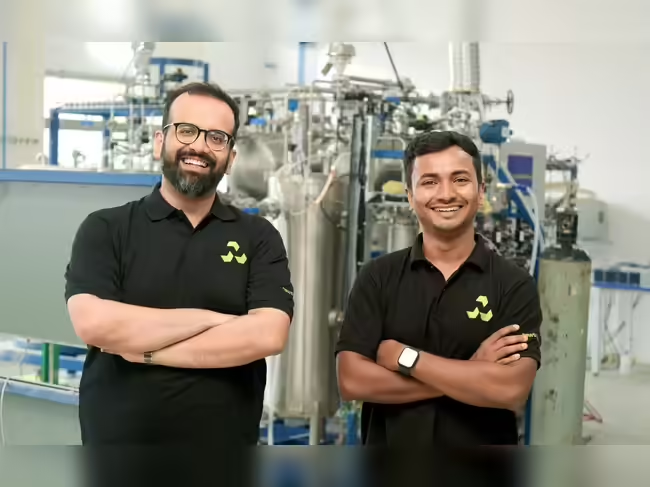
This deep-tech startup is tackling the problem at its most fundamental level: the electrode stack. And now, with a fresh infusion of capital from some of the most respected names in finance and insurance, they are poised to scale their solution to the global market.
The Funding Round: A Consortium of Strategic Heavyweights
Newtrace has just announced a landmark funding round that brings its total capital raised to over $12 million. But it’s not just the amount that turns heads; it’s the composition of the investor syndicate.
The round is backed by a powerful mix of strategic and institutional investors, including:
- HDFC Bank: India’s largest private sector bank, signaling the commercial banking sector’s growing appetite for funding deep-tech climate solutions.
- Mitsui Sumitomo Insurance Venture Capital: A major Japanese financial institution, bringing global perspective and credibility.
- Peak XV Partners: Formerly Sequoia India, one of the most influential venture capital firms in the region, doubling down on their climate-tech thesis.
- Other partners: Including existing backers who continue to support the vision.
This mix of a top-tier VC, a major Indian bank, and a global insurance giant’s venture arm is a powerful validation. It suggests that Newtrace’s technology is not just scientifically interesting, but commercially viable and scalable.
The Technology: Re-engineering the Heart of the Electrolyser
To understand why investors are excited, we have to look under the hood at what Newtrace is actually building. The startup develops proprietary, high-performance electrodes and membrane electrode assemblies (MEAs) specifically designed for alkaline electrolysers.
These components are the “engine room” of the hydrogen production process. Their performance dictates everything: how much hydrogen you get for a given unit of electricity, how long the system lasts, and ultimately, how much the hydrogen costs.
Newtrace’s innovation focuses on four critical areas:
1. Eliminating Expensive Metals
Traditional electrolysers often rely on platinum-group metals (PGMs) as catalysts. These materials are rare and expensive, driving up capital costs. Newtrace is developing electrode architectures that significantly reduce or eliminate the need for PGMs, replacing them with more abundant and affordable materials without compromising performance.
2. Boosting Energy Efficiency
The single biggest operating cost for green hydrogen is electricity. If an electrolyser is inefficient, it wastes renewable power. Newtrace’s electrodes are designed to maximize hydrogen output per kilowatt-hour, improving the overall system efficiency and making the economic math work better for producers.
3. Enhancing Durability
Electrolysers operate in harsh chemical environments. Over time, electrodes degrade, leading to performance loss and costly downtime. Newtrace is engineering its materials to withstand real-world operating conditions—including the fluctuating power supply that comes with renewable energy—extending the lifespan of the entire system.
4. Driving Down LCOH
All of these improvements funnel into one crucial metric: the Levelized Cost of Hydrogen (LCOH) . By making electrolysers cheaper to build (fewer precious metals) and cheaper to run (higher efficiency, longer life), Newtrace aims to make green hydrogen price-competitive with grey and blue hydrogen. This is the “holy grail” moment the industry is waiting for.
The Deployment Plan: From Lab to Gigafactory
With the fresh capital in the bank, Newtrace has a clear roadmap for the next phase of growth.
- Scaling Manufacturing: The immediate priority is to move from lab-scale prototypes to pilot and semi-commercial production. This means setting up facilities to manufacture advanced electrodes and MEAs in larger volumes to supply to electrolyser OEMs (Original Equipment Manufacturers).
- Strengthening R&D: The race for efficiency is never over. The funding will fuel further material science innovation, extensive testing under industrial conditions, and the expansion of their intellectual property (IP) portfolio to build a defensible moat.
- Deepening Partnerships: Newtrace plans to forge closer ties with global energy companies, electrolyser manufacturers, and large Indian industrial players (in steel, refining, and fertilizers) for co-development, validation, and early-stage deployments.
- Building the Team: Scaling a hardware-deep-tech startup requires top-tier engineering and operational talent. Part of the capital will go toward building the team required to support larger-scale production and customer trials.
Why This Matters: India’s Green Hydrogen Mission
This funding round is not happening in a vacuum. It is a direct response to the massive policy push from the Government of India through the National Green Hydrogen Mission.
With a ₹19,744 crore outlay and a production target of 5 million metric tonnes (MMT) per annum by 2030, India is betting big on becoming a global hub for green hydrogen production and export.
However, a target is just a number without the technology to back it up. Startups like Newtrace are critical to the mission’s success. They are building the indigenous IP and manufacturing capability that will allow India to be a technology leader in the green hydrogen space, not just a consumer of imported electrolyser technology.
The investment from HDFC Bank and Mitsui Sumitomo shows that strategic capital recognizes this opportunity. They are betting that Newtrace can become a key supplier to the massive electrolyser manufacturing capacity that will need to be built in India over the next decade.
The Bigger Picture: Climate-Tech Momentum
Newtrace’s raise is part of a broader wave of climate-tech optimism in India. From the Namma Bengaluru Challenge awards for urban sustainability to Trichy’s EV funding and Sanyark Space’s satellite launch, investors are increasingly willing to back hardware-intensive, high-impact solutions.
The days of software-only startups dominating the funding charts are over. Deep-tech, physical-science innovation is having its moment, and Newtrace is a shining example.
The Road Ahead
Green hydrogen is often described as the fuel of the future. With this funding, Newtrace is working to ensure that future arrives sooner—and that India plays a central role in building it.
By solving the critical bottleneck of electrolyser performance, Newtrace is helping position India as a serious innovator in the global green hydrogen value chain. It’s a strong step forward for sustainable deep tech from India, and a company to watch closely in the coming years.