“India Is Moving at a Pace Few Places Can Match”: Scale AI’s Alexandr Wang on Why Bharat Will Lead the Personal Superintelligence Era
As the world’s attention remains fixed on Silicon Valley and Beijing, one of AI’s most influential voices has placed a bold bet elsewhere: India.
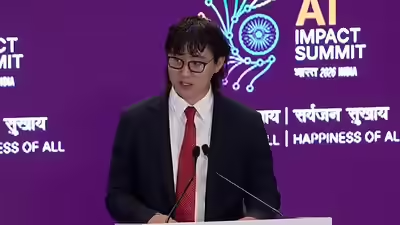
In remarks delivered at a high-profile tech event coinciding with the historic India AI Impact Summit 2026, Alexandr Wang, CEO of Scale AI and one of the youngest self-made billionaires in the tech world, offered a compelling vision of India’s rise as a global AI powerhouse .
Wang, whose company provides data infrastructure for frontier AI models (including those from OpenAI, Meta, and the U.S. Department of Defense), didn’t hold back his enthusiasm. He painted a picture of an ecosystem that has reached a critical inflection point—one that is now poised to leapfrog established players in the race toward personal superintelligence .
India’s Unparalleled Advantages: Why Now?
Wang’s optimism isn’t based on hope—it’s grounded in what he described as India’s unique and structural advantages in the AI era.
1. The World’s Second-Largest Developer Community
With over 5 million developers and counting, India’s technical talent pool is second only to the United States. But Wang emphasized that it’s not just about quantity—it’s about quality and adaptability:
“Indian engineers and founders are not just executing—they’re innovating at the frontier. They’re building agentic systems, multimodal models, and personalized intelligence solutions that rival anything being built anywhere in the world.”
2. A Vibrant, Fast-Moving Startup Ecosystem
Wang pointed to the remarkable momentum in India’s deep-tech landscape:
- Sarvam AI’s 105B-parameter model —outperforming global giants on Indic benchmarks
- Krutrim —building sovereign AI infrastructure
- InfinyAI Labs —pioneering efficient, India-optimized AI
- Hundreds of emerging startups across healthcare, agriculture, fintech, and governance
“The speed and creativity of Indian founders is extraordinary. This ecosystem is moving at a pace few places can match.”
3. A Massive Digital Population with Appetite for AI
India’s 1.4 billion people represent one-sixth of humanity, but what excites Wang is the combination of:
- High smartphone penetration —hundreds of millions of connected users
- Digital native behavior —comfort with UPI, WhatsApp, and other digital services
- Appetite for personalized experiences —users who embrace AI-powered interactions
- Voice-first culture —natural alignment with conversational AI interfaces
4. Cultural and Linguistic Diversity
Perhaps most significantly, Wang highlighted India’s diversity as a competitive advantage, not a challenge:
*”India is the perfect real-world testbed for inclusive, multilingual models. If you can build AI that works for India—with its 22 languages, countless dialects, code-mixing, and cultural nuances—you can build AI that works for the world.”*
This insight aligns perfectly with recent breakthroughs like Sarvam-105B, which demonstrated native-level fluency across all scheduled Indian languages and strong handling of Hinglish and regional variations .
Meta’s India Commitment: Building on Llama’s Foundation
Wang’s remarks gain additional significance given his role in the broader AI ecosystem. As the head of Scale AI—which partners closely with major foundation model developers—he offered insight into how global players are thinking about India.
Meta’s Deepening India Focus
Wang noted that Meta (parent company of Facebook, WhatsApp, and Instagram) is doubling down on its India commitment across multiple dimensions:
1. India-Specific AI Models
- Developing models explicitly tailored for Indian languages, accents, code-mixing, and cultural context
- Building on Llama’s open-source foundation to create India-optimized variants
- Ensuring these models understand not just words, but cultural nuance and context
2. Infrastructure Investment
- Expanding investments in local compute capacity to support Indian developers
- Providing developer tools and APIs that lower barriers to AI experimentation
- Strengthening ecosystem partnerships with Indian startups and research institutions
3. Strategic Priority
- Positioning India as a core growth market in Meta’s global AI strategy
- Not just for user adoption of Meta’s products, but for co-creation of next-generation technologies
- Recognizing that solutions built for India can scale globally
Real-World Impact Already Visible
Meta’s India AI push is already bearing fruit:
- Llama-based tools seeing growing adoption among Indian developers
- WhatsApp AI features reaching millions of users in multiple languages
- Enterprise collaborations with Indian companies exploring AI-powered customer engagement
Personal Superintelligence: The Next Frontier
Wang’s most provocative framing was around the concept of personal superintelligence—AI systems that don’t just answer questions but truly understand individuals, anticipate needs, and act as intelligent partners in daily life.
“We’re moving from AI as a tool to AI as a collaborator—something that knows you, understands your context, and helps you navigate an increasingly complex world.”
Why India Is Poised to Lead in This Era
Wang offered several reasons why India might leapfrog other markets in the personal superintelligence race:
1. Mobile-First, Voice-First Mindset
Unlike Western markets where desktop computing shaped digital behavior, India leapfrogged directly to mobile. This creates natural affinity for:
- Voice interfaces over text
- Conversational AI over menus and forms
- Personalized assistants over generic tools
2. Data-Rich Environment
India’s digital public infrastructure—UPI, Aadhaar, DigiLocker, CoWIN—has created unprecedented data flows that, with appropriate privacy safeguards, can train AI systems to understand Indian users at scale.
3. Frugal Innovation DNA
Indian engineers have always excelled at doing more with less—building solutions that work within constraints. This mindset is perfectly suited for:
- Efficient model architectures that deliver high performance per watt and per rupee
- Edge AI that runs on modest hardware
- Cost-effective scaling to reach hundreds of millions of users
4. Global South Leadership
As Wang noted:
“The next billion AI users will come from the Global South. They won’t speak English as their first language. They’ll interact through voice. They’ll have different needs and contexts. India is where the solutions for this future are being built today.”
Global Giants Betting Big on Bharat
Wang’s remarks add to a growing chorus of global tech leaders placing significant bets on India’s AI future:
Anthropic
- Engaged with Indian policymakers on AI safety and responsible development
- Exploring India-specific model variants and applications
- Deep investment in multilingual AI and Indic language models
- Partnerships with Indian research institutions and startups
NVIDIA
- $1 billion+ DGX Cloud deal with Yotta for India’s largest AI supercluster
- Partnership with AIGI to catalyze 500+ AI ventures
- Collaborations with top Indian VCs (Peak XV, Accel India, Elevation Capital)
OpenAI
- Engaged with Indian ecosystem through the India AI Impact Summit
- Exploring India-specific deployments and partnerships
Meta
- As highlighted by Wang, deep commitment to India across models, infrastructure, and ecosystem
Microsoft
- Significant Azure infrastructure investment in India
- Partnerships with Indian enterprises and startups for AI adoption
The message is unmistakable: India is no longer just a market for global AI companies—it’s a partner in building the future of the technology itself .
What This Means for Indian Founders and Developers
For those building in India’s AI ecosystem, Wang’s remarks carry several actionable implications:
1. Validation That the World Is Watching
When leaders like Alexandr Wang publicly praise India’s ecosystem, it signals to global investors, partners, and customers that Indian innovation is world-class. This translates into:
- Easier access to international capital
- Stronger partnerships with global companies
- Greater credibility when expanding abroad
2. Opportunity to Build for India First, Scale Globally
The message from Wang and other global leaders is consistent: solutions that work in India will work everywhere. Founders should:
- Embrace India’s complexity as a feature, not a bug
- Build deeply for Indian languages, contexts, and constraints
- Recognize that success in India positions them for global expansion
3. Access to Global Platforms and Tools
With companies like Meta, Google, and NVIDIA investing heavily in India, developers gain access to:
- Cutting-edge models (like Llama) optimized for local needs
- Developer tools that accelerate experimentation
- Cloud and compute infrastructure at scale
- Ecosystem programs (like NVIDIA-AIGI) that provide mentorship and funding
4. Path to Personal Superintelligence
Wang’s vision of personal superintelligence—AI that truly knows and serves individuals—is not distant science fiction. It’s being built today. Indian developers have the opportunity to:
- Shape how billions interact with AI
- Build systems that understand diversity (linguistic, cultural, contextual)
- Create value at population scale
The Bigger Picture: India’s AI Moment
Wang’s remarks didn’t happen in isolation. They came amid a historic week for Indian AI:
- Sarvam AI’s 105B model launch, outperforming global giants on Indic benchmarks
- Yotta’s $2 billion GPU supercluster announcement with NVIDIA Blackwell Ultra chips
- NVIDIA-AIGI partnership to catalyze 10,000+ builders and 500+ ventures
- IN-SPACe’s ₹6 crore seed fund for space-AI startups
- PM Modi’s MANAV Vision for ethical, inclusive AI
- New Delhi Frontier AI Impact Commitments for responsible development
- T-Hub’s Indo-French Startup Corridor with Hauts-de-France
- Karnataka’s bilateral pacts with France and Poland
- PARAM quadruped robot debut showcasing hardware innovation
- InfinyAI Labs’ vision for efficient, India-optimized AI
Each of these developments reinforces the others. Compute infrastructure enables model development. Model development creates demand for tools and platforms. Tools empower startups. Startups build applications that demonstrate value. Demonstrated value attracts global attention. Global attention brings investment and partnerships. And all of it is guided by policy frameworks that prioritize sovereignty, inclusion, and sustainability.
India’s Pace Is Unmatched
Alexandr Wang’s observation that India’s ecosystem is “moving at a pace few places can match” captures something essential about this moment.
It’s not just about any single breakthrough—though Sarvam’s 105B model, Yotta’s supercluster, and PARAM’s debut are each remarkable achievements. It’s about the compound effect of all these developments happening simultaneously, reinforcing each other, and creating momentum that becomes self-sustaining.
For Indian founders, this means the window of opportunity is wide open. Global players are not just watching—they’re eager to partner, invest, and co-create.
For Indian developers, this means the tools, platforms, and infrastructure to build world-class AI are more accessible than ever.
For the 1.4 billion people of India, this means the AI revolution will be built for them, with them, and by them—not imported and adapted, but homegrown and optimized.
As Wang put it:
“India isn’t just catching the AI wave—it’s poised to ride it faster and further than most, turning personal superintelligence from a distant dream into an everyday reality for millions.”
The world is taking notice. And as it does, one thing becomes increasingly clear: India’s AI moment has arrived.