Akashalabdhi’s Inflatable Breakthrough: How a Bengaluru Startup is Reimagining Life in Orbit
In a landmark leap for India’s New Space ambitions, Bengaluru-based startup Akashalabdhi is on the cusp of delivering the country’s first inflatable space habitat. Having successfully cleared critical validation tests in Switzerland, the company’s Antariksh HAB (ANTARIKSHAB) is no longer a conceptual marvel but a tested hardware prototype, positioning India squarely in the global race to build the sustainable, scalable infrastructure for humanity’s future in orbit.
Founded by Siddarth Jena and incubated at IISc Bangalore, Akashalabdhi is tackling one of the most fundamental constraints of space exploration: volume. Traditional rigid modules are limited by the diameter of rocket fairings, making them heavy, expensive, and volumetrically inefficient. Akashalabdhi’s innovation—a multi-layered, flexible, inflatable structure that launches compactly and expands on-site—shatters this paradigm, promising to revolutionize the economics and possibilities of living and working in space.
The Technology: From Folded Package to Orbital Home
The Antariksh HAB represents a symphony of advanced engineering:
- Launch Compact, Inflate in Orbit: The habitat can be folded into a fraction of its deployed size for launch, drastically reducing cost and complexity. Once in orbit, it inflates to provide 70–330 cubic meters of pressurized volume, scalable to house 6–16 astronauts or function as a dedicated orbital lab or factory.
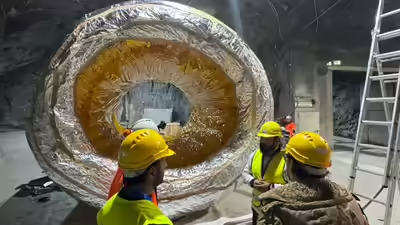
- Rigorous International Validation: The recent tests at Switzerland’s Hagerbach Test Gallery, a facility used for simulating extreme subterranean and environmental stresses, are a testament to the startup’s global standards. Tests focused on structural integrity under pressure, advanced material performance, radiation shielding efficacy, and flawless deployment mechanics.
- Multi-Layer Defense: The habitat’s walls are not simple balloons. They are sophisticated composites designed to protect against micrometeoroid impacts, extreme temperature swings, and cosmic radiation, creating a safe, stable environment.
The Market: Beyond Astronauts, A Platform for Industry
Akashalabdhi’s vision extends far beyond crew quarters. The habitat is designed as a versatile platform for the emerging in-space economy:
- Microgravity R&D: Enabling advanced drug development, novel material synthesis, and protein crystallization experiments impossible on Earth.
- Orbital Manufacturing & Data Centers: Providing the real estate and environment for nascent industries looking to leverage the unique conditions of space.
- Space Logistics & Defense: Serving as a flexible hub for satellite servicing, cargo storage, or strategic operations.
- The Road to the Moon and Mars: Inflatable technology is seen as critical for future surface habitats, where landing large rigid structures is prohibitively difficult.
The Strategic Significance: India’s Entry into the Orbital Infrastructure League
This milestone is transformative for India’s space profile:
- From Participant to Enabler: India moves from providing launch services and satellites to building the foundational habitats where future space commerce will occur. This is a move up the highest-value chain.
- Alignment with Global Trends: Akashalabdhi places India alongside pioneers like NASA (with its BEAM module) and Sierra Space (LIFE habitat), proving Indian engineers can compete at the frontier of space habitation.
- A Testbed for Sovereign Capability: The project, supported by IDEX grants, DRDO testing, and military pilot partnerships, showcases a successful model of deep-tech innovation fueled by strategic public support and private ambition.
- The SpaceX Connection: Advanced talks for a prototype launch on SpaceX in Q1 2026 underscore the commercial seriousness of the venture. A successful launch would provide unparalleled validation on the global stage.
Challenges and the Countdown Ahead
The path from successful ground tests to an operational habitat in orbit is formidable. The startup must secure the launch, prove the deployment sequence in the vacuum of space, and demonstrate long-term durability against the harsh space environment. It will also need to navigate the complex regulatory and safety certifications for human-rating the habitat.
Conclusion: Building the Rooms Where the Future Will Be Invented
Akashalabdhi’s progress is more than a technical achievement; it is an act of profound imagination. It redefines what is possible from a startup ecosystem often perceived as focused on software. By conquering the immense challenge of creating safe, expandable living space in the void, this Bengaluru team is not just building a module; they are laying the groundwork for the orbital neighborhoods, research parks, and industrial zones of the 21st century.
As the countdown to a potential 2026 launch begins, Akashalabdhi carries the promise of making India a key landlord and architect in the new frontier of space. The message is clear: the future of space will not only be launched from India—it will be lived in, and built within, structures conceived in Indian labs.
Stay tuned to Startup Point for continuous coverage of Akashalabdhi’s journey and the rise of India’s space infrastructure pioneers.