The AI Founder Exodus: A Wake-Up Call for India’s Deep-Tech Ambition
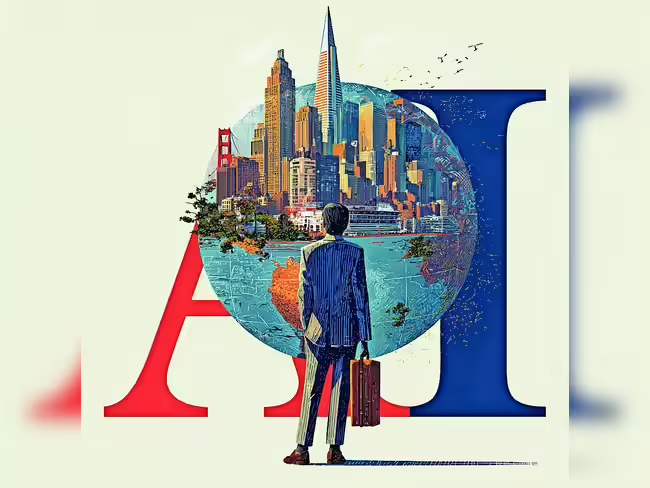
A seismic shift is underway in India’s most promising tech sector, and it’s heading west. As reported by The Economic Times, over 100 founders of Indian AI startups are either relocating to the United States or making concrete plans to do so. This is not a quiet trickle of talent; it is a pronounced migration of the very architects meant to build India’s sovereign AI future. While names like Composio, Meetstream.ai, and Beatoven.ai make the move, this trend ignites a fierce debate: Is this a natural evolution for global ambition, or a damning indictment of India’s deep-tech ecosystem?
This exodus is driven by a powerful gravitational pull toward what founders call the “epicenter effect“—the intangible yet critical advantage of being in Silicon Valley. The reasons are pragmatic, not patriotic:
- Capital Concentration & Conviction: The Valley offers denser pools of venture capital with a higher risk appetite for foundational AI and infrastructure bets. While Indian investors excel in SaaS and application layers, understanding and funding the multi-year, capital-intensive grind of building AI infrastructure or foundational models remains limited.
- Proximity to “Lightning-in-a-Bottle” Innovation: Breakthroughs in AI happen in real-time in Bay Area labs, universities, and even casual conversations. For founders working on the cutting edge, being minutes away from OpenAI, Anthropic, or Stanford researchers is a strategic necessity that remote collaboration cannot replicate.
- Sophisticated First Customers: For B2B AI startups, especially those selling developer tools or enterprise infrastructure, the early-adopter market in the US is deeper and more willing to pay premium prices. Indian enterprises, while vast, often exhibit slower adoption cycles and higher price sensitivity for nascent tech.
The Inconvenient Truth: India’s AI Stack Imbalance
This migration highlights a critical structural weakness. India is producing world-class AI application talent—teams that can brilliantly adapt global models to local problems (as seen with Sarvam AI and Krutrim). However, the infrastructure and foundational model layer—the engine room of the AI revolution—remains overwhelmingly concentrated in the US and China.
Founders moving are signaling that to build the platforms upon which applications run, they feel they must be where the platforms are built. This creates a dangerous dependency: India risks becoming a brilliant app developer on top of foreign-owned operating systems, ceding strategic control and the highest value capture.
The Push and Pull: Navigating a New Reality
The move isn’t without friction. Stricter US immigration policies under the current administration, including heightened scrutiny for O-1 (extraordinary ability) visas and potential H-1B reforms, are creating significant roadblocks. This bureaucratic maze can delay critical hires and force founders to navigate a precarious legal landscape, tempering the allure of relocation.
Yet, these hurdles have not stemmed the flow. This indicates that the pull factors are overwhelmingly strong, suggesting that India’s domestic push factors—while improving—are not yet strong enough.
The Roadmap for Retention: Building a Sovereign Epicenter
The solution is not to lament the departure or erect barriers, but to make staying or returning irresistibly compelling. This requires a multi-pronged, war-time effort:
- Create a “Foundational AI” Capital Corridor: India needs dedicated, patient capital funds with the mandate and expertise to back high-risk, deep-tech AI infrastructure plays. This could involve sovereign wealth fund allocations, corporate venture arms from tech giants, and evolved VC funds that think in 10-year horizons, not 3-year exit cycles.
- Forge Unbreakable Research-Industry Links: Programs like IndiaAI Mission must aggressively bridge the gap between elite research institutions (IISc, IITs) and startups. This means funding PhDs to spin out companies, creating shared compute infrastructure, and incentivizing professors to engage deeply with the commercial ecosystem.
- Cultivate Anchor Enterprise Demand: The government and large Indian corporates must become lead customers for indigenous AI infra. Public procurement and corporate innovation mandates can create the initial market that helps startups cross the chasm to global competitiveness.
- Celebrate and Support the “Glocal” Founder: The ecosystem must champion and structurally support founders who keep R&D in India while commercializing globally. This includes simplifying global remittance of ESOP proceeds, providing tax benefits for IP developed in India, and creating a seamless regulatory environment for serving international customers from home.
Conclusion: A Defining Moment for Sovereign Innovation
The departure of 100+ AI founders is not a failure; it is a diagnosis. It reveals the gaps in India’s ambition to be an AI superpower. These founders are the canaries in the coal mine—highly sensitive individuals voting with their feet on where the optimal conditions for breakthrough innovation currently lie.
India has a narrowing window to act. It possesses the talent, the problem sets, and the digital infrastructure. What it must now build with urgency is the specialized capital, the research-commercial fusion, and the bold first-customer confidence that turns Bangalore, Hyderabad, and Delhi into undeniable epicenters in their own right.
The goal should not be to stop founders from going to the Bay Area, but to create a Bay Area they never feel compelled to leave. The future of India’s technological sovereignty depends on it.
Stay tuned to Startup Point for ongoing analysis of India’s AI policy, deep-tech funding, and the global strategies of Indian founders.