Zetwerk Files Confidentially for ₹5,000 Crore IPO, Eyes Pre-IPO Round Amid Cooling Tech Markets
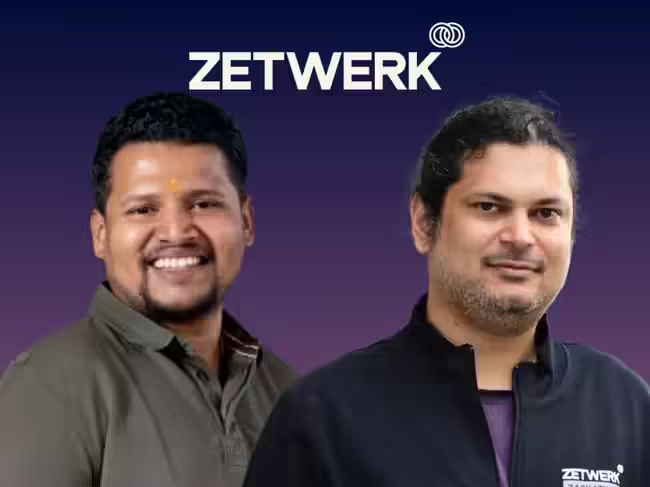
In a move that signals the coming-of-age of India’s industrial-tech sector, business-to-business manufacturing marketplace Zetwerk has confidentially filed its draft papers for an initial public offering (IPO) with the Securities and Exchange Board of India (SEBI) . The Bengaluru-based unicorn is looking to raise approximately ₹5,000 crore (around $550–600 million) , marking one of the most anticipated listings from the country’s deep-tech and manufacturing startup ecosystem .
The confidential filing, made under SEBI’s pre-filing route, allows the company greater flexibility in timing its public debut . Zetwerk is also simultaneously in discussions to raise a ₹500 crore (approximately $50-60 million) pre-IPO round from Bharat Value Fund and a group of high-net-worth individuals, aiming to strengthen its balance sheet and provide partial exits to early investors ahead of the listing .
IPO Structure: Fresh Issue and Offer for Sale
The proposed public issue is expected to consist of both fresh capital and an offer for sale (OFS) component .
| Component | Details |
|---|---|
| Total IPO Size | Approximately ₹5,000 crore ($550-600 million) |
| Fresh Issue | ₹2,700-2,800 crore (approx. $300 million) |
| Offer for Sale (OFS) | Remaining portion (early investors to partially exit) |
| Expected Valuation | $3–4 billion (₹25,000-34,000 crore) |
| Pre-IPO Round | ₹500 crore from Bharat Value Fund & HNIs |
The company has appointed a strong syndicate of investment bankers to manage the offering, including Kotak Mahindra Capital, Goldman Sachs, Morgan Stanley, JM Financial, HSBC, and Pantomath Capital . The bankers will advise on pricing and investor roadshows, navigating what has become a cautious market for new-age tech listings.
Financial Performance: Navigating a Pivot to Profitability
Zetwerk’s financial trajectory reflects a strategic shift from hyper-growth to sustainable profitability. For the fiscal year 2025, the company reported an 11% decline in operating revenue to ₹12,798 crore compared to the previous year . However, the company significantly narrowed its net loss by nearly 60% to ₹371 crore, down from a loss of ₹918 crore in FY24 .
The dip in revenue was a deliberate strategic choice. Co-founder and CEO Amrit Acharya explained that the company is focusing less on capital-intensive construction projects and more on high-margin manufacturing contracts, particularly in the booming electronics, aerospace, and AI-data center sectors . The company expects revenues to exceed $2 billion by FY26, driven by rising demand from AI and data center-related manufacturing .
The Pre-IPO Round: Bharat Value Fund in Talks
The pre-IPO funding round is a critical component of Zetwerk’s strategy to ensure a successful public debut. The company is in advanced discussions with Bharat Value Fund, an alternative investment fund (AIF) managed by financial services group Pantomath, to secure about ₹500 crore . This round is expected to value the company at ₹25,000-26,000 crore (approximately $3 billion) , largely unchanged from its previous valuation .
The stability in valuation reflects cautious investor sentiment in the current market environment, where public market investors are demanding sharper discounts for loss-making companies . By securing this pre-IPO capital, Zetwerk can strengthen its balance sheet and demonstrate improved financial health to public market investors.
Market Context: Testing the Waters Amid Tech Sector Volatility
Zetwerk’s IPO filing comes at a time when India’s public markets are experiencing a shift in sentiment. While India was the world’s second-largest IPO market in 2025, recent listings such as Fractal Analytics and Shadowfax have struggled on debut amid a broader selloff in technology services stocks .
Several other new-age companies are also evaluating IPOs in the coming months, including Zepto, Oyo, Flipkart, Razorpay, and PhonePe . However, PhonePe recently pushed back its $1.3 billion IPO amid volatile market conditions and a valuation gap with mutual fund investors .
Zetwerk’s ability to differentiate itself from pure software companies could work in its favor. Unlike many consumer-tech startups, Zetwerk operates in the physical economy—managing factories, supply chains, and industrial production. Its diversified portfolio spans sectors such as industrial machinery, electronics, renewables, aerospace, and defense, offering investors exposure to India’s manufacturing growth story rather than just digital consumption .
The Zetwerk Story: From Marketplace to Manufacturing Powerhouse
Founded in 2018 by Amrit Acharya, Srinath Ramakkrushnan, Rahul Sharma, and Vishal Chaudhary (IIT Madras alumni), Zetwerk began as a digital marketplace connecting enterprise buyers with manufacturing suppliers . It has since evolved into a full-stack industrial manufacturing platform, offering end-to-end services spanning engineering, production, quality control, and logistics .
The company’s model is often described as a “universal factory.” It aggregates manufacturing capacity across a network of over 20 owned facilities and more than 5,000 third-party suppliers globally, operating across India, Southeast Asia, the Middle East, Europe, and North America . Clients provide designs; Zetwerk handles supplier selection, production, quality control, and delivery.
In a significant strategic move, Zetwerk recently inaugurated a new design-led electronics manufacturing facility in Bengaluru, marking its entry into automotive, aerospace, defense, and IT hardware—sectors central to industrial growth and national security . The facility is part of the company’s push to build a globally competitive, India-born electronics manufacturing platform, aligning with government initiatives such as Make in India, Digital India, and Startup India .
Leadership and Operational Updates
In February 2026, Zetwerk saw its electronics business head Josh Foulger, a former senior Foxconn executive, leave the company to join rival Dixon Technologies . Despite the senior exit, the company continues to expand its electronics capabilities, positioning itself as a key player in India’s contract manufacturing ecosystem.
Zetwerk is backed by a distinguished roster of investors, including Khosla Ventures, Accel, Lightspeed, Peak XV Partners, Greenoaks, Avenir, and Baillie Gifford, as well as IndiGo co-founder Rakesh Gangwal . The company last raised close to $90 million in late 2024 at a valuation of approximately $3.1 billion .
What This Means for India’s Industrial-Tech Ecosystem
Zetwerk’s journey toward a public listing carries several important signals for India’s startup ecosystem.
1. B2B Startups Are Maturing into Large-Scale Enterprises
The IPO pipeline is no longer dominated solely by consumer-tech companies. Zetwerk’s public debut would validate that B2B manufacturing and supply-chain startups can achieve the scale and financial discipline required to attract public market investors.
2. Industrial-Tech Is a Serious Contender
Zetwerk’s success could pave the way for other industrial-tech ventures, such as Infra.Market (which has also filed confidentially for a ₹5,000 crore IPO) and OfBusiness (considering a $1 billion offering), to enter the public markets .
3. Diversifying India’s Startup Success Stories
India’s startup ecosystem is often associated with fintech, e-commerce, and SaaS. Zetwerk’s listing would broaden the definition of “tech” in the public markets, showcasing that deep industrial innovation is also a part of India’s startup story.
4. A Test of Public Appetite for Asset-Heavy Models
Unlike asset-light software companies, Zetwerk operates in capital-intensive sectors. How public investors value such businesses will provide important signals for other hardware, manufacturing, and deep-tech startups considering IPOs.
The Road Ahead
Zetwerk’s confidential filing with SEBI is a significant milestone, but the company has clarified that the pre-filed DRHP does not necessarily mean it will proceed immediately with the IPO . The timing will depend on market conditions, investor appetite, and geopolitical developments—particularly tensions in West Asia, which could impact investor sentiment .
If successful, Zetwerk’s IPO could become one of the most significant listings from India’s industrial-tech sector, providing a liquidity event for early investors and opening the doors for more manufacturing-focused startups to access public capital.
The Final Word
Zetwerk’s confidential filing for a ₹5,000 crore IPO marks a turning point for India’s startup ecosystem. It signals that the country’s innovation story is no longer confined to software and services—it is expanding into the physical economy, where companies build electronics, aerospace components, and renewable energy infrastructure.
As Zetwerk navigates the cautious market environment, its ability to demonstrate profitability, manage geopolitical risks, and articulate its growth story to public investors will determine the success of its listing. If it succeeds, it will not only reward its early backers but also inspire a new generation of industrial-tech founders to build world-class manufacturing businesses from India.