
The Tiger Global Tax Ripple Effect: Why Startups are Demanding Urgent Clarity from the Finance Ministry
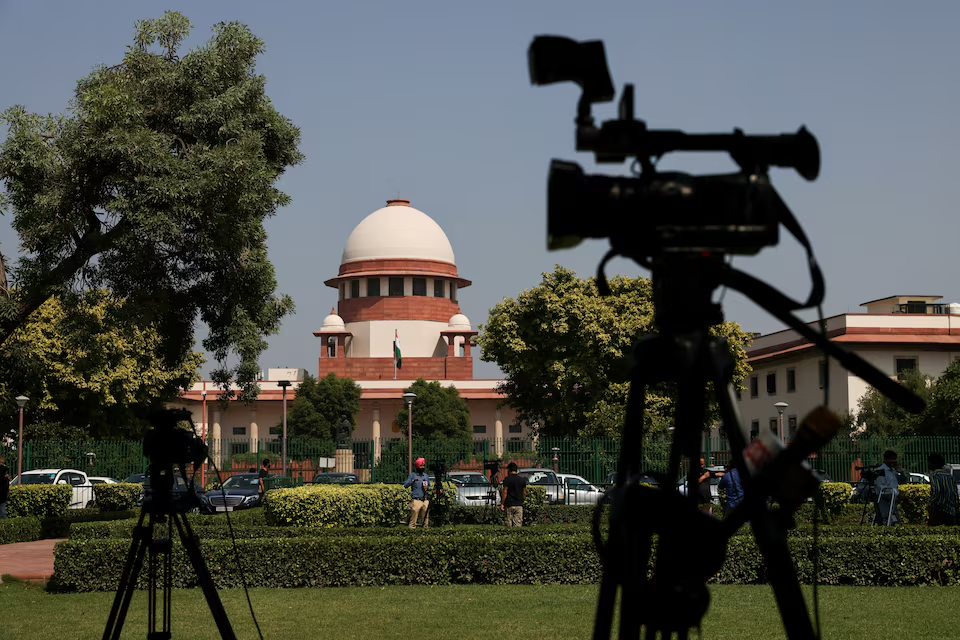
A landmark Supreme Court ruling has sent shockwaves through India’s investment ecosystem, prompting leading startup advocacy groups, including the Startup Policy Forum, to urgently petition the Finance Ministry. The court’s January 15, 2026, decision—mandating Tiger Global to pay capital gains tax on its historic $1.6 billion Flipkart stake sale to Walmart in 2018—has become a flashpoint, raising profound questions about tax certainty, the sanctity of treaties, and the future of foreign capital in Indian startups.
The ruling didn’t just target a single transaction; it pierced the veil of a common offshore investment structure, declaring the Mauritius-based entities involved as mere “conduits” lacking commercial substance, thus allowing India’s General Anti-Avoidance Rules (GAAR) to override protections under the India-Mauritius Double Taxation Avoidance Agreement (DTAA). This has triggered acute anxiety among global funds, forcing a crucial dialogue on the rules of engagement for building India’s innovation economy.
Decoding the Supreme Court’s Verdict: Substance Over Form
The core of the judgment rests on a principle of economic reality over legal formality. Key takeaways include:
- “Conduit” Theory Applied: The court scrutinized and rejected the commercial rationale of the Mauritius structures, finding them primarily established for tax avoidance, despite holding valid Tax Residency Certificates (TRCs). This sets a powerful precedent for piercing corporate veils in future cases.
- GAAR’s Supremacy Asserted: The ruling firmly establishes that GAAR provisions can override treaty benefits in cases of proven tax avoidance. This empowers tax authorities to look beyond paperwork to the genuine purpose of an investment vehicle.
- Retrospective Fear: While the case involved a 2018 exit, the legal principle opens the door for potential retrospective scrutiny of pre-2017 investments made through Mauritius and Singapore, an era before treaty amendments explicitly favored source-based taxation.
The Startup Ecosystem’s Alarm: A Plea for Protection
In a letter dated January 20, 2026, representing around 60 startups, the advocacy groups have sounded a clear warning: the ruling “risks sending mixed signals to foreign investors and may have longer-term implications for India’s startup ecosystem.”
Their concern is not about defending tax evasion but about defending predictability. The Indian startup boom has been fueled by foreign venture capital, much of which flowed through established, treaty-protected channels that were considered legitimate. A sudden shift in interpretation, applied retroactively, could:
- Erode Investor Confidence: Create a chilling effect, making global funds hesitant to deploy capital for fear of unforeseen tax liabilities years down the line.
- Complicate Exits & IPOs: Scuttle ongoing exit discussions and muddy the waters for upcoming IPOs, as investors demand higher risk premiums or indemnities against potential tax reassessments.
- Undermine the 2017 Grandfathering Promise: The 2017 amendment to the India-Mauritius DTAA introduced source-based taxation but included a “grandfathering” clause protecting investments made before April 1, 2017. The startup groups seek an explicit reassurance that this commitment will be honored, preventing a wave of reassessments on older investments.
The Critical Ask: Policy Clarity to Preserve Momentum
The startup forums are not asking for a rollback of the judgment but for proactive, clarifying policy action. Their specific request to the Finance Ministry is to:
- Issue clear guidelines affirming the protection of pre-2017 investments under the grandfathering clause.
- Provide certainty that GAAR will not be applied arbitrarily to reopen past, treaty-compliant transactions.
- Reaffirm India’s commitment to a stable, predictable tax regime for long-term investment.
This clarity is not a favor to foreign funds; it is a strategic necessity for India’s growth. At a time when India is experiencing record IPO momentum and positioning itself as a global alternative for capital, perceived tax instability could divert investment to competing ecosystems in Southeast Asia, Europe, and elsewhere.
The Bigger Picture: Balancing Curbing Abuse and Encouraging Investment
This moment presents a delicate balancing act for policymakers. On one hand, India rightly seeks to curb aggressive tax avoidance and claim its fair share of revenues from massive economic value created within its borders. On the other, it must recognize that risk capital is mobile and sensitive to regulatory uncertainty.
The solution lies in forward-looking clarity, not retrospective ambiguity. The government must distinguish between blatant abuse and structures that were legally accepted in the past, providing a clean slate for future investments under well-defined, contemporary rules.
Conclusion: A Test of India’s Maturity as a Capital Destination
The Finance Ministry’s response to this plea will be a defining signal of India’s maturity as a global investment destination. Will it provide the tax certainty that allows entrepreneurs to build and investors to back them with confidence? Or will a cloud of retrospective ambiguity linger?
For the sake of the thousands of startups driving job creation, innovation, and India’s digital future, the hope is for swift, stabilizing action. Tax certainty is the bedrock upon which the risky, long-term bets of venture capital are made. By providing it, India can ensure that the Supreme Court’s push for tax fairness strengthens, rather than inadvertently undermines, the very ecosystem that creates the value to be taxed in the first place.