StrainX Bioworks Secures $13M to Advance Synthetic Biology
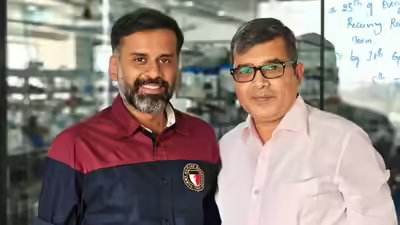
India’s synthetic biology startup ecosystem has taken a significant leap forward with StrainX Bioworks emerging from stealth after securing $13 million in Series A funding co-led by Prime Venture Partners and Leo Capital .
This is not just another funding announcement; it signals a strategic maturation of the Indian biotech landscape—moving from pharmaceutical services towards building indigenous, deep-tech manufacturing capabilities in precision fermentation .
The Rise of Precision Fermentation in India
StrainX Bioworks is leveraging precision fermentation, a technology that engineers microorganisms (like yeast or bacteria) to produce complex proteins and molecules . This method offers a sustainable alternative to traditional animal and chemical manufacturing.
Unlike software startups that can iterate at high speed, StrainX has spent roughly three years in stealth mode building a “full-stack” integrated platform. This includes capabilities in:
- Strain Engineering: Designing the biological blueprints.
- Process Scale-Up: Moving from lab glassware to industrial-sized tanks.
- Product Development: Ensuring the final ingredients meet market standards .
Brij Bhushan, Managing Partner at Prime Venture Partners, noted that the startup stands out because it combines “serious science and sharp business execution”—traits rarely found together in early-stage biotech .
Breaking Down the $13M Series A Round
| Aspect | Details |
|---|---|
| Total Raised | $13 Million (approx. ₹124 crore) |
| Lead Investors | Prime Venture Partners, Leo Capital |
| Other Participants | Good Startup, Sparrow Capital, Sun Icon Ventures, Dholakia Ventures, WindT (IIT Delhi) Angels |
| Use of Funds | Scaling fermentation capacity, R&D, global partnerships, and hiring |
Key Background:
- Founded: 2023 by IIT Delhi alumni Akshay Mittal (CEO) and Dr. Alok Malaviya (CTO) .
- Base: Bhopal (manufacturing) and Bengaluru (R&D lab) .
- Scale: Already achieved repeatable results at 10,000-litre fermentation scale, targeting a tenfold increase to 100,000 litres .
“The last hundred years were defined by chemical manufacturing… Bio-manufacturing is going to define the next decade.” – Akshay Mittal, Co-founder & CEO
From Lab to Global Market: The Execution Roadmap
StrainX’s strategy goes beyond the “pilot plant” stage. The funding is specifically allocated to crossing the commercial “Valley of Death” that often kills deep-tech ventures.
1. Production Scale-Up
The investment will significantly expand fermentation infrastructure. The target is to move from the current 10,000-litre capacity to 100,000 litres, enabling cost-efficient bulk manufacturing of bio-ingredients .
2. Team Expansion
Currently employing over 100 scientists and engineers, the startup aims to double its workforce by the end of the financial year to support R&D and commercial operations .
3. Navigating Regulation
A critical milestone already achieved is the US self-GRAS status (Generally Recognized as Safe) for one of its molecules. This allows the startup to legally enter the massive US food ingredient market .
The Bigger Picture: India’s Biotech Inflection Point
StrainX’s emergence aligns with a broader push towards science-led, capital-intensive manufacturing in India.
1. Policy Tailwinds
The Union Budget 2026-27 has explicitly targeted deep-tech sectors for support:
- Biopharma SHAKTI program: Includes a ₹10,000 crore allocation for biopharmaceuticals and fermentation-based manufacturing .
- Deep Tech Fund of Funds: Aims to channel patient capital into sectors like biotech, addressing the long 10-15 year commercialization cycles .
2. Bridging the Gap
This funding comes at a crucial time. Kiran Mazumdar-Shaw, Executive Chairperson of Biocon, recently warned that India must address gaps in venture funding and regulatory navigation to prevent homegrown innovation from migrating overseas . By building a full-stack manufacturing model in Bhopal, StrainX is executing the kind of “systemic reform” that industry leaders have been calling for .
3. Investor Confidence
The participation of Good Startup—a fund focused exclusively on biology-first deep-tech—marks its first India investment. This suggests that international specialist funds see India’s fermentation infrastructure as a viable, cost-advantaged alternative to Western hubs .
This development puts India firmly on the map as a contender in the global synthetic biology revolution. What are your thoughts on India’s potential to lead in sustainable biomanufacturing? Share your views below.
For more updates on India’s startup ecosystem, funding trends, and deep-tech innovation, keep it locked on StartupPoint.in.
#StrainXBioworks #SyntheticBiology #Biotech #IndianStartups #FundingNews #DeepScience #HealthTech #InnovationEconomy #TechInIndia #InvestorConfidence