Startups and MSMEs Unite: How India’s Tier-2 Regions Are Becoming the New Engines of Growth
There is a quiet entrepreneurial revolution happening in India—one that doesn’t always make the glossy business magazines or the headlines of Silicon Valley-style conferences. It is unfolding in the factories of Surat, the manufacturing units of Indore, the workshops of Ludhiana, and the IT parks of Mysuru .
This revolution is driven by the powerful and growing collaboration between two pillars of India’s economy: startups and Micro, Small, and Medium Enterprises (MSMEs) . And nowhere is this synergy more visible than in the Tier-2 cities that are rapidly emerging as the new engines of the nation’s growth.
Recent SME summits across India—from the ET Make in India SME Regional Summit in Dehradun to the MSME Business Summit in Mumbai—have spotlighted this transformative partnership . The message is clear: when the agility and technological prowess of startups combine with the stability, reach, and manufacturing depth of MSMEs, the result is a mutually reinforcing growth cycle that benefits the entire economy.
The Numbers Tell the Story
The scale of this transformation is staggering. Today, close to 51% of India’s registered MSMEs are coming from Tier-2 and Tier-3 cities . These enterprises are no longer just support systems for the metros; they are becoming economic powerhouses in their own right.
Consider these indicators:
- 63% of all e-commerce orders now originate from smaller cities, with the average spending of a Tier-2 buyer now at par with metro city consumers
- The MSME sector contributes nearly 46% to India’s total exports, with exports surging from ₹3.95 lakh crore in 2020-21 to ₹12.39 lakh crore in 2024-25
- The sector’s share of Gross Value Added (GVA) in India’s GDP has risen from 27.3% in 2020-21 to 30.1% in 2022-23
At the heart of this growth is the increasing integration of startups into the MSME ecosystem. As the Institute of Chartered Accountants of India (ICAI) noted, MSMEs and startups are “important constituents and the backbone of our economy,” with the rise of entrepreneurship in Tier-2 and Tier-3 cities helping to bridge the rural-urban divide .
The SME Summit Circuit: A Platform for Collaboration
Recent months have seen a flurry of SME-focused events across India, each serving as a vital platform for connecting startups with established MSMEs.
Dehradun: Enterprise from the Himalayas
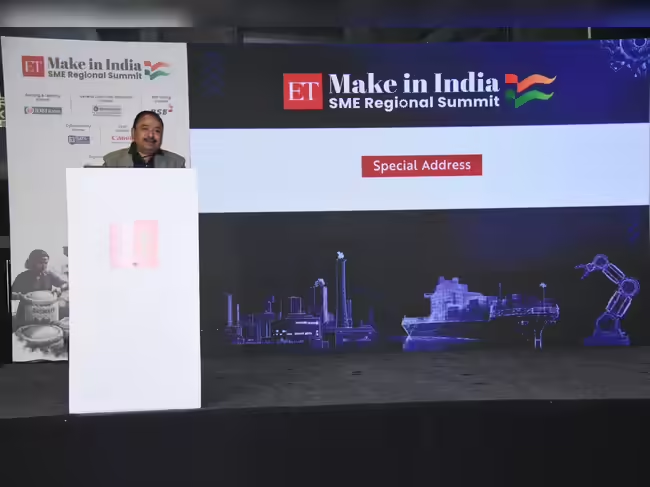
On March 20, 2026, Dehradun hosted the ET Make in India SME Regional Summit under the theme “Enterprise from the Himalayas: Unlocking MSME potential in Uttarakhand” . With over 6,500 registered MSMEs in the city—spanning electronics, manufacturing, pharmaceuticals, food processing, and IT—the event brought together entrepreneurs, policymakers, and industry leaders to deliberate on the future of the sector.
A dedicated session on “From idea to impact: Building a thriving startup ecosystem” featured founders like Vikas Kumar Shah of Flux Motors and Abhinav Ahluwalia of KIWI Kisan Window, alongside Radha Kirthivasan, Head of SME Listing at BSE . The session exemplified how startups are leveraging the infrastructure and market access of established MSMEs to scale rapidly.
Mumbai: Empowering the MSME Ecosystem
Similarly, the MSME Business Summit 2026 in Mumbai focused on bridging critical gaps in funding, mentorship, and resources for small and medium enterprises . The summit featured dedicated pitch segments where founders could present ideas to potential investors, panel discussions on scaling businesses, and networking sessions designed to foster long-term partnerships between startups and established industry players.
Government Initiatives: Building the Infrastructure for Collaboration
The government has recognized the strategic importance of this collaboration and is actively building the infrastructure to support it.
DPIIT’s Vision for Inclusive Entrepreneurship
In June 2025, the Department for Promotion of Industry and Internal Trade (DPIIT) signed a landmark MoU with YourStory Media to empower 1 million entrepreneurs in Tier-2, Tier-3, and rural areas . The initiative leverages AI-powered tools, venture launchpads, and regional language storytelling to expand access to networks and knowledge for aspiring founders from underserved regions.
Shri Sanjiv Singh, Joint Secretary, DPIIT, emphasized the significance of inclusive platforms, noting that the partnership would “expand access to networks, knowledge, and success stories, particularly for aspiring founders from underserved regions, thereby accelerating India’s journey to becoming a global innovation hub” .
Chhattisgarh’s Deep-Tech Push
In February 2026, the Government of Chhattisgarh signed an MoU with the Software Technology Parks of India (STPI) to accelerate the growth of startups and emerging technology sectors in the state . The agreement establishes two key initiatives:
- A Center of Entrepreneurship (CoE) focused on promoting startups in Artificial Intelligence, MedTech, Smart City solutions, and Smart Agriculture
- An Electronics System Design & Development (ESDD) Center designed to support 30–40 hardware startups and MSMEs annually
Chief Minister Vishnu Deo Sai noted that these initiatives would help retain talented youth within the state by creating high-quality employment opportunities locally, reducing the need for migration to metro cities .
Corporate Programs: Fueling the Digital Transformation
Corporate India is also playing a crucial role in fostering startup-MSME collaboration.
Kotak BizLabs: Reaching Beyond Metros
Kotak Mahindra Bank’s Kotak BizLabs Accelerator Programme has emerged as a flagship initiative supporting early-revenue stage startups with deep mentorship, market access, and catalytic funding . In its second season (October 2025–November 2026), the program is supporting 75+ startups across India, with a focus on deep-tech, sustainability, clean energy, fintech, and healthtech.
Himanshu Nivsarkar, Head – CSR & ESG at Kotak Mahindra Bank, highlighted the program’s focus: “Kotak has always believed in backing the entrepreneurial spirit of India—not just in metros, but in Tier-II and Tier-III cities where innovation is thriving” .
The program’s impact is already visible. Season 1 saw 32 high-potential startups awarded grants across agritech, climate tech, fintech, and healthcare, with these ventures now creating jobs, raising follow-on capital, and solving real-world challenges . The expansion to 20+ cities in Season 2 reflects the growing recognition that innovation is no longer confined to traditional tech hubs.
Mastercard’s Digital Saksham: Enabling MSME Digitization
The Digital Saksham program, a Mastercard Strive initiative implemented by the Confederation of Indian Industry (CII), has reached 304,623 enterprises nationwide, enabling 51,455 businesses to adopt digital technologies .
The program’s impact is measurable:
- 15% of surveyed MSEs reported sales growth of more than 10%
- Nearly 50% of surveyed MSEs that registered for GST reported approximately 15% additional income through improved access to credit and reduced payment delays
- Most participating businesses began experiencing measurable benefits within one to three months of adopting digital tools
By equipping MSMEs with digital tools—social media platforms, e-commerce channels, digital payments—the program is helping traditional businesses transition into tech-enabled ventures, creating a natural entry point for startup-led innovation.
Why Tier-2 Cities Are Winning
The surge in startup-MSME collaboration in Tier-2 cities is no accident. These cities offer fundamental advantages that make them ideal for sustainable business growth.
Cost Efficiency
Affordable real estate prices, lower wages, and reduced operational costs allow businesses in Tier-2 cities to achieve profitability faster and with less capital burn . As one analysis noted, “The small-town entrepreneur operates with a different DNA… The limited resources, restricted market reach, and finite credit access help tier II & III entrepreneurs to build with what they have, instead of relying on outside funding” .
Talent Availability
With almost 65% of India’s population under 35 years of age, and much of this demographic concentrated in smaller cities, there is a captive talent pool ready to fuel growth . The emergence of new manufacturing centers, logistics hubs, and IT parks in these towns is creating localized employment opportunities that reduce the need for migration to metros.
Infrastructure and Connectivity
Improved infrastructure, expanded road and rail connectivity, and rapidly growing digital access have cultivated business-friendly environments across Tier-2 cities . Cities like Ahmedabad, Coimbatore, Mysuru, Jaipur, Indore, and Bhubaneswar are now supported by robust industrial parks, software technology parks, and government incentives that make them attractive destinations for both startups and established MSMEs .
Government Incentives
State governments are increasingly offering targeted incentives to attract investment. Gujarat’s GCC Policy 2025–30 offers subsidies of up to ₹15 crore for business setups, while Rajasthan’s 2024 Industrial Policy provides 30% capital subsidies and 15-day approvals . Karnataka’s Elevate program offers up to ₹50 lakh in startup support, and Tamil Nadu’s 2025 reforms include MSME subsidies and land rebates .
The Frugal Innovation Advantage
Perhaps the most distinctive feature of the startup-MSME collaboration in Tier-2 India is the frugal innovation mindset that emerges from resource constraints.
As one analysis noted, “The small-town entrepreneur operates with a different DNA… The frugal innovation mindset, often termed as jugaad, leads to sustainable business models, which are either profitable much earlier or do not burn cash for many years to acquire customers” . This approach, combined with an intimate understanding of local preferences, regional nuances, and cultural contexts, gives Tier-2 entrepreneurs a distinct advantage in building businesses that are resilient, scalable, and deeply connected to their markets .
The Way Forward: From Inclusive Growth to Global Competitiveness
The partnership between startups and MSMEs in Tier-2 India is not just a domestic success story—it is laying the foundation for global competitiveness.
As the ICAI noted, India’s economic resurgence is being “powerfully driven by the rapid growth of the MSME sector and the expanding startup ecosystem” . The country is now the world’s third-largest startup ecosystem, with over 157,000 DPIIT-recognized startups and approximately 110 unicorns .
The recently concluded India-UK Free Trade Agreement (FTA) opens new global gateways for Indian enterprises, eliminating tariffs on 99% of Indian exports to the UK and enhancing opportunities in IT, financial services, and professional consulting . This creates unprecedented opportunities for startups and MSMEs that have built their foundations in Tier-2 India to now scale globally.
The Final Word
The growing collaboration between startups and MSMEs in India’s Tier-2 regions represents a fundamental shift in the country’s economic architecture. It is a story of decentralization, inclusivity, and sustainable growth—where innovation is not confined to a few metro cities but is flourishing across the length and breadth of the country.
As India advances from the fifth-largest to the fourth-largest economy in the world, the role of these partnerships is not just relevant—it is essential . They form the backbone of a self-reliant, future-ready India, where the agility of startups and the stability of MSMEs combine to drive job creation, regional development, and long-term competitiveness.