Skyroot Aerospace Becomes India’s First Space-Tech Unicorn with $60 Million Funding Led by Sherpalo Ventures
Hyderabad-based spacetech startup Skyroot Aerospace has officially entered the unicorn club, raising $60 million at a $1.1 billion valuation. The round was co-led by Sherpalo Ventures—the venture firm of early Google backer Ram Shriram—and Singapore’s sovereign wealth fund GIC .
The funding marks a significant milestone for India’s private space sector, coming just weeks before the company’s historic Vikram-1 orbital launch attempt. Skyroot becomes India’s first space-tech unicorn, nearly doubling its valuation in approximately 2.5 years .
🚀 The Funding Round
| Aspect | Details |
|---|---|
| Amount Raised | $60 million (~₹570 crore) |
| Valuation | $1.1 billion |
| Lead Investors | Sherpalo Ventures, GIC |
| Other Participants | BlackRock, Playbook Partners, Shanghvi Family Office, founders of Greenko Group, Arkam Ventures |
| Board Addition | Ram Shriram (Sherpalo founder, Alphabet board member) joins Skyroot’s board |
| Total Raised to Date | ~$100 million |
“The current round would also imply that the valuations have doubled in 2.5 years.”
— The Economic Times, citing sources familiar with the development
📈 From Suborbital Success to Orbital Ambition
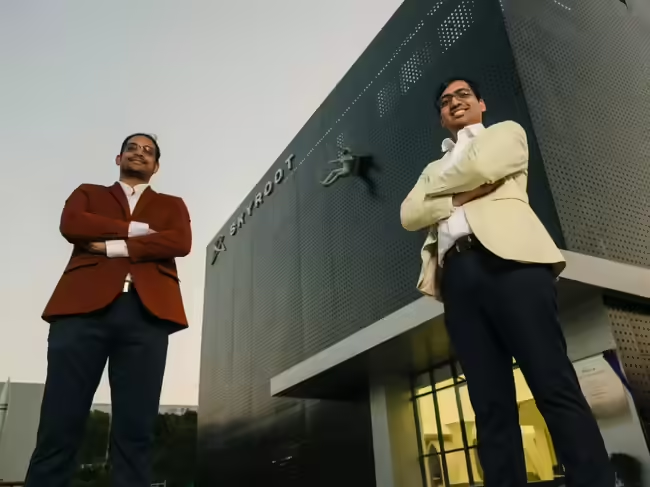
Founded in 2018 by former ISRO engineers Pawan Kumar Chandana and Naga Bharath Daka, Skyroot made history in 2022 with the launch of Vikram-S, India’s first privately built rocket to reach space .
The company is now on the cusp of an even greater achievement: the orbital launch of Vikram-1, India’s first privately developed orbital rocket. The three-stage vehicle has been flagged off to the Satish Dhawan Space Centre in Sriharikota for final integration .
Key Vikram-1 specifications:
- Payload capacity: Up to 350 kg to low Earth orbit
- Structure: All-carbon composite
- Propulsion: 3D-printed engines and high-thrust solid boosters
- Indigenous content: ~95% components sourced within India
- Launch target: June 2026 (launch window opening in June, spanning approximately one month)
📍 Strategic Deployment of Fresh Capital
The $60 million infusion will accelerate several critical initiatives :
| Priority | Details |
|---|---|
| Vikram-1 Launch Cadence | Scale to regular commercial operations |
| Manufacturing Capacity | Expand existing facilities (current capacity: up to one rocket per month) |
| Vikram-2 Development | Heavier launch vehicle with cryogenic stage for 1-tonne payloads |
| Global Market Expansion | Targeting Southeast Asia, Japan, US, and Europe |
“We at Skyroot are excited about the upcoming Vikram-1 launch, India’s first private orbital rocket, marking a significant milestone both for India and the global space sector.”
— Pawan Kumar Chandana, Co-founder and CEO, Skyroot Aerospace
🌍 Market Opportunity and Global Position
The global small satellite launch market is experiencing a structural supply gap. According to industry data, about 219 private launches were expected globally in 2025, but only 33 were serviced by private providers outside China and SpaceX .
India’s space sector is projected to expand from roughly $13 billion today to nearly $40 billion by 2030, potentially making it the world’s third-largest spacetech ecosystem .
🏆 Investor Confidence in India’s Space Ecosystem
The funding round represents a significant vote of confidence in India’s private space sector from marquee global investors:
- Ram Shriram was Google’s first outside investor and remains on Alphabet’s board
- GIC (Singapore sovereign wealth fund) and Temasek have been consistent backers
- BlackRock participated through managed funds, marking its entry into Indian spacetech
“If the company is good, there is no shortage of capital.”
— Pawan Kumar Chandana, Co-founder and CEO, Skyroot Aerospace
🔭 The Road Ahead
With unicorn status secured and Vikram-1 launch preparations in final stages, Skyroot is positioned to be a cornerstone of India’s emerging private space industry. The company plans multiple Vikram-1 missions and envisions scaling to a launch cadence of approximately one rocket per month from its existing facilities .
The company has already attracted interest from customers worldwide, with an anticipated one-third of demand from domestic clients and the remaining from international markets . If the Vikram-1 mission succeeds, India will join a select group of nations with active private orbital launch capability.
For more updates on India’s spacetech ecosystem, startup funding, and deep-tech innovation, keep it locked on StartupPoint.in.
#SpaceTech #Unicorn #IndiaStartups #SkyrootAerospace #Innovation #Deeptech #SatelliteLaunch #RocketTechnology #GlobalExpansion #FutureOfSpace