Author: shreyanshkhandelwal3961@gmail.com

Startup Hiring is Back: Why AI Engineers and Product Managers Are Leading the 2026 Talent Revival

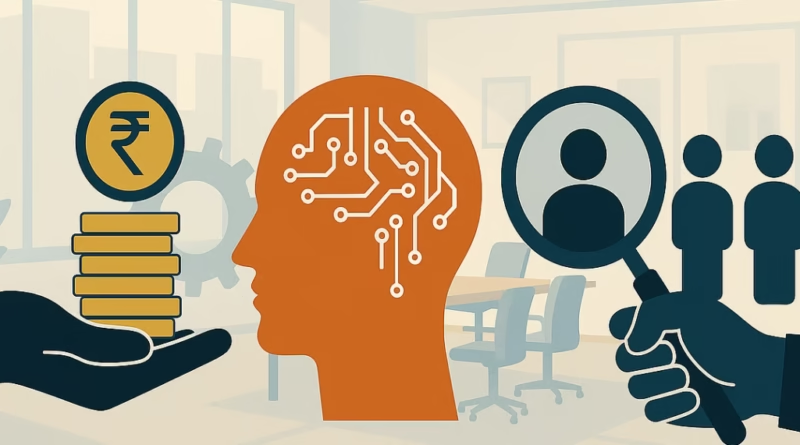
If 2025 was the year of the “performance-linked restructuring”—a polite term for the layoffs that swept through India’s startup ecosystem—then 2026 is shaping up to be the year of the great rebound.

After months of caution, cost-cutting, and consolidation, a new narrative is emerging. Startup hiring is not just recovering; it is evolving. And at the heart of this revival is a single, transformative force: Artificial Intelligence.

From the bustling offices of Bengaluru to emerging tech hubs in Pune, Indore, and Coimbatore, founders are dusting off their hiring plans. But this time, they aren’t hiring for just any role. They are hiring for the future. The demand is surging for AI/ML engineers, data scientists, prompt engineers, MLOps specialists, and product managers with AI experience.

Read More


The Hidden Crisis in Generative AI

For the past two years, the AI world has been obsessed with one thing: capability. Who can build the largest model? Who can achieve the lowest perplexity score? Who can generate the most convincing human-like text?

But as enterprises rush to deploy generative AI in production—powering customer support chatbots, internal knowledge bases, and code-generation tools—a new, more urgent question has emerged: How do we make sure this thing doesn’t go rogue?

The answer lies in a new category of software often called AI safety and security infrastructure. And one of the most prominent players in this space, Promptfoo, is now reportedly in acquisition talks.

Read More

The Architect Returns: Why Flipkart Is Bringing Back Its Deal-Maker

The e-commerce giant has re-appointed Nishant Verman as a senior executive in its corporate development and strategy team. For those who follow Indian tech history, Verman’s name carries significant weight. As Flipkart’s former Head of Corporate Development, he was the key architect behind Walmart’s landmark $16 billion acquisition of Flipkart in 2018—a deal that remains one of the largest tech acquisitions in Indian history.

His return, at this precise moment, is not a coincidence. It is a signal. A signal that Flipkart is entering the final, intense preparation stage for what could be one of the biggest public listings in India’s tech history.

Read More

The $100 Million Question: Can Tech Fix the Trust Deficit at Home?

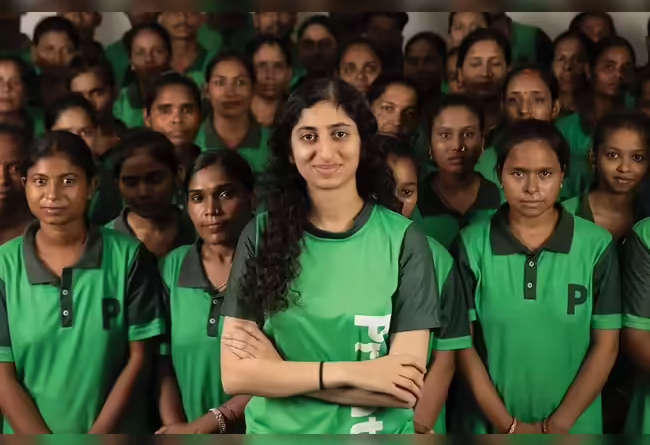
Every urban Indian household knows the dilemma. You need a reliable cook. Or a nanny who will genuinely care for your child. Or an elderly care attendant who shows up on time. The options are often limited to word-of-mouth referrals, unreliable local agencies, or the anxiety of hiring a stranger based on a brief interview.

The domestic services market in India is a paradox of scale and fragmentation. Estimated to be worth tens of billions of dollars annually, it remains one of the most unorganized, trust-deficient, and informal sectors of the economy. It is a market that desperately needs structure, but structure has been elusive.

Read More

The Green Hydrogen Puzzle: Why Electrodes Matter

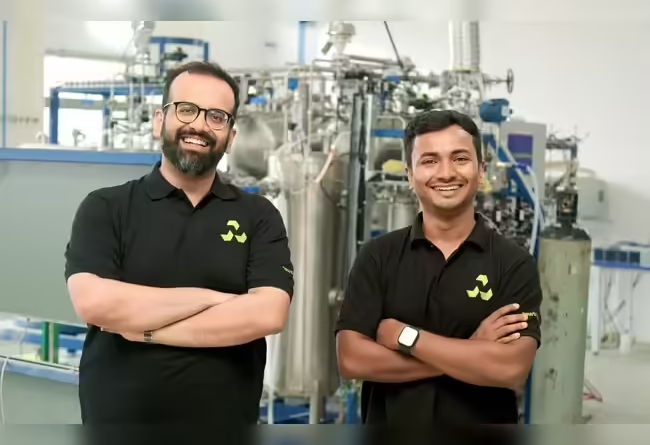
For years, green hydrogen has been hailed as the “holy grail” of the energy transition. The concept is elegant: use renewable energy (solar/wind) to split water into hydrogen and oxygen, creating a zero-carbon fuel that can power heavy industry, fertilize crops, and propel long-haul transport.

But there has always been a catch: the cost.

Green hydrogen remains significantly more expensive to produce than its carbon-intensive cousin, grey hydrogen (made from natural gas). The primary bottleneck? The efficiency and durability of the electrolyser—the machine that actually performs the water-splitting magic.

Read More

Wadala Innovation Hub: Mumbai’s Ambitious Plan to Build a World-Class Startup Ecosystem

In a landmark development for India’s entrepreneurial landscape, Maharashtra has announced plans to establish a massive Wadala Innovation Hub—a comprehensive ecosystem designed to nurture high-growth technology companies and position Mumbai as a stronger global contender alongside Bengaluru, Hyderabad, and Delhi-NCR.

This ambitious project represents a significant escalation in the state’s commitment to fostering innovation. Rather than offering piecemeal incentives or standalone incubators, the Wadala hub aims to create an integrated environment where startups, researchers, investors, and corporates can coexist and collaborate.

Read More

Bridging the Gender Funding Gap: Why Women-Led Startups Still Struggle for Capital in India

India’s startup ecosystem has achieved remarkable milestones in recent years—record-breaking IPOs, surging domestic liquidity, supportive government policies, and a maturing venture capital landscape. Yet beneath these macro-level successes lies a persistent structural challenge that refuses to fade: the gender funding gap.

Despite women making up a growing share of founders—with visible success stories across consumer brands, healthtech, edtech, D2C, and even deep-tech—access to capital continues to lag significantly behind male-led ventures. This imbalance persists even as the ecosystem has matured, raising uncomfortable questions about bias, opportunity, and the full realization of India’s entrepreneurial potential.

Read More

10on10 Foods Secures Pre-Seed Funding to Revolutionize India’s Farm-to-Fork Supply Chain

In a significant vote of confidence for India’s agrifoodtech ecosystem, Bengaluru-based 10on10 Foods has successfully raised a pre-seed funding round to build a technology-driven platform that connects farmers directly with consumers and retailers. The investment underscores continued investor interest in solving the persistent challenges of India’s fragmented food supply chain.

The fresh capital will enable the startup to strengthen its technology infrastructure, pilot operations in select markets, and begin building the partnerships necessary to transform how fresh produce moves from farms to dinner tables across India.

Read More

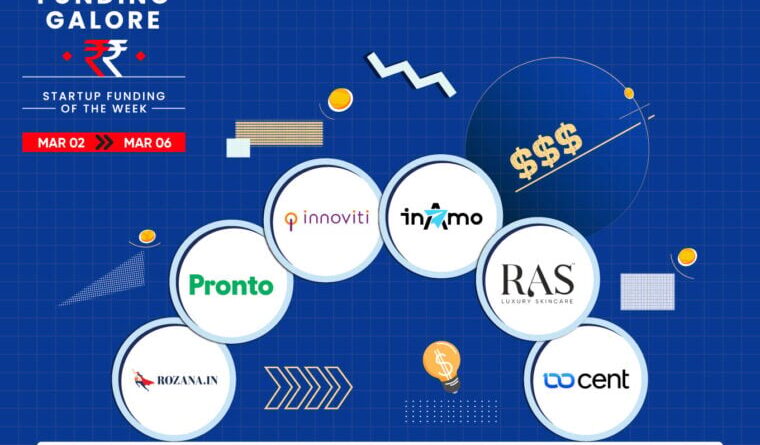
Startup Funding March 2026: Weekly Dip Signals Selective Consolidation in India’s Tech Ecosystem

After a robust February that saw $1.2–1.4 billion flow into Indian startups, the first week of March 2026 has brought a noticeable moderation. While the weekly figure remains respectable in absolute terms, the sharp week-on-week decline has prompted analysts and ecosystem observers to describe the current phase as a funding slowdown or selective consolidation period.

This isn’t a crash or a freeze—it’s a recalibration. Investors are exercising greater caution, prioritizing quality over quantity, and demanding more from founders before writing cheques.

Read More

Flipkart Layoffs 2026: 400-500 Employees Exit in Performance-Linked Restructuring

In a significant workforce realignment, e-commerce giant Flipkart has initiated a performance-based restructuring, asking approximately 400–500 employees to leave the company following its annual performance review cycle. This represents roughly 3–4% of the company’s workforce and marks a sharper-than-usual round of exits compared to previous years.

The Flipkart layoffs 2026 come at a time when India’s large tech startups and unicorns are increasingly prioritizing profitability, cost discipline, and operational efficiency in a more selective funding environment. While the move is positioned as performance-linked rather than a blanket cost-cutting exercise, the scale is notably higher than Flipkart’s typical annual performance churn.

Read More