
Kerala Submits Revised DPR for ₹700 Crore Emerging Tech Hub at Technopark Phase IV
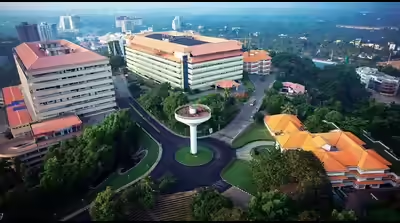
The long-awaited Emerging Technology Startup Hub at Technopark Phase IV in Thiruvananthapuram has entered a crucial execution stage. The Kerala Startup Mission (KSUM) submitted a revised Detailed Project Report (DPR) to the state government last week, introducing a transformative public-private partnership (PPP) framework designed to drive this ambitious ₹700 crore project .
This submission marks a significant step forward for what could become one of India’s largest dedicated startup infrastructure projects, positioning Kerala as a serious contender in the national deep-tech landscape . The revised proposal outlines a sophisticated dual-entity structure: a not-for-profit foundation company to manage public assets alongside a dedicated commercial investment arm to deploy private capital into high-growth startups.
The Revised DPR: Key Structural Components
The revised DPR introduces a two-pronged approach to governance and investment:
1. Emerging Tech Hub Foundation (ETH) – Not-for-Profit Entity
- Function: Mission-driven core of the project
- Role: Holds and manages government-backed assets including land, buildings, laboratories, and technical infrastructure
- Grants Channel: Acts as the channel for grants from state government, central agencies, CSR funds, and philanthropic sources
- Incubation Oversight: Oversees incubation and research support programmes through specialised Technology Advancement Centres (TACs)
2. Apex Investment Holdings Kerala Pvt Ltd – Commercial Engine
- Function: For-profit investment vehicle
- Ownership: Jointly owned by ETH Foundation and private investors
- Role: Aggregates capital and deploys funds into startups across high-growth sectors including space technology, digital media, healthcare and life sciences, food and agriculture, clean energy, artificial intelligence, IoT, and communications technology
Ownership Structure:
- ETH Foundation – 51% majority stake
- Private investors (via Apex) – 49%
Officials noted that this structure has been designed to ensure that public assets and policy priorities remain protected while leveraging private capital for faster ecosystem growth .
Revised Cost and Scale
The project has seen significant cost escalation from its original estimates:
| Aspect | Previous Estimate | Revised Estimate |
|---|---|---|
| Total Project Cost | ~₹500 crore (2025 estimate) | ₹700 crore |
| Operational Expenditure | Over ₹1,000 crore (5-year period) | Under review |
| Building Area | — | Nearly 7 lakh sq ft |
| Structure | 2 blocks | 7 floors each |
Sources: The Times of India , The Hindu
The hub is proposed to come up on a strategically located three-acre plot within Technopark Phase IV (also known as Technocity) and is envisioned as a dedicated cluster for emerging technologies, combining research labs, startup incubation spaces, corporate innovation centres, and high-end technical testing facilities under one roof .
Projected Returns and Revenue Channels
The hub is designed to generate returns through multiple channels, ensuring long-term financial sustainability:
- Equity exits from startups – Returns from successful portfolio companies
- Corporate innovation partnerships – Industry-sponsored R&D and collaboration
- Intellectual property licensing – Monetisation of technologies developed
- Consulting services – Fee-based advisory and technical services
- Revenue-sharing models with scale-ups – Success-based revenue from incubated companies
Sector Focus: Deep Tech and Emerging Technologies
The hub will focus on supporting startups across critical emerging technology sectors :
| Sector | Sub-focus Areas |
|---|---|
| Artificial Intelligence | Generative AI, machine learning, computer vision |
| Space Technology | Satellite communication, ground station services, LEO satellites, data analytics |
| Digital Media | AR/VR, extended reality, animation, gaming |
| Healthcare & Life Sciences | Image processing, medical electronics, regenerative medicine, brain-computer interface |
| Clean Energy | Green hydrogen, perovskite solar cells, smart grid, marine energy |
| IoT & Communications | Blockchain, 5G/6G applications, optical computing |
| Food & Agriculture | Agri-tech, supply chain innovation, precision farming |
KSUM CEO Anoop Ambika highlighted that Kerala has unique strengths in healthcare, with institutions of global standards such as Sree Chitra Tirunal Institute for Medical Sciences and Technology, Rajiv Gandhi Centre for Biotechnology, Regional Cancer Centre, and Malabar Cancer Centre . Similarly, the space sector is supported by premier institutions including ISRO, Vikram Sarabhai Space Centre, and the Liquid Propulsion Systems Centre .
Timeline and Implementation Roadmap
Key Milestones:
- DPR submitted: April 2026
- Administrative sanction: Expected after new government takes office (May-June 2026)
- Expression of Interest (EOI): To be issued post-approval
- Construction start: Targeted for late 2026/early 2027
The project had previously been delayed due to model code of conduct ahead of state elections, with approval now expected from the new government .
Political and Administrative Context
The submission comes at a politically sensitive time, as Kerala recently concluded state elections and a new government is expected to take office next week . The new administration’s approval is critical for the project to proceed.
Sources noted that the project may face further scrutiny if the incoming government chooses to review it afresh . However, given the broad political consensus around the importance of technology and innovation, any review is expected to result in adjustments rather than outright cancellation.
Prime Minister Narendra Modi had, during his January 2026 visit to Thiruvananthapuram, laid the foundation for the Innovation Technology and Entrepreneurship hub as part of a series of development projects worth ₹250 crore .
KSUM’s Deep-Tech Vision for Kerala
The Emerging Technology Hub is part of a broader strategy by KSUM to position Kerala as a leader in deep-tech innovation. In August 2025, celebrating its 10th anniversary, KSUM set an ambitious target of developing 10 deep-tech startups across five critical sectors with an annual turnover of ₹1,000 crore in the next 10 years .
Additional KSUM Initiatives:
| Initiative | Details |
|---|---|
| Deep Tech Innovation Clusters | Decentralised clusters at district level integrating research institutes, medical colleges, higher education institutions |
| GPU Cluster | Collection of interconnected GPUs to support deep-tech startups |
| “New Innings” Programme | Encourage retired employees aged 60+ to begin startups |
| IEDC Network | 550+ Innovation and Entrepreneurship Development Centres across educational institutions |
| Fab Lab Network | Affordable access to advanced prototyping tools |
KSUM CEO Anoop Ambika noted that developing an ecosystem for deep-tech startups requires “modern and constantly reinventing technologies” including data science, generative AI, machine learning, quantum computing, biotechnology, genetic engineering, IoT, blockchain, nano programmable matter, neuromorphic and optical computing, 4D printing, and synthetic biology .
Complementary Initiatives: The Kerala GCC Framework
The Emerging Technology Hub aligns with the state’s broader Kerala Global Capabilities Centre (GCC) Framework . The framework aims to position Kerala as a leading destination for global business and technology innovation, with a focus on:
- Strategic location and world-class infrastructure
- Emerging technologies including AI, machine learning, quantum computing, and photonics
- Support for startups and innovation through IEDCs and LEAP programme
- Inclusive growth and social enterprise development
The state is developing a draft framework on GCC policy, aiming to transform companies into Global Technology Centres (GTC) in the advent of AI and other advanced technologies .
What This Means for India’s Startup Ecosystem
The Kerala Emerging Technology Startup Hub carries significant implications for India’s decentralising startup landscape:
1. Deep-Tech Infrastructure
The hub provides specialised labs, prototyping facilities, and testing environments that deep-tech startups require—infrastructure that is often missing in traditional incubation models .
2. Public-Private Partnership Model
The 51:49 ownership structure with a not-for-profit foundation and a commercial investment arm creates a sustainable model that protects public assets while enabling private capital deployment .
3. Regional Decentralisation
By building world-class infrastructure outside traditional metro hubs like Bengaluru and Hyderabad, Kerala is positioning itself as a serious contender for deep-tech innovation .
4. Institutional Linkages
Proximity to institutions like VSSC, SCTIMST, and RGCB creates a talent pipeline and research ecosystem that few other regions can match .
5. Tier-2/3 Startup Growth
The hub is expected to accelerate startup formation and job creation in Kerala, contributing to the decentralisation of India’s startup story .
The Road Ahead
The ₹700 crore Emerging Technology Startup Hub represents the most ambitious infrastructure project in KSUM’s history. With the revised DPR now submitted and awaiting government approval, the project is poised to enter its implementation phase.
Immediate Priorities:
- Government Approval: The new administration’s administrative sanction (expected May-June 2026)
- EOI Process: Attracting qualified private partners to join the project
- Construction: Building the 7 lakh sq ft facility across two blocks
- Operational Framework: Establishing the Technology Advancement Centres (TACs)
Long-Term Vision:
KSUM’s goal of developing 10 deep-tech startups with ₹1,000 crore annual turnover within a decade reflects a patient, long-term approach to ecosystem building . The Emerging Technology Hub is the physical infrastructure that will house and nurture those startups.
As KSUM CEO Anoop Ambika noted, the revised model “marks a significant shift in how startup infrastructure is conceived in the state,” combining institutional governance with strong investment capability to create “a sustainable innovation and investment ecosystem for Kerala’s next generation of technology start-ups”



The idea of a “transformative public-private partnership framework” is really interesting, as it could drive the ₹700 crore project and position Kerala as a contender in the national deep-tech landscape. As someone who travels with family and considers Muslim-friendly destinations, I think it’s also important to consider the local ecosystem and amenities that would support startup families. For instance, having halal food options and prayer facilities nearby could be a big plus. The parallel between Kerala’s tech hub ambitions and other emerging tech hubs I’ve been reading about is something I’ve been thinking about because they all seem to be leveraging unique regional advantages. I wonder how Kerala’s approach will balance local needs with global aspirations, and what that might mean for the state’s future as a tech destination.