India Startup Funding February 2026: $1.4 Billion Signals Strong Investor Comeback
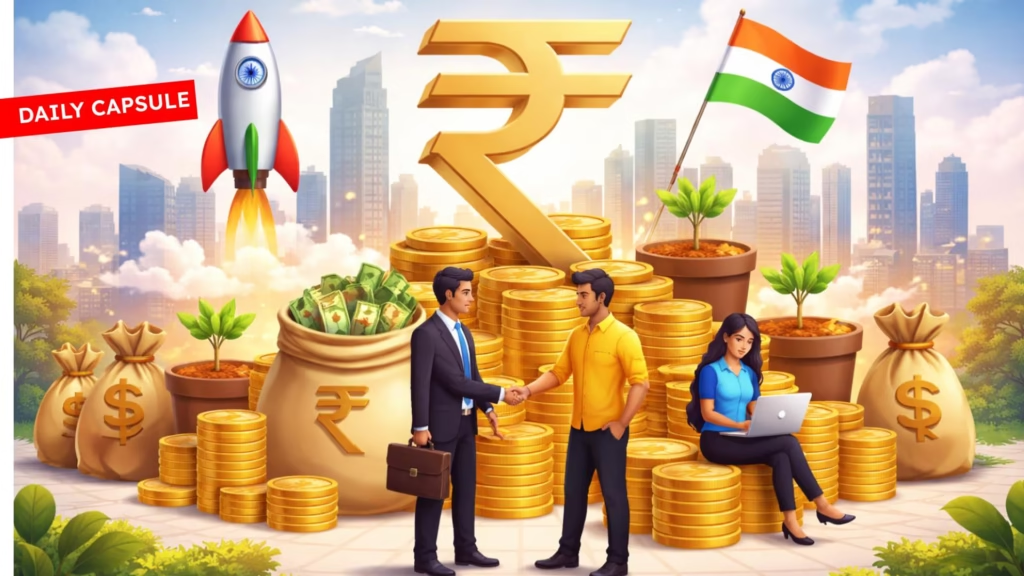
After months of cautious capital deployment and selective deal-making, India’s startup ecosystem has roared back to life. India startup funding February 2026 crossed an impressive $1.4 billion, marking one of the strongest monthly performances in recent memory and sending a clear signal that investor confidence in the country’s tech story is not just intact—it’s accelerating.
The surge was powered by several large-ticket deals in high-conviction sectors, even as the overall number of rounds remained relatively disciplined. This isn’t the frothy, growth-at-all-costs environment of 2021–2022. Instead, February 2026 reflects a maturing ecosystem where investors are writing bigger cheques for fewer, more deserving startups.
The New Investment Paradigm: Quality Over Quantity
What makes the February funding surge particularly significant is the underlying discipline. Investors continue to be highly selective, focusing on startups that demonstrate:
- Proven technology with defensible intellectual property
- Scalable unit economics that suggest a path to profitability
- Strong founder execution and domain expertise
- Clear paths to profitability or global relevance
This selective approach means that while the total funding amount is impressive, it’s concentrated among startups that have graduated from the “story stage” to the “proof stage.” The days of funding PowerPoint presentations are firmly behind us.
Key Drivers Behind the February Momentum
Several factors converged to create February’s funding surge, with capital flowing across multiple high-conviction sectors.
1. Large AI and Deep-Tech Rounds
Artificial intelligence continues to dominate investor attention, with sovereign AI platforms, enterprise automation tools, and compute infrastructure companies attracting outsized cheques. This reflects both global enthusiasm for AI and a growing belief in India’s applied AI opportunity.
Unlike the first wave of AI funding, which focused on foundational models, February’s rounds targeted startups building:
- India-specific AI applications tailored to local languages and contexts
- Enterprise automation tools addressing efficiency gaps in Indian businesses
- Compute infrastructure that reduces dependence on foreign cloud providers
The success of homegrown AI leaders like Sarvam AI and the policy support from the IndiaAI Mission have created a conducive environment for deep-tech funding.
2. Fintech Resurgence
After a period of regulatory uncertainty, fintech is back with a vengeance. February saw significant pre-IPO and growth-stage financings across:
- Digital lending platforms with proven underwriting models
- Regtech solutions helping financial institutions navigate compliance
- Payments infrastructure companies powering India’s digital economy
What’s different this time? Investors are backing profitable, regulated models rather than growth-at-all-costs consumer lending apps. The focus is on sustainability, compliance, and unit economics—qualities that position these companies for long-term success and eventual public listings.
3. Healthtech and Biotech Strength
India’s massive healthcare gaps continue to attract impact-focused capital. February’s funding rounds in healthtech targeted:
- Oncology care platforms addressing cancer treatment access
- Mental health AI solutions tackling India’s silent epidemic
- Preventive diagnostics companies enabling early disease detection
The success of startups like Cent Health in raising capital for AI-driven diagnostics reflects investor confidence in technology-enabled healthcare solutions. With rising chronic disease burden and an aging population, healthtech represents a massive opportunity that’s just beginning to be tapped.
4. Mobility and Sustainability
The transition to clean energy and sustainable mobility remains a high-conviction theme. February saw continued capital flow into:
- EV charging infrastructure companies building the backbone of electric mobility
- Battery technology startups innovating on energy storage
- Regional green mobility ventures serving Tier-2 and Tier-3 cities
State incentives, rising consumer adoption, and the imperative to reduce carbon emissions are creating a favorable environment for mobility and sustainability startups.
5. Global Investor Re-engagement
Perhaps the most significant driver of February’s surge is the renewed commitment from global investors. Key developments include:
- General Catalyst’s $5 billion pledge to India, signaling long-term conviction
- Peak XV and Lightspeed fund closes demonstrating continued capital availability
- Blackstone-backed Neysa’s IPO plans showing a clear exit path for investors
This global re-engagement validates India’s position as a high-conviction emerging market, capable of producing world-class companies and delivering strong returns.
The Numbers Tell the Story
While the $1.4 billion February total is impressive, the composition of funding is equally telling:
- Fewer but larger rounds — The market has consolidated around high-quality startups
- Higher bar for traction — Revenue, profitability, and unit economics matter more than ever
- Growth-stage focus — Capital is flowing to companies ready to scale rather than early-stage experiments
- Domestic capital depth — Indian VCs, family offices, and corporate investors are playing larger roles
What This Means for the Ecosystem
The February funding surge carries several implications for India’s startup ecosystem:
A Maturing Market
The discipline underlying February’s numbers suggests that the ecosystem has learned from the 2021–2022 excesses. Startups are building sustainably, and investors are deploying capital responsibly. This maturity bodes well for long-term value creation.
Clear Exit Pathways
With PhonePe and Turtlemint filing for IPOs, and Blackstone backing Neysa’s public market debut, the IPO pipeline is strengthening. This provides liquidity pathways that encourage further investment.
Policy Tailwinds
Government initiatives continue to support the ecosystem:
- Fund of Funds 2.0 providing capital to emerging managers
- Deep-tech recognition expansion enabling more startups to access benefits
- State-level incentives attracting startups to emerging hubs
Sectoral Diversification
Unlike previous funding cycles dominated by consumer internet, February’s rounds spanned AI, fintech, healthtech, mobility, and deep tech. This diversification makes the ecosystem more resilient and reflective of India’s broader economic opportunities.
The Road Ahead: Which Sector Will Lead?
As the ecosystem builds on February’s momentum, the question on everyone’s mind is: which sector will lead the next big funding wave?
AI Applications
With India’s sovereign AI ambitions and the success of foundational models, applied AI startups addressing enterprise, healthcare, and governance use cases could dominate.
Fintech Scale-Ups
As profitable fintech models emerge and the IPO pipeline builds, growth-stage financings in this sector could accelerate.
Healthtech Innovation
The combination of massive unmet need, rising digital adoption, and proven business models positions healthtech for sustained growth.
Clean Mobility
With EV adoption accelerating and infrastructure building, mobility and sustainability startups could attract significant capital.
The likely answer is that all four sectors will thrive, but the leaders will be those with the strongest unit economics, the most defensible technology, and the clearest paths to profitability.
A Signal of Resilience
February 2026 will be remembered as the month when India’s startup ecosystem proved its resilience. After the correction of 2023–2024, the cautious recovery of 2025, and now the selective surge of early 2026, the message is clear: investor appetite for India’s tech story is back—selective, disciplined, but very much alive.
For founders, this means building sustainably matters more than ever. For investors, it means opportunities abound for those willing to do the diligence. And for the ecosystem as a whole, it means the next phase of India’s startup journey—focused on quality, profitability, and global relevance—has begun.