Deepinder Goyal’s Temple Raises $54M: Inside the Bold Vision for Brain-Tracking Wearables
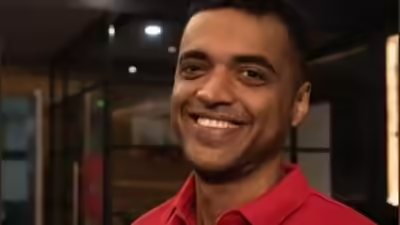
In one of the most anticipated startup launches of the year, Zomato founder Deepinder Goyal’s new health-tech venture, Temple, has secured $54 million in its first funding round, valuing the company at approximately $190 million.
The round, announced on February 27, 2026, represents a powerful vote of confidence in Goyal’s ambitious foray into neurotechnology and precision wearables. What makes this funding particularly remarkable is its composition: every investor is either a founder friend or an early-stage Zomato backer who wanted in “whether or not Temple ever makes it to market” .
With more than 30 Temple employees also participating at par valuation—investing their own money with no discount—Goyal describes this as “the kind of belief you can’t buy” . This internal conviction, combined with backing from some of India’s most successful entrepreneurs, signals that Temple is more than just another wearable startup—it’s a bet on a fundamentally different approach to human performance monitoring.
The Funding Round: Friends, Family, and Founder Conviction
Round Details at a Glance
| Aspect | Details |
|---|---|
| Amount Raised | $54 million (approximately ₹493 crore) |
| Valuation | $190 million post-money |
| Round Type | Friends and Family / Seed |
| Lead Investors | Peak XV Partners, Steadview Capital, Info Edge Ventures, Dharana Capital |
| Individual Investors | Kunal Shah (Cred), Vijay Shekhar Sharma (Paytm), Nithin & Nikhil Kamath (Zerodha), Varun Alagh (Mamaearth), Vikram Chopra (Cars24), Raj Shamani, Abhiraj Singh Bhal (Urban Company) |
| Eternal Executives | CFO Akshant Goyal, district head Rahul Ganjoo, food delivery CEO Aditya Mangla, ex-CPO Akriti Chopra’s family office |
| Goyal’s Personal Investment | ₹104 crore (21% of total funding) |
| Employee Participation | 30+ Temple employees at par valuation |
The Investor Profile: A Who’s Who of Indian Entrepreneurship
The investor list reads like a directory of India’s most successful founders . This isn’t institutional capital chasing returns—it’s founder capital backing a peer they trust.
Kunal Shah (Cred), Vijay Shekhar Sharma (Paytm), the Kamath brothers (Zerodha), and Varun Alagh (Mamaearth) are not passive investors; they’re successful entrepreneurs who understand the risks of deep-tech hardware ventures. Their participation signals belief in both the vision and the founder.
Sanjeev Bikhchandani of Info Edge, who invested ₹5 crore in Zomato back in 2010 when the company was staring at a shutdown, continues his decade-plus association with Goyal . Similarly, Peak XV Partners (then Sequoia Capital India), which led Zomato’s $35 million Series A in 2013, remains a backer .
Employee Skin in the Game
Perhaps the strongest signal of internal confidence is the participation of more than 30 Temple employees in the round—at the same valuation as external investors, with no discount .
As Goyal noted on X: “Their own money. That’s the kind of belief you can’t buy.”
For a pre-revenue hardware startup with significant technical risk, this level of employee commitment is extraordinary. It speaks to the culture Goyal is building and the conviction the team shares in the product vision.
Goyal’s Personal Commitment
Goyal himself invested ₹104 crore, representing approximately 21% of the total funding amount . Post-transaction, he holds a 28.5% stake in the company .
This isn’t founder-speak about “putting skin in the game”—it’s a tangible, multi-crore commitment that aligns his personal wealth with Temple’s success.
The Origin Story: From Longevity Research to Wearable Tech
The Gravity Ageing Hypothesis
Temple didn’t emerge from nowhere. It spun out of Continue, Goyal’s longevity research venture, into which he has invested $25 million of his own capital .
Continue explores what Goyal calls the “Gravity Ageing Hypothesis” —the theory that because humans spend most of their lives upright, gravity chronically reduces blood flow to the brain, potentially accelerating neurological ageing .
The hypothesis suggests that cerebral blood flow naturally drops up to 0.7% annually, resulting in a 20-40% fall between ages 20 and 80. Reduced cerebral blood flow is associated with nearly double the risk of death from any cause .
The Birth of Temple
If Continue is the research arm, Temple is the product arm—translating hypotheses into wearable technology that can continuously monitor cerebral blood flow and other biomarkers in real time.
The journey from concept to company happened remarkably fast. In November 2025, Goyal was photographed at a Feeding India event with a small, metallic clip-like device near his temple. The internet speculated wildly about what it might be .
By early January 2026, Goyal appeared on Raj Shamani’s Figuring Out podcast wearing the device, explaining it was called Temple and designed to measure cerebral blood flow .
Now, just weeks later, Temple has announced a $54 million funding round and a sweeping hiring drive. The transition from mystery device to funded startup has taken less than three months.
The Corporate Context
Goyal’s move to focus on Temple aligns with his broader transition away from day-to-day operations at Eternal (the parent company of Zomato and Blinkit).
Effective February 1, 2026, Goyal stepped down as Group CEO, with Blinkit founder Albinder Dhindsa taking over. Goyal transitioned to the role of Vice Chairman, citing a desire to pursue “higher-risk exploration and experimentation” that doesn’t fit inside a listed public company .
Temple is widely understood to be the primary driver of his exit—the venture that requires the kind of patient capital and long-term vision that public market pressures don’t easily accommodate.
What Temple Is Building: The Device
The Core Product
Temple is developing a non-invasive wearable device that users wear on their temples to measure cerebral blood flow in real time .
Described as a “small patch” or “clip-like device,” it’s designed to continuously monitor brain flow through proxy measurements, while also tracking other biomarkers similar to established wearables like Whoop or Oura rings .
The Technical Ambition
Goyal has positioned Temple as building “the ultimate wearable for elite performance athletes” —a device that measures what no other wearable in the world measures, with a level of precision that doesn’t yet exist .
The technology stack outlined in Temple’s hiring call suggests a convergence of multiple advanced domains :
| Domain | Application |
|---|---|
| Analog Systems Engineering | High-precision sensor interfaces |
| Embedded Systems | Real-time data processing |
| Sensor Fusion | Combining multiple biomarker streams |
| Deep Learning | Physiological modelling and pattern recognition |
| Computational Neuroscience | Brain signal interpretation |
| Brain-Computer Interfaces | Neural decoding |
| Computer Vision | Facial microexpression analysis |
| Neuroimaging ML | Advanced brain data processing |
Beyond Consumer Wearables
Unlike mainstream fitness trackers that measure steps, heart rate, and sleep, Temple aims for clinical-grade precision in tracking metrics that matter for elite performance and potentially for early detection of neurological decline.
The device originated from Goyal’s longevity research at Continue, which is investigating how gravity might influence human ageing—specifically, the hypothesis that reduced cerebral blood flow over decades may accelerate cognitive decline .
Skepticism and Scientific Validation
Not everyone is convinced. An AIIMS radiologist publicly called the device a “toy” with “zero scientific standing,” citing the absence of clinical validation .
The medical community remains divided: some find the cerebral blood flow angle genuinely interesting as a biomarker, while others question whether a skin-mounted sensor can accurately measure deep-brain circulation.
Goyal has positioned Temple as a research instrument first and a consumer product second, acknowledging that the path to validation requires rigorous scientific work .
The Hiring Philosophy: Engineers Who Are Also Athletes
The Body Fat Requirement
Hours before announcing the funding, Goyal posted a sweeping hiring call that came with an unusual condition: applicants must have body fat below 16% (for men) and 26% (for women), or commit to getting there within three months on probation .
The rationale? Temple is building for elite athletes, and Goyal wants the team to embody the lifestyle they’re building for.
“We are building for people who push their bodies to the edge. We want to be those people, not just serve them,” Goyal wrote .
For candidates not meeting the fitness criteria but still interested, they can apply with the commitment to meet the standards in three months—remaining on probation until they do .
The Roles
Temple is hiring across a wide spectrum of engineering and science roles :
- Analog Systems Engineers
- Electronics Design Engineers
- Embedded Systems Engineers
- Design and Validation Engineers
- CMF (Color, Material, Finish) Engineers
- Adhesive Materials Engineers
- Sensor Algorithms Engineers
- Deep Learning Engineers
- Computational Neuroscientists
- Computer Vision Engineers
- Neuroimaging ML Engineers
- Product Managers (who can independently use Figma without relying on a separate design team)
The Cultural Signal
The hiring criteria has sparked discussions about inclusivity and the implications of such requirements in hiring practices . But Goyal is unapologetic, framing it as alignment between product and team.
The response online was mixed but engaged. One observer described it as “pure skin in the game” and a “massive signal of alignment,” especially given the execution risks associated with hardware-plus-neuro innovation .
The Competitive Landscape
Existing Wearable Giants
| Company | Focus |
|---|---|
| Whoop | Recovery and strain monitoring for athletes |
| Oura | Sleep and readiness tracking via smart ring |
| Apple Watch | General fitness, ECG, blood oxygen |
| Fitbit | Activity and health tracking |
| Ultrahuman | Metabolic fitness (Goyal is a shareholder) |
Temple’s Differentiation
What sets Temple apart is its focus on cerebral blood flow—a metric no consumer wearable currently tracks. If the technology delivers on its promise, it could open entirely new categories of health monitoring:
- Athletic performance —Optimising recovery and cognitive function under physical stress
- Neurological health —Early detection of decline associated with ageing
- Research applications —Understanding brain health longitudinally
The Neurotechnology Opportunity
Global interest in neurotechnology is accelerating. Companies like Neuralink (brain-computer interfaces), Kernel (brain monitoring helmets), and Flow Neuroscience (depression treatment via transcranial direct current stimulation) have attracted significant investment and attention.
Temple’s approach—non-invasive, wearable, continuous monitoring—sits at the intersection of consumer wearables and medical-grade neurotechnology.
The India Health-Tech Context
Temple’s funding round is among the largest early-stage rounds in Indian health-tech history. It reflects broader trends:
1. Deep-Tech Momentum
Recent months have seen significant capital flowing into deep-tech ventures:
- Constelli (defence-tech) raised $20 million led by General Catalyst
- Tattvam AI (semiconductor design) raised $1.7 million pre-seed
- Spintly (IoT security) raised $8 million from Accel
- DATOMS (industrial IoT) raised ₹25 crore Series A
- Coulomb Litech (EV battery) raised ₹20 crore seed
Temple joins this cohort of deep-tech startups building complex, hardware-enabled solutions with long R&D cycles.
2. Founder-Backed Ventures
The phenomenon of successful founders backing peers is growing in India. Kunal Shah, Vijay Shekhar Sharma, and the Kamath brothers are increasingly active as angel investors in ventures they believe in.
This “founder network” effect provides not just capital but mentorship, connections, and credibility.
3. Sovereign Innovation
Temple represents India’s ambition to build globally competitive deep-tech products rather than adapt foreign innovations. The device is designed, engineered, and manufactured by an Indian team for global markets.
What This Means for Different Stakeholders
For Consumers
- Potential access to unprecedented health metrics (cerebral blood flow tracking)
- Higher precision than current wearables claim
- Athlete-grade insights potentially trickling down to general wellness
For Athletes and Performers
- Elite-level monitoring for those pushing physical and cognitive limits
- Real-time feedback on brain response to training stress
- Optimisation of recovery and performance
For the Medical Community
- New research tool for understanding brain health longitudinally
- Potential screening applications for neurological decline
- Need for rigorous validation before clinical adoption
For Investors
- Exposure to frontier neurotechnology with significant upside
- Founder-led venture with proven execution capability
- Long-term horizon appropriate for deep-tech hardware
For India’s Startup Ecosystem
- Proof point that deep-tech hardware can attract large early-stage capital
- Inspiration for founders tackling complex technical challenges
- Validation of the “founder-backed” funding model
The Road Ahead for Temple
Near-Term Priorities
- Hiring the engineering and science team across 20+ roles
- Product development moving from prototype to production-ready design
- Clinical validation addressing scepticism about measurement accuracy
- Waitlist launch for early adopters and elite athletes
Medium-Term Goals
- Consumer launch of the first-generation device
- Building the dataset to train algorithms and improve accuracy
- Expanding biomarkers beyond cerebral blood flow
- Establishing partnerships with sports teams and research institutions
Long-Term Vision
- Becoming the definitive wearable for human performance monitoring
- Expanding into clinical applications for neurological health
- Building a platform for continuous health intelligence
- Creating a global brand from India
Conclusion: A Bold Bet on the Future of Human Performance
Deepinder Goyal’s Temple represents one of the most ambitious consumer hardware ventures to emerge from India. With $54 million in funding, a valuation of $190 million, and backing from the country’s most successful entrepreneurs, it has the resources and credibility to attempt something genuinely difficult.
The product—a wearable that tracks cerebral blood flow with unprecedented precision—sits at the intersection of neurotechnology, sports science, and preventive health. If successful, it could redefine what consumers expect from wearables and open new frontiers in understanding brain health.
But the road is long and uncertain. Clinical validation, technical execution, and market adoption are all significant hurdles. The medical community remains sceptical. Hardware is hard. And consumer adoption of new health metrics takes time.
Yet the team Goyal is assembling—engineers who are also athletes, neuroscientists who code, product managers who design—reflects a culture built for the challenge. And the funding round, with its unusual mix of founder peers, early Zomato backers, and employees investing their own money, signals a depth of conviction that goes beyond spreadsheets.
As Goyal himself put it, more than 30 Temple employees invested at par valuation—no discount, their own money. “That’s the kind of belief you can’t buy.”
The market will ultimately decide whether Temple’s technology works and whether consumers want what it offers. But one thing is already clear: Indian entrepreneurship is no longer just about adapting global models. It’s about building frontier technology for the world.
Temple is the latest—and perhaps boldest—example yet.