
Armatrix Raises $2.1 Million Led by pi Ventures
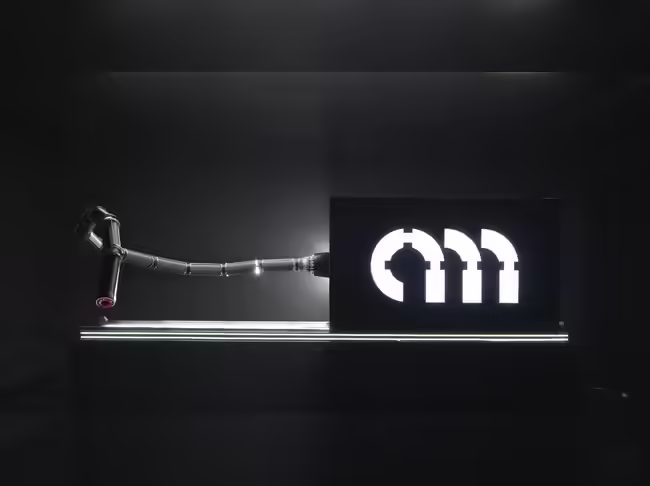
In a significant win for India’s deep-tech robotics ecosystem, Bengaluru-based Armatrix has secured $2.1 million in a seed funding round led by pi Ventures to accelerate its mission of building safer, smarter industrial inspections through innovative snake-like robotic arms.
The funding round, announced on February 25, 2026, also saw participation from Inuka Capital, Boundless Ventures, Boost VC, Turbostart, and returning investor gradCapital . This capital infusion will enable the startup to complete development of its proprietary hyper-redundant, snake-like flexible robotic arm technology, expand its engineering and R&D team, and accelerate pilot deployments with industrial customers .
Armatrix joins a rising cohort of Indian robotics startups—including Unbox Robotics, Addverb, and GreyOrange—proving that deep-tech hardware innovation from India can solve real-world industrial pain points with global relevance .
The Funding Round: Key Details
At a Glance
Investor Profile
pi Ventures, the lead investor, is a prominent early-stage venture capital firm focused on deep-tech and AI-first startups in India. Manish Singhal, Founding Partner at pi Ventures, explained the investment rationale:
“India’s industries face costly maintenance and inspection failures, causing downtime, safety hazards, and revenue loss. The market need for advanced maintenance robotics is not only massive but also urgent. We backed Armatrix because the convergence of its groundbreaking hardware and AI-driven control architecture solves a real, costly problem for critical industries. Armatrix’s unique extrinsic actuation offers a critical advantage over competitors and we believe that Armatrix is poised to define a new category in industrial robotics, starting in India” .
The participation of Boost VC—a Silicon Valley-based fund known for backing moonshot deep-tech ventures—alongside Inuka Capital, Boundless Ventures, and Turbostart, signals strong international and domestic confidence in Armatrix’s technology and team .
The Founders: IIT Kanpur Alumni with Deep-Tech Vision
Armatrix was founded in 2024 by three engineers from the prestigious Indian Institute of Technology Kanpur :
| Founder | Role |
|---|---|
| Vishrant Dave | Co-founder & CEO |
| Prateesh Awasthi | Co-founder |
| Ayush Ranjan | Co-founder |
The team’s IIT Kanpur pedigree is significant—the institute has emerged as a powerhouse for deep-tech entrepreneurship, particularly in robotics and automation. Their decision to build in the industrial robotics space reflects a recognition that India can lead in developing advanced manufacturing and inspection technologies, not just consume them.
In under two years since founding, the team has built a functional 3-metre proof-of-concept arm and attracted institutional backing from top-tier investors—a testament to their execution capability and the technology’s potential .
The Technology: Snake-Like Robotic Arms for Hazardous Environments
What Armatrix Builds
Armatrix specializes in developing hyper-redundant, snake-like robotic systems designed specifically for hazardous and confined industrial environments .
Key Technical Specifications
| Parameter | Specification |
|---|---|
| Length | 3-5 metres |
| Diameter | 50-150 mm |
| Degrees of Freedom | 22+ |
| Actuation | Extrinsic (motors external to arm) |
Target Applications
The robotic arms are engineered for environments where human entry is dangerous or impossible :
- Tight pipes and conduits in industrial plants
- Boilers, reactors, and storage tanks in petrochemical facilities
- Ship hulls for marine inspection and maintenance
- Nuclear facilities where radiation poses human risk
- Sewers and underground infrastructure
- Aerospace maintenance in confined aircraft sections
Core Capabilities
1. Extreme Dexterity and Reach
With over 22 degrees of freedom, the Armatrix arm can navigate complex geometries and obstacles with millimeter precision—reaching spaces that conventional rigid robotic arms simply cannot access .
2. Integrated Sensors and Cameras
The platform supports modular payloads for various inspection tasks :
- Real-time visual inspection with high-definition cameras
- Thickness gauging for corrosion assessment
- Crack detection using advanced imaging
- Corrosion mapping over extended surfaces
- Non-destructive testing (NDT) capabilities
3. Reduced Downtime and Human Risk
By replacing manual entry in high-risk zones, Armatrix’s robots :
- Cut inspection time from days to hours
- Improve operational safety by eliminating human exposure
- Enhance efficiency with faster, more consistent inspections
4. Modular and Scalable Design
The platform uses modular, swappable end-effectors enabling a single robotic arm to perform multiple tasks without changing the base hardware. For industrial operators, this means one platform across an entire facility’s maintenance needs, not a separate system for each task .
The Key Differentiation: Extrinsic Actuation Architecture
What truly sets Armatrix apart from competitors is its extrinsic actuation architecture .
The Problem with Conventional Robotic Arms
Most robotic arms have motors integrated within the arm itself (intrinsic actuation). This creates fundamental limitations:
- Motors occupy space, limiting reach in narrow passages
- Electronics are exposed to hazardous environments
- Flammable, liquid, or high-temperature zones can damage sensitive components
- Size constraints prevent access to extremely confined spaces
Armatrix’s Solution
Armatrix’s innovative design places motors externally, separate from the arm . The benefits are transformative :
| Advantage | Impact |
|---|---|
| Slender profile | Arm diameter as small as 50mm—accesses extremely tight spaces |
| Hazardous environment capability | Operates safely in flammable, liquid, or high-temperature zones where conventional arms would fail |
| No electronics in the arm | Reduced risk of damage, longer operational life |
| Greater reach | Longer arms possible without power/motor limitations |
As Vishrant Dave, Co-founder & CEO, explained :
“Hazardous industrial operations should not require humans to enter unsafe and confined spaces. At Armatrix, we are building a robotic platform that is genuinely different from anything currently deployed in India, and aims to augment maintenance and operations for global critical infrastructure” .
AI Integration: Intelligence at the Edge
Beyond the hardware breakthrough, Armatrix integrates advanced AI capabilities throughout its platform :
AI-Based Navigation System
- Real-time path planning in unpredictable, dynamic environments
- Obstacle avoidance without human intervention
- Adaptive control based on real-time sensor feedback
Digital Twin Simulation
- Pre-deployment modelling to optimize inspection paths
- Virtual testing of scenarios before physical deployment
- Training data generation for machine learning models
AI-Driven Defect Recognition
- Automated crack detection using computer vision
- Corrosion analysis with machine learning algorithms
- Anomaly identification without human interpretation
- Consistent, repeatable assessments eliminating human error
Multi-Modal Sensing Integration
- Fusing data from cameras, ultrasonic sensors, and other instruments
- Real-time analysis providing immediate feedback to operators
- Supporting faster, more informed decision-making for maintenance teams
This integration of hardware innovation with AI-driven intelligence positions Armatrix at the forefront of Industry 4.0 transformation in industrial maintenance .
The Market Opportunity: Industrial Maintenance Robotics
Global Market Size
According to market research, the global robotics maintenance market was valued at $41.66 billion in 2023 and is projected to reach $150 billion by 2032 . This represents a compound annual growth rate (CAGR) of approximately 15% over the forecast period.
Addressable Sectors
Armatrix’s technology addresses critical needs across multiple high-value industries :
| Sector | Applications |
|---|---|
| Oil & Gas | Pipeline inspection, tank cleaning, refinery maintenance |
| Power Generation | Boiler tube inspection, nuclear facility monitoring |
| Petrochemicals | Reactor vessel inspection, confined space entry |
| Shipbuilding | Hull inspection, void space entry, maintenance |
| Aerospace | Aircraft wing and fuselage inspection, engine maintenance |
| Water & Wastewater | Sewer line inspection, pipe rehabilitation |
| Defense | Military vehicle maintenance, restricted area inspection |
The Pain Point
Inspection and maintenance of critical infrastructure—such as storage tanks, fuel tanks, ship hulls, and reactors—routinely require human entry into confined and hazardous spaces . Fatal injuries related to confined space work are regularly reported across these industries.
The business impact is equally severe:
- Unplanned downtime costs millions per hour in some industries
- Manual inspections are slow, inconsistent, and risky
- Regulatory compliance demands rigorous inspection regimes
- Workforce safety is both ethical imperative and business necessity
The Value Proposition
Armatrix’s value proposition is compelling :
- Zero human entry into hazardous spaces
- Faster inspections (days to hours)
- Higher accuracy through consistent, sensor-based inspection
- Reduced downtime with faster, more frequent inspections
- Lower costs by eliminating confined-space entry protocols
- Predictive maintenance enabling proactive rather than reactive repairs
As the company states: “Our mission is to move from a reactive, high-cost maintenance model to a proactive, zero-downtime standard, creating a paradigm shift in industrial inspection and maintenance” .
How the Funds Will Be Used
1. Complete Development of Proprietary Technology
While Armatrix has already built a functional 3-metre proof-of-concept arm, the fresh capital will enable completion of development for commercial deployment . This includes:
- Refining the extrinsic actuation system
- Enhancing arm flexibility and reach
- Improving reliability and durability for industrial use
- Developing additional end-effector modules for different tasks
2. Expand Engineering and R&D Team
Deep-tech hardware development requires specialized talent. Funding will support:
- Hiring additional robotics engineers
- Expanding software and AI development team
- Bringing on board domain experts from target industries
- Building capacity for continuous innovation
3. Accelerate Pilot Deployments
The most critical near-term objective is to validate the platform across real-world inspection and operational use cases . This involves:
- Deploying pilot units with early enterprise customers
- Conducting rigorous field testing across different environments
- Gathering feedback for product refinement
- Building referenceable case studies and performance data
4. Build Go-to-Market Engine
As the company moves from development to commercialization, funds will support:
- Sales team expansion to engage industrial customers
- Service capabilities for deployment and support
- Strategic partnerships with industrial majors and inspection service providers
- Marketing and awareness building in target sectors
The Competitive Landscape
Global Players
Armatrix operates in a specialized segment with relatively few global competitors :
| Company | Status |
|---|---|
| OC Robotics | Acquired by GE Aviation in 2017 |
| Nimbl’Bot | International player |
| HiBot | International player |
Domestic Players
| Company | Focus |
|---|---|
| Domtech Robotics & Automation | Indian competitor |
| IRTI Robotics | Indian competitor |
Armatrix’s Competitive Advantages
- Extrinsic actuation architecture —Unique differentiator enabling operation in hazardous environments
- AI-native design —Real-time adaptability and intelligent control
- Modular platform —Single system for multiple tasks
- IIT Kanpur pedigree —Deep technical expertise
- Early institutional backing —pi Ventures and international investors
- India cost advantage —Competitive development and manufacturing costs
The Regulatory and Policy Context
Armatrix’s growth is supported by favorable regulatory trends :
Occupational Safety, Health and Working Conditions Code, 2020
This landmark legislation modernises 13 previous labour laws to create safer workplaces and provide hazard-free environments to employees. The code pushes industries toward automation of hazardous tasks, creating demand for robotic alternatives.
India’s Draft National Strategy on Robotics (2024)
The draft strategy emphasises building a safe, regulated environment for robotic adoption across manufacturing, agriculture, healthcare, and security sectors. It provides policy direction that benefits early-stage robotics startups.
Growing Industrial Automation Push
Across oil & gas, power, manufacturing, and infrastructure, there is increasing focus on:
- Industry 4.0 upgrades and digital transformation
- Predictive maintenance to reduce downtime
- ESG-driven safety improvements
- Workforce optimization through automation
These trends create a favorable demand environment for Armatrix’s solutions.
Business Model: Robotics-as-a-Service (RaaS) and Direct Sales
Armatrix plans a dual approach to monetization :
1. Robotics-as-a-Service (RaaS)
For many industrial customers, the RaaS model is attractive because it:
- Reduces upfront capital expenditure
- Shifts cost to operational expense
- Includes maintenance and upgrades in service fee
- Aligns vendor incentives with customer outcomes
2. Direct Sales
In industries where IP regulations or security concerns restrict service-based offerings, Armatrix will sell robots directly to customers. This applies particularly to:
- Defense applications
- Nuclear facilities
- Classified industrial operations
The hybrid model provides flexibility to address different customer segments and procurement preferences.
What This Means for Different Stakeholders
For Industrial Enterprises
- Safer operations with zero human entry into confined spaces
- Faster inspections reducing downtime
- More accurate data for maintenance decisions
- Predictive maintenance enabling proactive repairs
- Regulatory compliance with safety codes
For Investors
- Exposure to high-growth industrial robotics market
- Backing of deep-tech IIT alumni founders
- Unique technology with global competitive advantage
- Alignment with Industry 4.0 and ESG trends
For India’s Robotics Ecosystem
- Another success story from Bengaluru’s deep-tech cluster
- Validation that complex hardware startups can attract capital
- Inspiration for more founders to build in industrial robotics
- Strengthening of India’s reputation in advanced manufacturing
For the Global Robotics Industry
- India emerging as a source of innovative robotics solutions
- New competition for established global players
- Potential acquisition targets for industrial majors
The Road Ahead for Armatrix
Near-Term Priorities
- Complete technology development for commercial deployment
- Scale engineering and R&D team to accelerate progress
- Deploy pilot units with early enterprise customers
- Validate platform across real-world use cases
Medium-Term Goals
- Scale production for commercial roll-out
- Expand sales and service team to reach more customers
- Build strategic partnerships with industrial majors
- Develop additional end-effector modules for new applications
Long-Term Vision
- Emerges as globally competitive deep-tech robotics company
- Builds AI-native, high-performance robotic systems
- Sets new benchmarks in safety, precision, and efficiency
- Defines a new category in industrial robotics starting from India
As Vishrant Dave articulated: “Our mission is to move from a reactive, high-cost maintenance model to a proactive, zero-downtime standard, creating a paradigm shift in industrial inspection and maintenance” .
Conclusion: A Win for Indian Deep-Tech Robotics
Armatrix’s $2.1 million seed funding led by pi Ventures is more than a financial milestone—it’s a validation of the thesis that India can build world-class industrial robotics with global relevance.
The startup’s focus on:
- Snake-like robotic arms for hazardous environments
- Extrinsic actuation enabling operation where conventional robots fail
- AI-driven navigation and real-time adaptability
- Modular design serving multiple applications
- Proven IIT Kanpur pedigree and strong team
positions it as a significant player in the global industrial maintenance robotics market.
With the fresh capital, Armatrix is poised to:
- Complete technology development
- Scale its engineering team
- Deploy pilots with industrial customers
- Prove its platform in real-world conditions
For India’s deep-tech ecosystem, this funding round adds to the growing momentum—following successes like Unbox Robotics, Addverb, GreyOrange, and others—and reinforces that Bengaluru is emerging as a serious hub for robotics innovation.
For industrial enterprises facing the daily challenge of inspecting and maintaining confined, hazardous spaces, Armatrix offers a future where no human needs to enter dangerous environments, where inspections are faster and more accurate, and where downtime is minimized through predictive maintenance.
As Manish Singhal of pi Ventures noted, Armatrix is “poised to define a new category in industrial robotics, starting in India.”
The journey from proof-of-concept to global leadership is long, but with this funding and a clear vision, Armatrix has taken a significant step forward.