
Bharat Taxi Launches: Amit Shah Inaugurates India’s First Driver-Owned Cooperative Mobility Platform
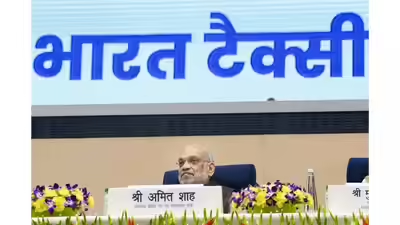
In a landmark move that could redefine the gig economy, Union Home Minister Amit Shah today inaugurated Bharat Taxi—a revolutionary cooperative mobility startup built on a driver-owner model that empowers cab drivers to become co-owners with an entry point of just ₹500.
Launched under the cooperative framework and backed by government initiatives for inclusive growth, Bharat Taxi flips the traditional ride-hailing model on its head. Instead of drivers working purely for corporate platforms, earning a fixed or commission-based share, Bharat Taxi allows drivers to invest a nominal amount to gain ownership stakes in the cooperative .
This initiative represents a fundamental shift in power dynamics within India’s gig economy—moving profits and decision-making from large corporations to the workers themselves .
The Announcement: A Historic Moment for India’s Gig Workers
The Inauguration
Union Home Minister Amit Shah formally launched Bharat Taxi at an event attended by thousands of drivers, cooperative society members, and government officials. The launch marks a significant milestone in the government’s vision of Atmanirbhar Bharat (self-reliant India) extended to the gig economy.
In his address, Shah emphasized the transformative potential of the cooperative model:
*”Bharat Taxi is not just another ride-hailing app. It is a movement to ensure that those who drive our economy—our hardworking drivers—also share in the prosperity they help create. With just ₹500, a driver becomes not just an employee but a co-owner, a stakeholder, a partner in this enterprise.”*
What Is Bharat Taxi?
| Aspect | Details |
|---|---|
| Model | Cooperative mobility platform (driver-owner) |
| Entry Barrier | ₹500 (one-time investment) |
| Governance | Democratic, drivers have voting rights |
| Profit Sharing | Dividends and bonuses to member-owners |
| Launch Cities | Major metros and Tier-1/2 hubs initially |
| Vision | Shift power from corporations to workers |
The Problem Bharat Taxi Solves
The Traditional Ride-Hailing Model
For over a decade, India’s ride-hailing market has been dominated by corporate platforms (like Ola and Uber) where drivers are treated as:
- Contractors rather than employees
- Commission payers (20-30% of each ride)
- Price-takers with no say in fare structures
- Risk-bearers for fuel, maintenance, and vehicle costs
The Pain Points for Drivers
| Challenge | Impact |
|---|---|
| High commissions | 20-30% of earnings deducted by platforms |
| Unpredictable income | Surge pricing benefits platform, not drivers |
| No ownership | Drivers build no equity despite years of service |
| No voice | Platform decisions made unilaterally |
| Debt burden | Many drivers take loans for vehicles, then struggle |
The Result
Despite being the backbone of the ride-hailing industry, millions of drivers face:
- Precarious livelihoods
- No wealth-building opportunities
- Limited bargaining power
- High stress and long hours
The Bharat Taxi Solution: A New Paradigm
How It Works
- Driver joins cooperative by paying ₹500 (one-time)
- Becomes member-owner with voting rights
- Accesses rides through Bharat Taxi platform
- Pays lower commission than traditional platforms
- Receives dividends from cooperative profits
- Participates in governance through democratic structures
Key Features
| Feature | Description |
|---|---|
| Low entry barrier | ₹500 makes ownership accessible to lakhs of drivers |
| Direct profit sharing | Earnings flow back as dividends and bonuses |
| Fairer wages | Reduced commission cuts, transparent pricing |
| Priority rides | Higher-paying rides prioritized for member-owners |
| Democratic governance | Drivers have real voice in decisions |
| Inclusive design | Uplifts gig workers, especially from lower-income backgrounds |
The Economic Model
Unlike traditional platforms where profits flow to shareholders (often offshore), Bharat Taxi’s cooperative structure ensures that surplus generated by drivers’ work returns to drivers through:
- Dividends based on cooperative profits
- Bonuses for performance and loyalty
- Reserves for driver welfare and emergencies
- Reinvestment in platform improvements benefiting members
The Cooperative Advantage
What Is a Cooperative?
A cooperative is an enterprise owned and democratically controlled by its members—in this case, the drivers themselves. Key principles include:
- Voluntary and open membership
- Democratic member control (one member, one vote)
- Member economic participation
- Autonomy and independence
- Education, training, and information
- Cooperation among cooperatives
- Concern for community
Why Cooperatives Work for Gig Economy
| Traditional Corporate | Cooperative Model |
|---|---|
| Profits to shareholders | Profits to members |
| Top-down decisions | Democratic governance |
| Workers as cost | Members as owners |
| Exit strategy (IPO/sale) | Perpetual member-owned |
| Risk borne by workers | Risk shared collectively |
Global Precedents
Successful cooperative platforms exist globally:
- Green Taxi Cooperative (Denver, USA) — Taxi drivers collectively operate dispatch and booking
- CoopCycle (Europe) — Bicycle couriers own their delivery platform
- SMart (Europe) — Freelancers cooperative providing services and benefits
Bharat Taxi adapts this model to India’s unique context and scale.
The Government’s Vision: Atmanirbhar Bharat in the Gig Economy
Policy Context
Bharat Taxi aligns with multiple government initiatives:
| Initiative | Alignment |
|---|---|
| Atmanirbhar Bharat | Self-reliance through ownership, not just employment |
| Sahakar se Samriddhi (Prosperity through Cooperatives) | Promoting cooperative models across sectors |
| Gig Economy Welfare | Extending social security to platform workers |
| Startup India | Encouraging innovative business models |
Ministerial Support
The launch under Union Home Minister Amit Shah’s leadership signals strong political backing. Shah has long advocated for cooperative models as tools for inclusive growth:
“Cooperatives have been the backbone of India’s rural economy for decades. Now, we are bringing that same spirit to the gig economy—empowering workers to become owners.”
Broader Implications
Bharat Taxi could serve as a template for other gig sectors:
- Delivery platforms (Zomato, Swiggy, Amazon Flex)
- Logistics and trucking (porter services, freight)
- Freelance services (professional platforms)
- Domestic work and care economy
If successful, the cooperative model could spread across the gig economy, fundamentally reshaping worker-platform relationships.
What This Means for Drivers
Immediate Benefits
| Benefit | Impact |
|---|---|
| Ownership | Build equity with just ₹500 |
| Lower commissions | More money per ride in pocket |
| Dividends | Share in platform profits |
| Voice | Vote on major decisions |
| Dignity | Recognized as owner, not just contractor |
Long-Term Wealth Building
Unlike traditional platforms where drivers work for years with nothing to show but earnings spent on daily needs, Bharat Taxi enables:
- Asset accumulation through cooperative shares
- Dividend income supplementing ride earnings
- Retirement benefits potentially through cooperative schemes
- Legacy for families
Stories from the Ground
At the launch event, drivers expressed enthusiasm:
“I’ve driven for Ola for 7 years. I’ve paid lakhs in commissions, but I own nothing. Today, with ₹500, I become an owner. This is what we’ve been asking for.”
“My father was a farmer in a cooperative. I’m proud to be a driver in a cooperative.”
What This Means for Passengers
Service Quality
Bharat Taxi aims to provide:
- Reliable ride-hailing with professional driver-owners
- Affordable fares (lower platform costs passed on)
- Consistent experience as owners take pride in service
- Ethical choice for conscious consumers
The Passenger’s Role
Passengers choosing Bharat Taxi over traditional platforms:
- Support driver ownership and fair economics
- Enable cooperative growth through usage
- Promote inclusive business models
- Vote with their wallet for ethical mobility
Pricing
While specific fare structures haven’t been announced, lower commission costs should enable:
- Competitive pricing vs. traditional platforms
- Transparent fare calculation
- No surge pricing that gouges passengers while underpaying drivers
The Competitive Landscape
Traditional Players
| Platform | Model | Driver Status |
|---|---|---|
| Ola | Corporate | Contractor, commission-paying |
| Uber | Corporate | Contractor, commission-paying |
| Other apps | Mostly corporate | Contractor-based |
Bharat Taxi’s Differentiation
| Aspect | Bharat Taxi | Traditional Platforms |
|---|---|---|
| Ownership | Driver-owned | Corporate-owned |
| Commission | Lower (member benefit) | 20-30% |
| Profits | Return to drivers | To shareholders |
| Governance | Democratic | Top-down |
| Entry cost | ₹500 (ownership) | Zero (but no ownership) |
Challenges Ahead
- Scale —Building network effects to match incumbents
- Awareness —Educating passengers on cooperative model
- Technology —Maintaining app parity with global platforms
- Capital —Cooperatives raise equity differently than corporations
- Regulatory —Navigating transport and cooperative laws
The Broader Gig Economy Context
India’s Gig Workforce
| Metric | Value |
|---|---|
| Gig workers (2025) | ~15 million |
| Platform workers | ~7-8 million |
| Projected by 2030 | 23-25 million |
| Ride-hailing drivers | Millions |
The Need for New Models
Traditional gig economy platforms have faced criticism for:
- Precarious work with no benefits
- Algorithmic management reducing worker autonomy
- Income volatility and unpredictability
- No career progression or skill development
- Limited bargaining power despite collective action attempts
Policy Responses
Recent policy developments include:
- Code on Social Security extending benefits to gig workers
- State-level welfare boards (Rajasthan, Karnataka)
- Platform-worker consultations on fair work
Bharat Taxi represents a market-based solution rather than purely regulatory approach—showing that worker-friendly models can compete.
The Cooperative Movement in India
Historical Context
India has a rich cooperative history:
- Amul —Dairy cooperative transforming farmer livelihoods
- IFFCO —Fertilizer cooperative
- KRIBHCO —Agricultural cooperative
- Urban cooperative banks and credit societies
Modern Applications
Cooperatives are now entering new sectors:
- Solar energy cooperatives
- Producer companies in agriculture
- Housing cooperatives
- Digital platforms (Bharat Taxi)
The Sahakar se Samriddhi Vision
The government’s push for cooperatives includes:
- Strengthening cooperative institutions
- Modernizing governance and technology
- Expanding to new sectors
- Enabling access to capital
Bharat Taxi embodies this vision in the digital economy.
Challenges and Opportunities
Challenges
| Challenge | Mitigation |
|---|---|
| Network effects | Initial city focus, driver incentives |
| Tech investment | Government support, cooperative funding |
| Passenger acquisition | Ethical branding, competitive fares |
| Governance complexity | Professional management + democratic oversight |
| Capital constraints | Cooperative banks, government funds |
Opportunities
| Opportunity | Potential |
|---|---|
| Driver demand | Lakhs of drivers seeking better terms |
| Passenger consciousness | Growing ethical consumerism |
| Policy support | Government backing for cooperatives |
| Template for other sectors | Delivery, logistics, freelance platforms |
| Global relevance | Export cooperative model to other countries |
The Road Ahead for Bharat Taxi
Immediate Priorities
- Onboard drivers across launch cities
- Build passenger base through awareness and incentives
- Ensure smooth technology operations
- Establish governance structures and democratic processes
- Demonstrate proof of concept in initial markets
Medium-Term Goals
- Expand to more cities across India
- Add features (intercity, airport, corporate accounts)
- Diversify revenue (ads, partnerships)
- Build reserves for driver welfare and emergencies
- Refine cooperative model based on feedback
Long-Term Vision
- National cooperative mobility network
- Template for other gig sectors (delivery, logistics)
- Export model to other countries
- Driver wealth creation at scale
- Redefine gig economy globally
Conclusion: A Bold Step Toward Inclusive Growth
Bharat Taxi’s launch represents more than a new ride-hailing app—it’s a fundamental reimagining of how gig economy platforms can work.
By turning drivers into owners through a ₹500 entry point, the cooperative model:
- Empowers millions of gig workers
- Shares profits with those who create them
- Gives voice to workers in platform decisions
- Builds wealth for lower-income communities
- Aligns with Atmanirbhar Bharat vision
The challenges are real—scaling a cooperative platform to compete with well-funded incumbents is no small task. But the potential rewards are enormous:
- Dignity for millions of drivers
- Equity for gig economy workers
- Efficiency through aligned incentives
- Inspiration for other sectors to follow
As Union Home Minister Amit Shah noted at the launch:
“This is not just a taxi service. This is a movement to ensure that the fruits of India’s growth reach every citizen—especially those who power our economy every day.”
For India’s 15 million gig workers, for passengers seeking ethical mobility options, and for a government committed to inclusive growth, Bharat Taxi offers a glimpse of a different future—one where the gig economy works for everyone, not just corporate platforms.
The road ahead is long, but the direction is clear: ownership, dignity, and shared prosperity.